• Skip to primary navigation
  • Skip to main content
  • Skip to primary sidebar
  • Skip to secondary sidebar
  • NEWS:
  • SatNews
  • SatMagazine
  • MilSatMagazine
  • SmallSat News
  • |     EVENTS:
  • SmallSat Symposium
  • Satellite Innovation
  • MilSat Symposium
  • SmallSat Europe

SatNews

  • LATEST
  • EXPLORE ⌄
    • Missions & Constellations
    • Business & Finance
    • Military & Defense
    • Launch
    • Software Automation & Ground Systems
    • Government & Regulation
    • Services & Applications
  • Magazines
  • Events
  • Jobs
  • Calendar ⌄
    • IN PERSON
    • VIRTUAL
  • Subscribe

SmallSat Symposium 2026

From Sandbox to Shield: The SmallSat Industry Grows Up

February 10, 2026

By Abbey White, Staff Writer, SatNews

Dispatch from SmallSat Symposium. Coverage and analysis from across the conference, tracking the forces shaping the next phase of the SmallSat market.
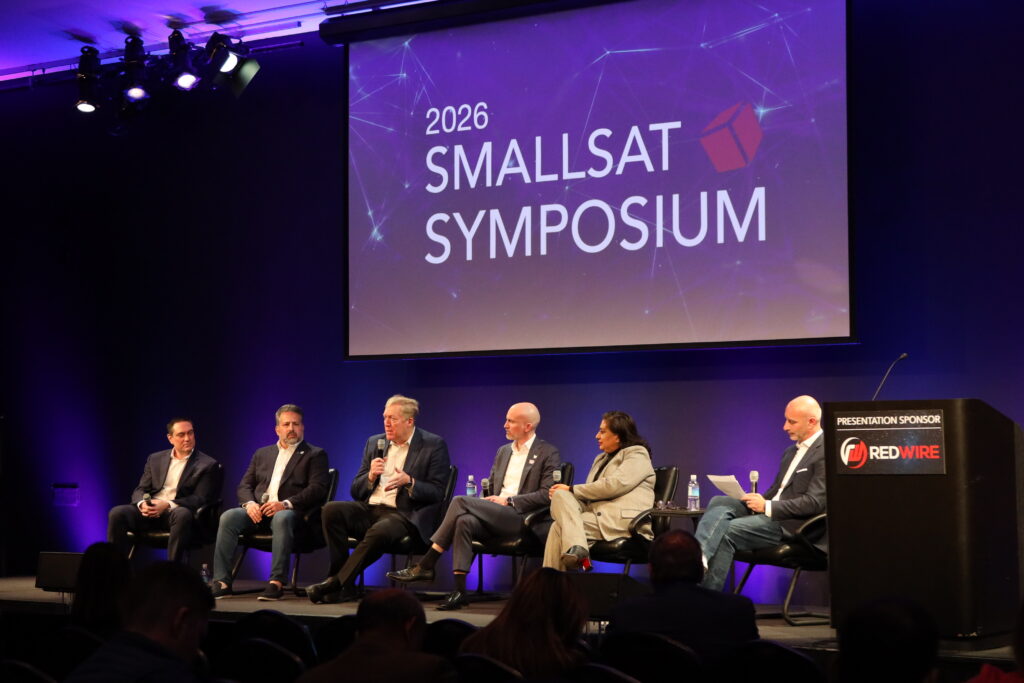
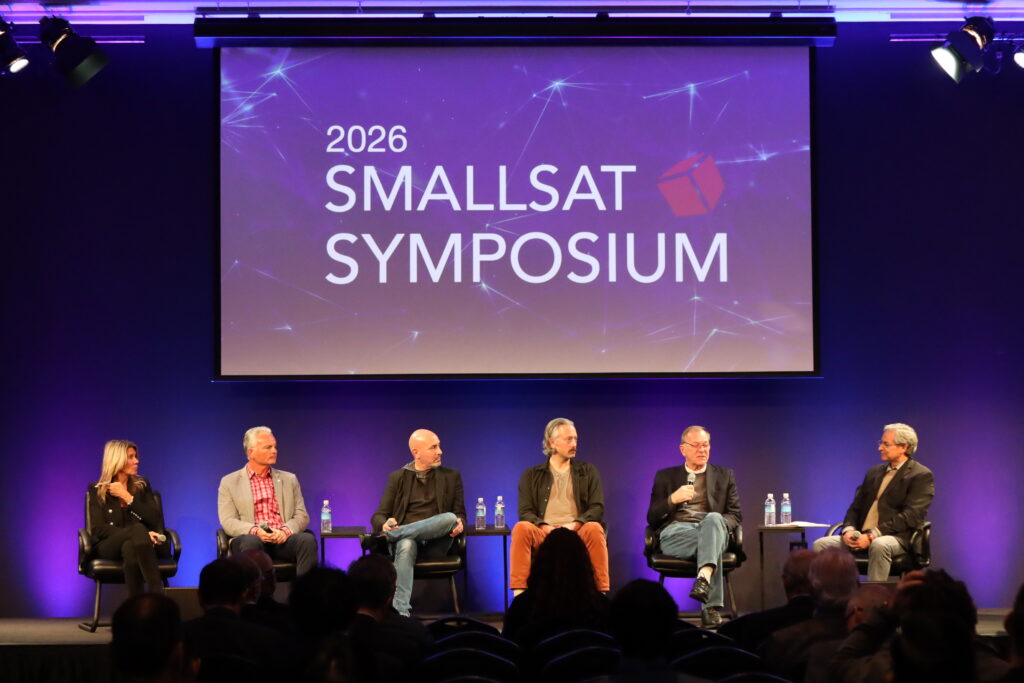
MOUNTAIN VIEW. If the mood at past SmallSat Symposiums was defined by exuberant experimentation, this year feels different. The energy has not vanished, but it has matured. During the session Engineering the Future Spacecraft, a clear signal emerged from the noise: the industry is graduating. Focus has shifted from the novelty of New Space to the serious, high-stakes business of national infrastructure and defense.

The practice of launching science projects to see what sticks is fading. In its place rises a drive for reliability, scale, and sovereign capability. As Peter Krauss, CEO of Terran Orbital, noted, “The days of flying things that are TRL 0… are over.”

The Bar Has Been Raised

This transition is not about shutting out innovation but professionalizing it. The customers driving the market today, primarily major defense primes and government agencies, demand a rigor that early startups often overlooked.

Krauss illustrated this shift by describing the industry’s talent gap. “You’re interviewing a 25-year-old, you want them to have a master’s degree and 10 years of work experience,” he said. His humorous exaggeration underscored a serious point regarding the expectation for day-one competence. Jan Smolders of Space Inventor captured this evolution perfectly, arguing, “It’s not a tech market anymore. It’s a delivery market.”

Engineering hurdles are no longer about just making something work in a vacuum. They are about manufacturing a product repeatedly, reliably, on time. The Golden Dome missile defense initiative referenced in the research serves as prime example, demanding an industrial base capable of churning out assets at a pace that boutique manufacturing simply cannot match.
Sovereignty Over Hype

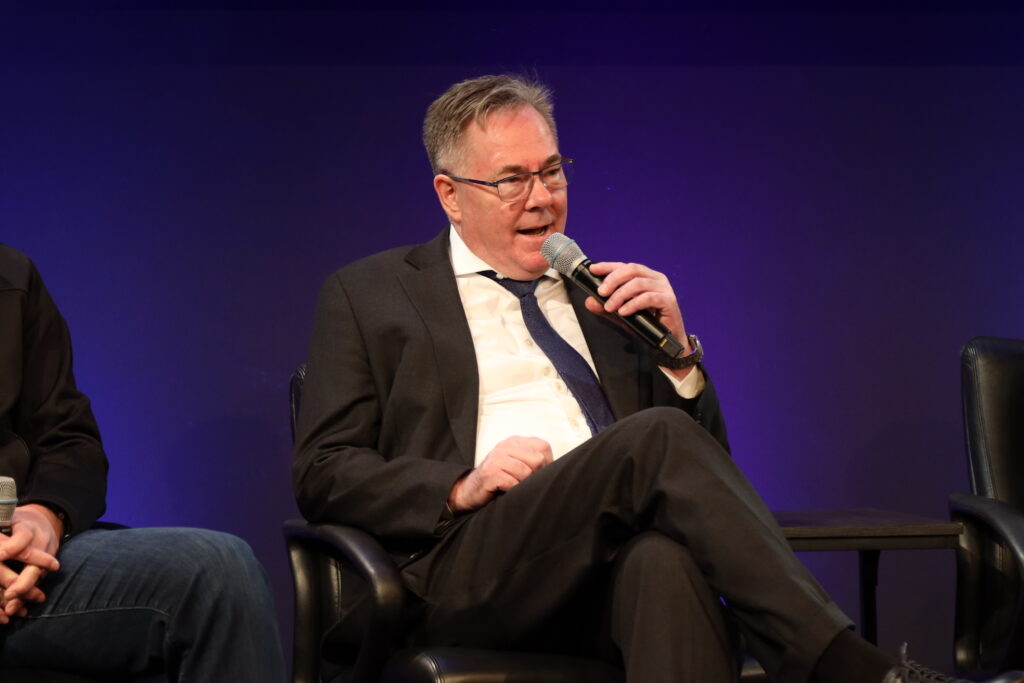
While the conference floor still buzzes with talk of orbital data centers and edge computing, the panelists brought the conversation back to geopolitical realities. When asked about near-term value drivers, Rusty Thomas, CEO of EnduroSat USA, steered the room away from speculation, stating, “What’s not going to unlock value in the next three years for any of us is data centers in space.”

Instead, Thomas highlighted the urgent need for resilient communications in an unstable world. “Sovereigns who want to have a resilient communication capability—countries in the Pacific who might get their cable undersea cables cut on a bad day—are still going to need to talk,” he explained. As global supply chains fracture, the ability to control one’s own communications infrastructure is becoming a critical asset.

The Integration Debate

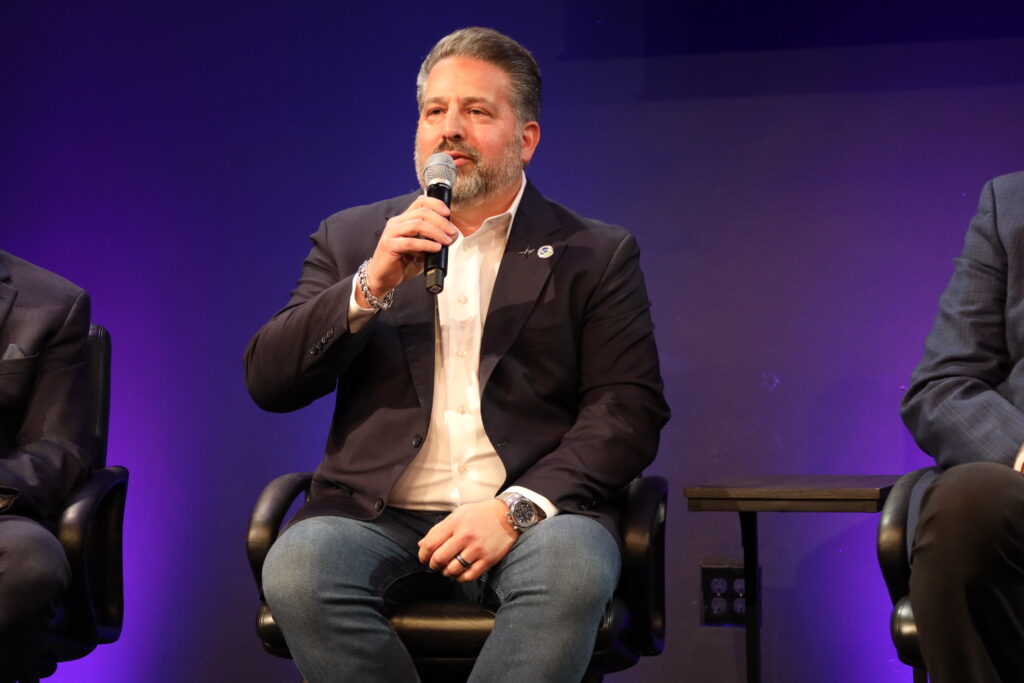
As the industry scales to meet these defense and sovereign needs, a debate is forming around the best path forward. Tina Ghataore of Aerospacelab described a vertical approach born from the need to secure a fragile supply chain. “We’ve had to pay for the roadmap,” she noted, explaining her company’s move to bring component manufacturing in-house.

In contrast, Rusty Thomas advocated for a model where customers leverage existing buses rather than building from scratch. He argued against past inefficiencies, suggesting that “companies don’t need to spend $10-20 billion” to build a constellation when the infrastructure already exists.

A New Era of Seriousness

The mood in Mountain View is not pessimistic but pragmatic. The industry is moving away from the move-fast-and-break-things era and entering a phase of industrial resilience.

The Strategic Edge is no longer just about having the most advanced sensor. It requires a supply chain that can survive geopolitical friction and a production line that can deliver at volume. The romance of the early days has not disappeared, but it has been replaced by the satisfaction of building something that truly works and matters on a global scale.

Filed Under: Business & Finance, Missions & Constellations, SmallSat Tagged With: SmallSat Symposium 2026

The Space Data Layer is Coming, Just Not as Fast or as Small as You Think

February 10, 2026

By Abbey White, Staff Writer, SatNews

Dispatch from SmallSat Symposium. Coverage and analysis from across the conference, tracking the forces shaping the next phase of the SmallSat market.

MOUNTAIN VIEW — Attendees at the SmallSat Symposium might have envisioned a future Space Data Layer as a seamless optical-mesh network capable of near-instant data transmission. During the symposium’s Edge of Orbit session, however, participants scrutinized the mechanics available to make that ideal materialize quickly. Attendees backed off from that theoretical end-state to debate the practical complexities and significant labor required to make this revolution operational.

Industry narratives have long painted low Earth orbit as an extension of the terrestrial internet—a high-speed, interoperable cloud above the clouds. Yet, when pressed on this unified network’s timeline, the panel’s optimism collided with engineering constraints. Carol Craig, CEO of Sidus Space, spoke plainly. While startups pitch immediate real-time capabilities to investors, she argued, “I think it’s still a good 10 years out when you talk about that full space data layer.” That assessment challenges a sector addicted to the concept of now. She attributed the delay to a fragmented landscape where commercial and defense priorities pull companies in different directions, creating what she termed “distractions.”

The Death of the CubeSat

The session also confirmed the demise of the form factor that gave this conference its name: the CubeSat. For a decade, shoebox-sized satellites costing less than a San Francisco condo defined the smallsat revolution. That era is over. The high-power optical terminals and onboard computer of the Space Data Layer simply cannot fit in a 3U box.

Beau Jarvis, Chief Revenue Officer at Kepler Communications, provided tangible evidence of this shift. Kepler, an early darling of the nanosatellite crowd, has radically upsized its architecture. Jarvis detailed their latest deployment: “This past January we launched ten 300-kilogram spacecraft that form the first tranche of our commercial constellation.”

This pivot represents a massive departure from the industry’s roots. As noted in research, Kepler’s shift requires a mass increase of over 2,000% from their original designs to accommodate the power-hungry realities of optical data relays. Building the internet in space cannot happen on disposable hardware, Jarvis posited. Larger satellites are necessary to form an always-on ring of connectivity—a feat impossible with the power budgets of the past.

Thermodynamics vs. The Pitch Deck

The most contentious subtext revolved around orbital data centers. Rob DeMillo, CEO of Sophia Space, pitched a vision where server racks migrate to orbit to escape terrestrial resource constraints. “We consider ourselves an orbital computer company,” DeMillo said, describing a modular tile system for processing data in the vacuum of space.

But this vision faces the elephant in the room: heat. While DeMillo argued that the move to orbit is as inevitable as the transition from dial-up to broadband, the thermal engineering community remains skeptical. On Earth, data centers use massive water loops and airflow to cool high-performance chips. In the vacuum of space, convection does not exist. Heat can only be rejected via radiation, a notoriously inefficient process.

Despite the polite tone of the panel, the gap between DeMillo’s vision of orbital data centers and the current reality of low-power edge processing was palpable. Planet’s David Marvin grounded the discussion in what is currently possible. He advocated using onboard NVIDIA chips, not to replace Amazon Web Services but to act as a filter. He described a scenario where a satellite tips off a wildfire commander with vector data layers rather than raw imagery. “Sending down a few megabyte package . . . is a huge advantage,” Marvin said. Smart filtering, not floating server farms, represents a realistic near-term future.

The Walled Garden Problem

Beyond the physics, the panel highlighted a looming market failure in the lack of a common language. Richard Hadsall of Integrasys, a veteran of the ground segment, warned that without a unified software layer, the industry is just launching expensive, deaf noise. “They’re not talking to one another,” Hadsall noted, estimating that it will take another three to five years just to get constellation-based spectrum data sorted.

The threat of proprietary walled gardens, networks that don’t play nice with others, also loomed large. With Starlink and Amazon Kuiper building closed loops, the rest of the industry is scrambling to survive by banding together under open standards like those set by the Space Development Agency.

Jarvis was explicit about this divide. “Starlink and Amazon are obviously massive companies able to scale quickly,” he said, “but they’re doing it in a proprietary fashion—which is a choice.” European and defense customers are recoiling from that monopoly risk, however, instead seeking interoperability and trust over raw scale.

The Bottom Line

The Edge of Orbit session clarified that the Space Data Layer is inevitable, but not imminent. The technology is transitioning from experimental validation to a messy, capital-intensive operational deployment.

The winners in this next phase won’t be the ones with the best PowerPoint slides about orbital clouds. Instead, success belongs to those who, like Kepler, accept the physical reality that moving data requires power and mass—ones like Planet who focus on delivering trust in the data rather than raw pixels. As the panelists stepped off the stage, the consensus was clear. The days of the cheap, simple CubeSat are behind us. The future is heavy, hot, and expensive.

Filed Under: Business & Finance, SmallSat, Software Automation & Ground Systems Tagged With: SmallSat Symposium 2026

The Golden Dome Grinds into Gear: SDA Acting Chief Sovereign over the Supply Chain

February 10, 2026

By Abbey White, Staff Writer, SatNews

Dispatch from SmallSat Symposium. Coverage and analysis from across the conference, tracking the forces shaping the next phase of the SmallSat market.

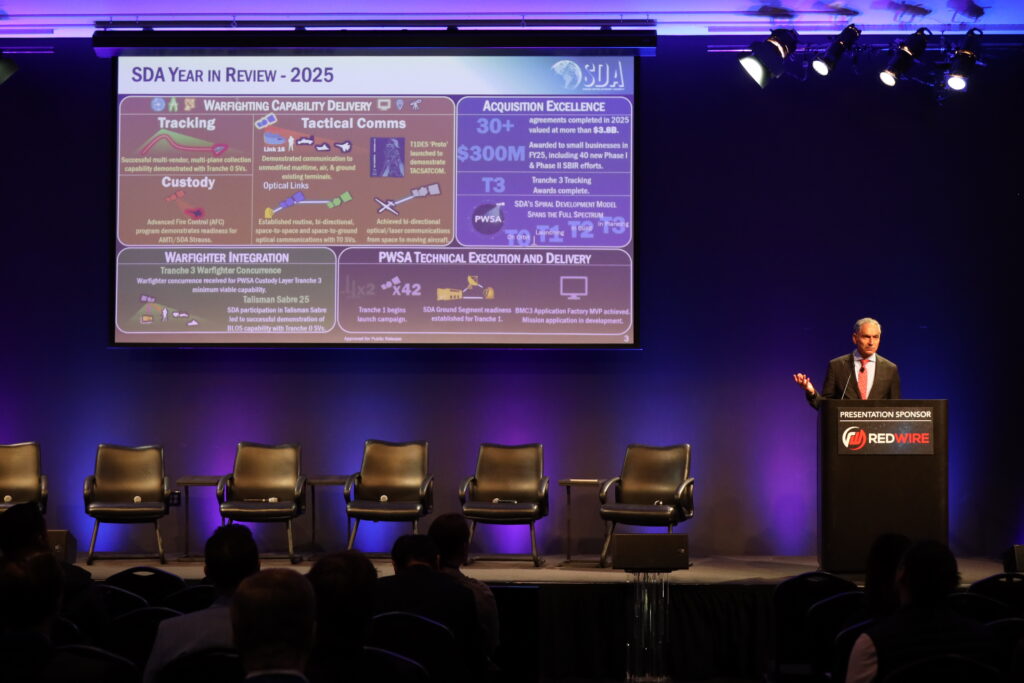
MOUNTAIN VIEW. The age of PowerPoint architecture has passed. For five years, the Space Development Agency operated as the Pentagon’s rebellious startup, promising to deliver a Proliferated Warfighter Space Architecture faster than the establishment could draft a requirements document. At the SmallSat Symposium, however, no celebratory mood pervaded the SDA Vision: Pacing Evolving Threats session. Instead, a sober atmosphere prevailed as SDA’s ambitions met the friction of reality.

Dr. GP Sandhoo, the agency’s Acting Director, took the stage at a precarious moment. He leads an organization recovering from a leadership decapitation following Derek Tournear’s departure and simultaneously facing a blistering Government Accountability Office report released just days ago. The report questioned the agency’s handle on technical risk. Consequently, Sandhoo arrived in Mountain View not to sell a vision, but to explain why the “Fight Tonight” mentality is harder to execute than it looks on a whiteboard.

The End of the Commodity Myth

The morning’s most striking admission was the demise of the easy satellite bus. The core thesis of the New Space revolution and the SDA’s acquisition strategy relied on the assumption that commercial satellite buses were commoditized goods, ready to be bought off the shelf like dependable pickup trucks. Sandhoo dismantled this belief with brutal transparency regarding the agency’s Tranche 0 demonstration.

“The biggest challenge we had with Tranche 0 was the buses—spacecraft buses—which were supposed to be a commodity . . . and none of them were,” Sandhoo admitted.

This represents a stark correction for an industry that prides itself on standardization. The Acting Director noted that while the exotic payloads (optical cross-links and Link-16 terminals) performed well, the basic infrastructure failed. He described the “onesie-twosies” failures that plagued the early deployment: “GNC [Guidance, Navigation, and Control] is not working, the thermal is not right.”

The implications for the supply chain are severe. Instead of theoretical speed, the SDA is enforcing rigor. Sandhoo noted that for the currently launching Tranche 1, the agency is behind schedule on checkouts precisely because they are forcing prime contractors to prove their buses work before they fly. “It’s one thing to launch a couple of satellites and kind of go through the whole checkout, it’s another thing to launch 21 at the same time,” Sandhoo said.

The Fire Control Pivot

While bus manufacturers face a reckoning, the SDA’s strategic scope has expanded dangerously close to the nuclear threshold. The conversation’s focus has shifted from warning (seeing a missile launch) to fire control (guiding an interceptor to kill it).

Sandhoo detailed the massive Tranche 3 awards made in December, which split the architecture into two distinct classes. The first is standard missile tracking. The second is the Golden Dome fully realized: a sensor specifically designed to close the fire control loop on hypersonic glide vehicles.

The Acting Director explained the distinction with engineer-like precision: “When you see MW/MT/MD, that takes a step further. That is, you can detect the missile, you can track the missile, but you can also come up with a fire control quality solution on board the spacecraft.”

That sequence presents the strategic edge in action, to which the Pentagon has committed roughly $3.5 billion, awarding contracts to Lockheed Martin and, in a major graduation moment, Rocket Lab for high-fidelity sensors. By trusting Rocket Lab with the defense mission rather than just the tracking mission, the SDA has officially elevated the company from a launch provider to a prime defense contractor capable of handling the DoD’s most sensitive data.

The Commercial Reserve Fleet

Sandhoo also addressed a subtle but critical shift: the enclave strategy. The SDA originally envisioned a self-contained intranet in the sky, but such an isolationist model has become defunct. Now the agency is actively looking to route military data through commercial constellations like Amazon’s Kuiper or the optical meshes of Kepler and Telesat, creating a hybrid space architecture that provides resilience through redundancy.

Using a domestic utility analogy to describe this pivot, Sandhoo stated, “When you have Verizon and Xfinity come to your doorstep, you should start using some of that stuff too to make sure you leverage all those things.”

This hybrid enclave architecture effectively deputizes the commercial sector. By publishing optical and networking standards, the SDA has created a market where commercial operators become reserve nodes for the Joint Force. If a Chinese ASAT weapon takes out a Lockheed satellite, the data could theoretically reroute through a commercial bird.

The Shadow of the GAO

Looming over the technical discussion was the shadow of the recent GAO report, which criticized the SDA for schedule optimism and for buying Tranche 3 satellites before Tranche 1 has proven its technology works. Although Sandhoo did not address the report by name, he noted the acting nature of his role and the budget’s palpable uncertainty.

Sandhoo acknowledged that the speed of acquisition is colliding with the reality of production throughput. “It’s one thing to have a technically ready thing; it is another thing to make 150 of those,” he said.

The Gamma variant of Tranche 2, critical for the advanced fire control mission, remains delayed following the Viasat protest and the subsequent leadership turmoil that ousted Dr. Tournear. Sandhoo nonetheless projected confidence in face of the undeniable friction, observing that due to competitive pricing, Tranche 3 proposals allowed SDA to buy 72 satellites instead of the planned 54.

The Verdict

The startup phase is over. The SDA is now a utility provider for the Combatant Commands. As Sandhoo put it, the goal is no longer simply to disrupt, but to pace the threat.

For attendees at the SmallSat Symposium, the message was clear. The government checkbook is still open, but the days of selling beta-test hardware are over. If you cannot build a bus that reliably handles thermal loads, or an optical terminal that instantly locks in a hostile environment, do not bid. The Golden Dome is being built, but the SDA is done laying bricks that crumble under pressure.

Filed Under: Military & Defense, SmallSat Tagged With: SmallSat Symposium 2026

From SmallSat Gold Rush to Fortress: The Militarization of Commercial Space

February 10, 2026

By Abbey White, Staff Writer, SatNews

Dispatch from SmallSat Symposium. Coverage and analysis from across the conference, tracking the forces shaping the next phase of the SmallSat market.

MOUNTAIN VIEW. The era of the slide-deck billionaire is dead. Attendees entering the Small Satellites: Trends and Opportunities session expecting standard futurism about connecting the unconnected or democratizing the stars were likely disappointed. The mood at SmallSat Symposium has shifted from gold-rush optimism to the cold calculus of a fortress under construction.

For years this industry thrived on the promise of cheap capital and Silicon Valley’s move-fast-and-break-things ethos. That narrative has collapsed as a starker reality has emerged: The U.S. government is no longer just a customer. It has become the market’s anchor tenant, safety net, predominant funder, and primary driver of innovation.

Charlotte Kiang, a principal at Boston Consulting Group, summarized this pivot with the morning’s most critical statistic. By 2034 defense satellites will likely comprise only 9% of orbital volume but will account, Kiang noted, for 48% of the satellite spend.

Nearly half the industry’s revenue, that is, will originate from less than a tenth of the hardware. The message to founders and investors was implicit but deafening: those not building for the Pentagon will be fighting for scraps.

The Dual-Use Mandate

The panel, moderated by Astroscale’s Janna Lewis, confronted this marketplace militarization. “Dual use” was once a convenient buzzword to justify government grants for commercial tech. That script has flipped so that now the business model presupposes defense funding with spillover applications possible for commercial use. 

Brett Loubert, leading U.S. Space practice at Deloitte, highlighted that government no longer wants to build exclusive, exquisite systems but intends instead to consume commercial data to augment classified missions. This integration introduces a terrifying caveat that is largely ignored by the commercial sector: cybersecurity. Terrestrial data centers undergo exhaustive audits, Loubert noted, but satellites fly naked.

“Satellites operate like computers in space and they largely have no cyber protections on orbit,” Loubert said.

This represents the new barrier to entry. Getting to orbit is insufficient. To capture a share of that 48% defense outlay, companies must prove they can survive a cyberwar. Launching a CubeSat with a Raspberry Pi and a prayer is no longer a viable strategy.

The Starlink Shadow

SpaceX loomed over the discussion. The Starlink constellation has achieved a scale and vertical integration that effectively closes the door on copycats. Armand Musey, a valuation expert with Summit Ridge Group, dismissed the notion that the market can support multiple mega-constellations.

“I might take exception with the idea that we have competition,” Musey said.

He noted that insufficient launch capacity exists to support the millions of satellites some engineers project in presentations. Starlink’s hegemony forces the rest of the market into a difficult position. Without the ability to replicate SpaceX, companies must find alternatives. 

Abhishek Tripathi from UC-Berkeley offered the only viable strategy: specialized, high-quality craftsmanship. “Sometimes the best way to make money and develop a business is to zag while everyone else is zigging,” Tripathi said.

Major players focus so heavily on mass production, he argued, that that they lose the ability to service high-priority niche missions. Yet, Musey countered, even this boutique approach faces headwinds: a boutique shop might make a nice little business, but it will not move the needle in a rapidly industrializing sector.

The Industrial Reality

Discussion ultimately returned to survival logistics. The industry faces a manufacturing catch-up crisis. The research brief accompanying the session highlighted an ossified if not obsolescent mid-stream supply chain. Due to Chinese export bans, manufacturers are running out of Hall thrusters and Gallium Arsenide for solar cells.

“You can’t beat a good propulsion system,” Loubert said.

This moment grounded the discussion. Visionaries discuss orbital data centers and lunar economies, but operators worry about sourcing enough krypton or hardened electronics to finish satellites that the Space Development Agency already purchased.

The European Disconnect

The contrast between the U.S. approach and the rest of the world was stark. The U.S. model, driven by the Space Development Agency’s proliferated architecture, forces commercial companies to adapt to military timelines.

Musey contrasted this with European efforts to replicate the model through subsidies rather than contracts. He argued that while commercial procurement in the U.S. has birthed giants like SpaceX, similar efforts in Europe often waste money on systems that are obsolete before their construction begins.

The Verdict

The SmallSat Renaissance is over; the Industrial Revolution has begun. The winners of the next decade will not be the companies with the best slide decks. They will be the companies capable of delivering reliable, cyber-hardened hardware at scale to the U.S. military. As the session closed, the takeaway was clear. The playground represents the past. The fortress represents the future. In Mountain View, the smart money is heading for the bunker.

Filed Under: Business & Finance, Government & Regulation, Military & Defense, Missions & Constellations Tagged With: SmallSat Symposium 2026

Primary Sidebar

Coverage

  • Missions & Constellations
  • Business & Finance
  • Military & Defense
  • Launch
  • Software Automation & Ground Systems
  • Government & Regulation
  • Services & Applications

Most Read Stories

  • Russia ‘intercepts Europe's key satellites’ placing NATO satellite at risk
  • Starlink vs AST SpaceMobile: Will the winner take it all?
  • ESA Expands IRIS² Low-LEO Component and Introduces Industrialization Cost Reimbursements
  • Germany boosts military space program with satellites and lasers
  • AT&T and Amazon Forge a Giant in the Skies: The Multi-Layered Strategy Behind the Kuiper-Cloud Pact

About Satnews

  • Contacts
  • History

Archives

Secondary Sidebar

We use cookies to ensure that we give you the best experience on our website. If you continue to use this site we will assume that you are happy with it.
x
Sign up Now (For Free)
Access daily or weekly satellite news updates covering all aspects of the commercial and military satellite industry.
Invalid email address
Notify Me Regarding ( At least one ):
We value your privacy and will not sell or share your email or other information with any other company. You may also unsubscribe at anytime.

Click Here to see our full privacy policy.
Thanks for subscribing!