• Skip to primary navigation
  • Skip to main content
  • Skip to primary sidebar
  • Skip to secondary sidebar
  • NEWS:
  • SatNews
  • SatMagazine
  • MilSatMagazine
  • SmallSat News
  • |     EVENTS:
  • SmallSat Symposium
  • Satellite Innovation
  • MilSat Symposium
  • SmallSat Europe

SatNews

  • LATEST
  • EXPLORE ⌄
    • Missions & Constellations
    • Business & Finance
    • Military & Defense
    • Launch
    • Software Automation & Ground Systems
    • Government & Regulation
    • Services & Applications
  • Magazines
  • Events
  • Calendar ⌄
    • IN PERSON
    • VIRTUAL
  • Subscribe

Featured

Aurora Insight’s Charlie To Launch Via The SpaceX Transporter-1 From Canaveral

January 19, 2021

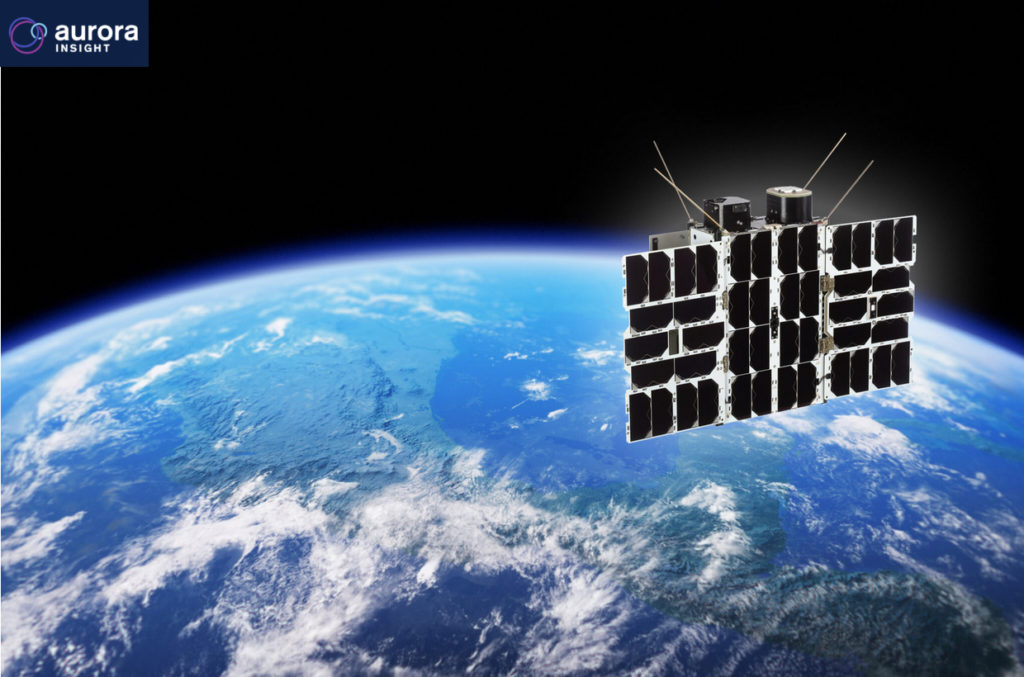
Aurora Insight is scheduled to launch its second, satellite-based. radio frequency spectrum sensor on SpaceX’s Transporter-1, on Friday, January 22nd from Cape Canaveral, Florida.

The launch is a part of SpaceX’s dedicated rideshare mission on the Falcon 9 rocket and will be broadcast live at www.spacex.com/launches. Aurora will host a special live stream discussion event on the morning of the launch, and details can be found at www.aurorainsight.com/charlie. Launching the satellite-based radio frequency spectrum sensor will unlock new opportunities and answers about wireless spectrum — one of the most valuable resources in the digital economy.

Charlie is the first of a two-part satellite mission this quarter. Aurora Insight partnered with NanoAvionics, a leading nanosatellite bus manufacturer and mission integrator, to build and integrate two nanosatellites, as well as provide launch services. Both 6U smallsats are based on NanoAvionics’ standard M6P bus in a higher performance configuration, providing greater technical performance capabilities for Aurora’s radio frequency spectrum mission. The second satellite is also scheduled to launch in the first quarter of 2021.

Jennifer Alvarez

Regarding the launch, Aurora Insight’s CEO Jennifer Alvarez explained, “This technology will provide Aurora Insight’s clients with an entirely new understanding of the RF spectrum environment, and we can shed light on the ambiguity that has surrounded it for years. The answers we uncover will help advance communications around the world and enable organizations to plan, invest, and move forward with a data-driven strategy.”

The satellite-based radio frequency spectrum sensor has unprecedented capabilities, including the ability to:

  • Monitor the deployment and growth of terrestrial mobile networks
  • Monitor the on-orbit radio frequency environmental performance to understand when and how ground-based transmissions affect satellite performance
  • Identify sources of harmful interference to on-orbit assets

Traditional methods of measuring spectrum are usually ad hoc, limited in scale, outdated and offer poor visibility into the availability of wireless. Aurora has developed an autonomous sensor network, powered by machine learning and advanced radio signal processing, to continuously sample and render the full radio spectrum environment.

Aurora Insight offers accurate, impartial insights on the radio frequency spectrum to inform the next generation of wireless services. Through an autonomous sensor network and machine learning of radio signals, Aurora continuously samples and reports on the radio frequency spectrum, from licensed infrastructure to dynamic utilization, enabling the best use of this scarce commodity. Companies around the globe rely on Aurora Insight’s unmatched data to help analyze, predict, transform, and answer questions about the next generation of applications. Headquartered in Denver, Colorado, and funded by the country’s top innovation investors, Aurora Insight is pushing the boundaries to help advance global communication. The team is composed of data scientists, engineers, and industry veterans, who leverage a deep expertise and understanding of the challenges that face the communications industry.

Filed Under: Launch, SmallSat Tagged With: Featured

Iodine Propulsion Proven Viable For Smallsats In Space By ThrustMe + Spacety

January 18, 2021

The space industry seeks new solutions to ensure economic and environmental space sustainability with the rise of satellite mega-constellations. A solution lies in the use of on-orbit propulsion, but traditional systems are not fit for the New Space paradigm.

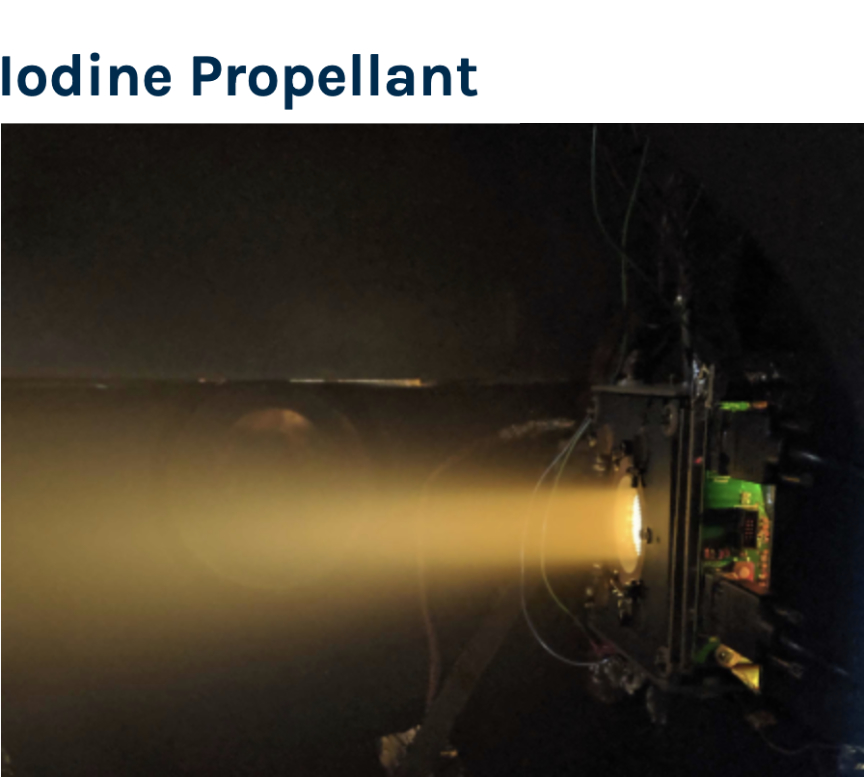
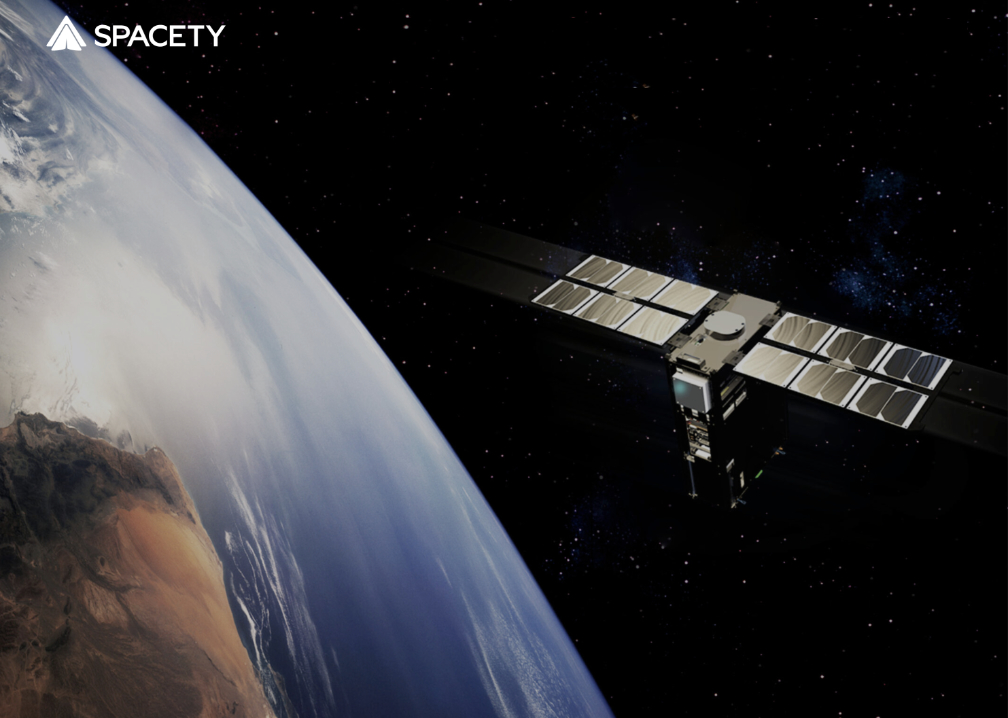
ThrustMe has announced that they have successfully tested the first iodine-fueled electric propulsion system in space aboard the Spacety Beihangkongshi-1 satellite. This world first, on-orbit demo has the potential to transform the space industry.

On December 28, 2020, the first iodine electric propulsion system to be launched into space was successfully fired, with a second successful test on January 2, 2021. Both test burns were performed by ThrustMe’s NPT30-I2-1U propulsion system onboard the Beihangkongshi -1 satellite from Spacety.

Photo of the Beihangkongshi-1 satellite is courtesy of Spacety.

The satellite was launched on November 6, 2020, and after several weeks of satellite commissioning, the propulsion system was operated during two, 90-minute burns that resulted in a total altitude change of 700 m. These tests represent the first in-space operation of the NPT30-I2-1U and the first demonstration of iodine as a viable propellant for electric propulsion systems: an important step in accelerating its commercial adoption.

A breakthrough for the satellite industry.

The NPT30-I2-1U allows propulsion systems to be delivered completely prefilled to customers and that allows the satellite integration process to be significantly simplified and streamlined. Therefore, iodine offers the potential to provide both economic, and environmental sustainability for the space industry. Indeed, most conventional electric propulsion systems make use of xenon or krypton which are expensive, rare and must be stored under very high pressure. Furthermore, satellite assembly, integration and testing can be more complicated as specialized equipment and trained personnel are required to safely load fuel tanks with such propellants.

Iodine, by contrast, can be stored as a solid at room temperature, is much less expensive, more abundant, and completely unpressurized.

In 2020, the European Space Agency (ESA), supported the development of ThrustMe’s NPT30-I2-1U propulsion system through the ARTES C&G (Competitiveness and Growth) program (funded by France) for innovative technologies for the SATCOM industry. In addition to the on-orbit demonstration, the NPT30-I2-1U is being prepared for the GEO satellite market and a separate unit is currently undergoing extensive radiation testing, which ThrustMe stated is proceeding as planned.

The development of ThrustMe’s NPT30-I2-1U was also supported by the French National Space Agency (CNES) via a project as part of their R&T program.

Ane Aanesland

“In 2008, we identified iodine as an ideal propellant for electric propulsion. Since then, we have developed a number of key technologies to be able to offer, as of today, a complete, standalone, propulsion system to meet current and emerging market needs. This is an important product for our customers as it allows them to deploy their satellite constellations, and to take corrective actions to mitigate collision or debris risks”, said Ane Aanesland, CEO of ThrustMe.

Dmytro Rafalskyi,

“It has been a long road to bring this product from dream to reality. To make it happen we had to innovate, develop a complex system from the ground up, and perform fundamental research studies since many properties of iodine are missing in scientific databases. I am happy that we have ended up with a very high performance, safe and reliable propulsion system that is now available for any smallsat, said Dmytro Rafalskyi, CTO of ThrustMe.

“The successful launch and the first firings are significant milestones in the development of ThrustMe’s iodine electric propulsion system. We are pleased to support ThrustMe in the development and demonstration of this propulsion module through the ARTES C&G program,” noted Barnaby Osborne, Small Satellite Technology Coordinator, ESA Telecommunications and Integrated Applications.

“We are very happy to have supported the in-orbit demonstration of ThrustMe’s iodine electric propulsion system and are very pleased to have helped a French company achieve such a historic milestone,” added Thomas Liénart, Head of the Propulsion, Pyrotechnics and Aerothermodynamics office at CNES.

ThrustMe is a deep-tech space propulsion company, based in the Paris-region, France. It leverages more than 10 years of applied and fundamental research at Ecole Polytechnique and the French National Centre for Scientific Research (CNRS). ThrustMe offers a portfolio of turnkey propulsion systems that have been tested in space and are available for a wide range of satellites and space missions. Its unique products make use of breakthrough innovations, such as solid iodine propellant, to streamline delivery and integration with client satellites, and to enable future economic and environmental sustainability of the space industry.

The NPT30-I2-1U is a complete, standalone, propulsion system that includes all subsystems necessary for its operation such as the power processing unit, an intelligent operation controller, and iodine propellant storage and management. It has a 1-Unit CubeSat form factor, and is prefilled with solid, unpressurized, iodine propellant. The NPT30-I2-1U is the first iodine-fueled electric propulsion system to be launched into space, and can provide a total impulse of 5500 Ns at a maximum thrust of 1.1 mN and with a specific impulse up to 2450s. Extreme miniaturization of the system is achieved through several innovations that include pipe-less propellant delivery, custom RF generation technology, a dedicated plasma ignition system, and integrated thermal management. A high level of robustness and safety is achieved through the implementation of built-in self-test and self-tuning algorithms, and several layers of security checks.

Filed Under: SmallSat, Spacecraft & Payload Technology Tagged With: Featured

Virgin Orbit’s 2nd Launch Demo Is Completed + 10 Smallsats Air Launched Via The LauncherOne Rocket

January 17, 2021

Virgin Orbit‘s LauncherOne rocket reached space during the company’s second launch demonstration on January 17, 2021, successfully deploying 10 payloads for NASA’s Launch Services Program (LSP).

Virgin Orbit’s launch system uses a technique called air launch, in which a rocket is launched from under the wing of a jet aircraft, rather than from a traditional launch pad on the ground. In addition to improving the payload capacity of the rocket, this technique allows the LauncherOne system to be the world’s most flexible and responsive launch service — flying on short notice and from a wide variety of locations to access any orbit.

For today’s mission, Virgin Orbit’s carrier aircraft, a customized 747-400 dubbed Cosmic Girl, took off from Mojave Air and Space Port at approximately 10:50 A.M. and flew out to a launch site over the Pacific Ocean, about 50 miles south of the Channel Islands. After a smooth release from the aircraft, the two-stage rocket ignited and powered itself to orbit.

At the conclusion of the flight, the LauncherOne rocket deployed 10 cubesats into the team’s precise target orbit, marking a major step forward for Virgin Orbit in its quest to bust down the barriers preventing affordable and responsive access to space.

The payloads onboard LauncherOne today were selected by NASA LSP as part of the agency’s CubeSat Launch Initiative (CSLI). Nearly all of the cubesat missions were designed, built and tested by universities across the U.S., including Brigham Young University (PICS), the University of Michigan (MiTEE), and the University of Louisiana at Lafayette (CAPE-3).

This flight also marks a historical first: no other orbital class, air-launched, liquid-fueled rocket had successfully reached space before today.

With this successful demonstration in the books, Virgin Orbit will officially transition into commercial service for its next mission. Virgin Orbit has subsequent launches booked by customers ranging from the U.S. Space Force and the U.K.’s Royal Air Force to commercial customers like Swarm Technologies, Italy’s SITAEL, and Denmark’s GomSpace.

The company’s next few rockets are already well into integration at its Long Beach manufacturing facility.

“A new gateway to space has just sprung open! That LauncherOne was able to successfully reach orbit today is a testament to this team’s talent, precision, drive, and ingenuity. Even in the face of a global pandemic, we’ve maintained a laser focus on fully demonstrating every element of this revolutionary launch system. That effort paid off today with a beautifully executed mission, and we couldn’t be happier,” said Virgin Orbit CEO Dan Hart.

Sir Richard Branson

“Virgin Orbit has achieved something many thought impossible. It was so inspiring to see our specially adapted Virgin Atlantic 747, Cosmic Girl, send the LauncherOne rocket soaring into orbit. This magnificent flight is the culmination of many years of hard work and will also unleash a whole new generation of innovators on the path to orbit. I can’t wait to see the incredible missions Dan and the team will launch to change the world for good,” said Virgin Group founder Sir Richard Branson.

All imagery is courtesy of Virgin Orbit.

Filed Under: Launch, SmallSat Tagged With: Featured

UPDATE: Blue Origin’s New Shepard Launch Is Successful

January 14, 2021

This image has an empty alt attribute; its file name is BO-NS-launch1.jpg

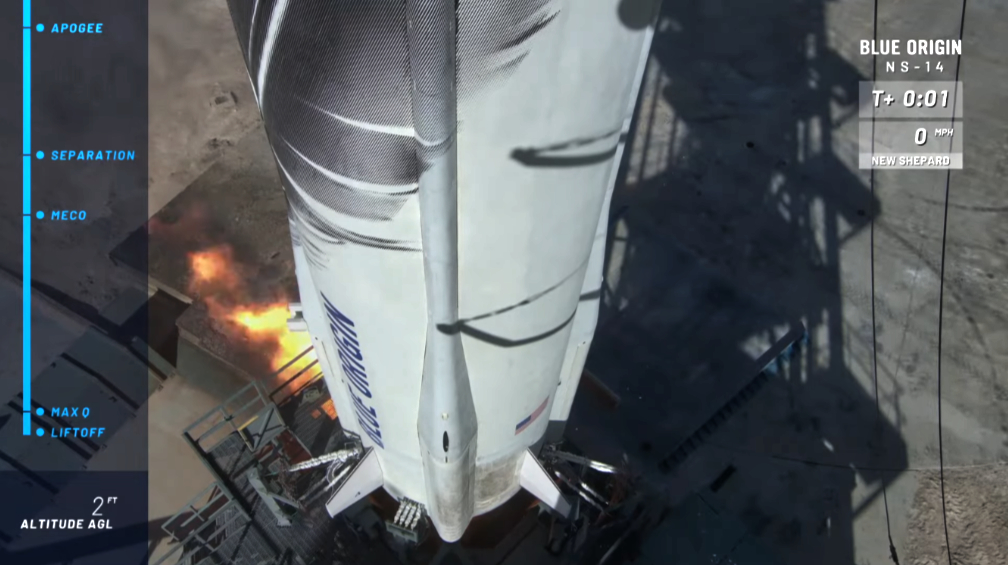
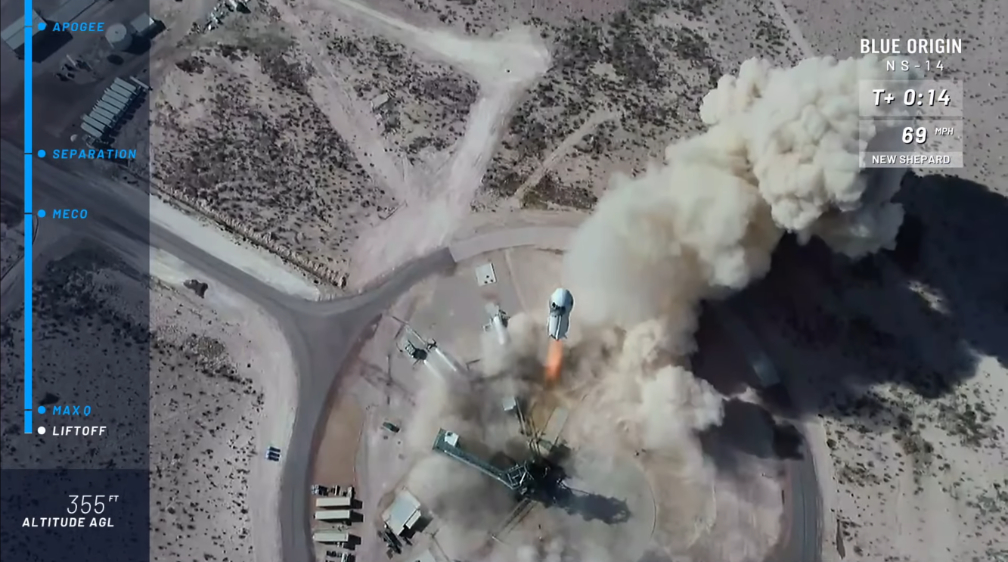
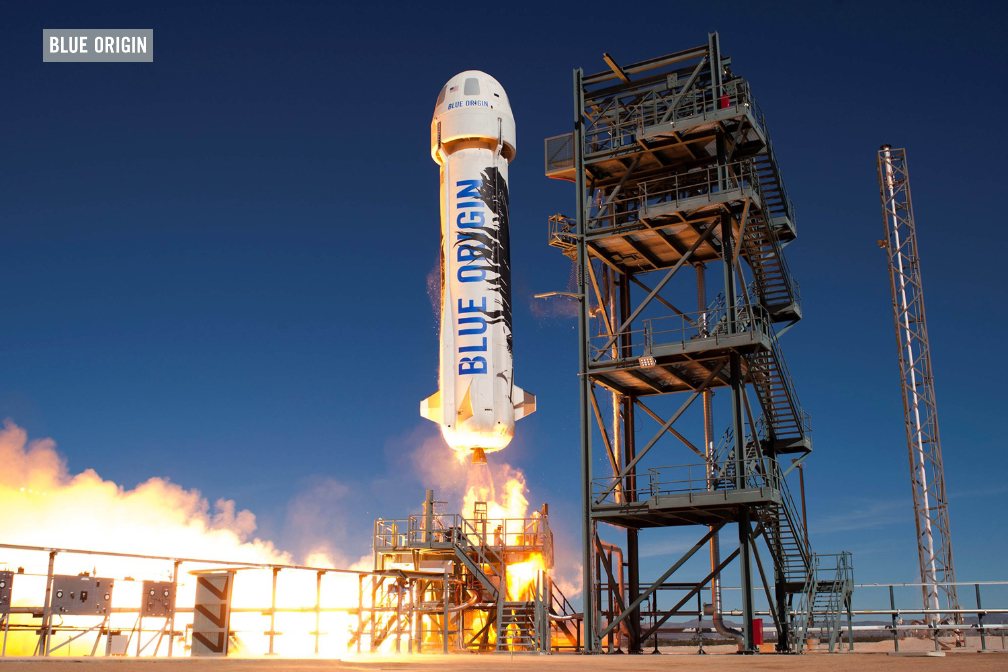
Blue Origin successfully completed its 14th mission to space and back on January 14, 2021, for the New Shepard program.

Mission NS-14 featured a crew capsule outfitted with astronaut experience upgrades for upcoming flights with passengers onboard.

Capsule upgrades included:

  • Speakers in the cabin with a microphone and a push-to-talk button at each seat so astronauts can continuously talk to Mission Control.
  • First flight of the crew alert system with a panel at each seat relaying important safety messages to passengers.
  • Cushioned wall linings and sound suppression devices to reduce ambient noise inside the capsule.
  • Environmental systems, including a cooling system and humidity controls to regulate temperature and prevent capsule windows from fogging during flight, as well as carbon dioxide scrubbing.
  • Six seats.

Also during the ascent, the booster rotated at 2-3 degrees per second. This is done to give future passengers a 360-degree view of space during the flight. 

This flight continued to prove the robustness and stability of the New Shepard system and the BE-3PM liquid hydrogen/liquid oxygen engine.
Also onboard today were more than 50,000 postcards from Blue Origin’s nonprofit Club for the Future. The Club has now flown over 100,000 postcards to space and back from students around the world.

Key Mission Stats…

  • 15th consecutive successful crew capsule landing (every flight in program, including pad escape test in 2012).
  • The crew capsule reached an apogee of 347,568 ft above ground level (AGL) / 351,215 ft mean sea level (MSL) (105 km AGL/107 km MSL).
  • The booster reached an apogee of 347,211 ft AGL / 350,858 ft MSL (105 km AGL/ 106 km MSL).
  • The mission elapsed time was 10 min 10 sec and the max ascent velocity was 2,242 mph / 3,609 km/h.

Original news story post…

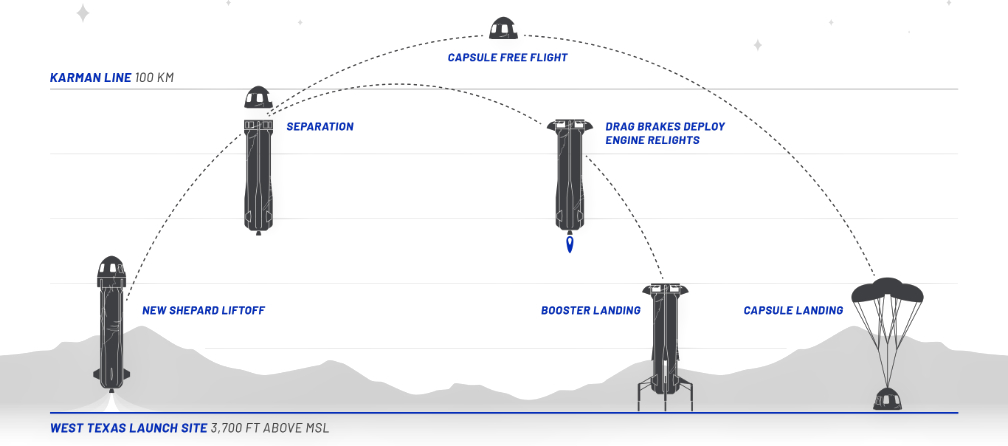
Blue Origin’s next New Shepard flight is targeting liftoff for January 14, at 9:45 AM CST / 15:45 UTC from Launch Site One in West Texas — Mission NS-14 is the 14th flight for the New Shepard program. 

For this mission, the crew capsule will be outfitted with upgrades for the astronaut experience as the program nears human space flight. The upgrades include improvements to environmental features such as acoustics and temperature regulation inside the capsule, crew display panels, and speakers with a microphone and push-to-talk button at each seat.

The mission will also test a number of astronaut communication and safety alert systems. The capsule will be outfitted with six seats, including one occupied by Mannequin Skywalker.  

Also inside the capsule, Blue Origin’s nonprofit Club for the Future will fly more than 50,000 postcards to space and back from students around the globe. A selection of postcards will fly in Mannequin Skywalker’s pockets. This is the third batch of Club for the Future postcards flown to space. To participate in the postcard program and to watch an informative video, access this direct link…

All mission crew supporting this launch are exercising strict social distancing and safety measures to mitigate COVID-19 risks to personnel, customers, and surrounding communities.   

Blue Origin New Shepard flight plan.

Launch coverage begins at T-30 minutes on BlueOrigin.com. Follow @BlueOrigin on Twitter for launch updates.  

Filed Under: Launch, Spacecraft & Payload Technology Tagged With: Featured

Space Mobility On-Orbit Demo Success By Exotrail

January 14, 2021

Exotrail reports the full success of the first-ever cubesat mission equipped with Hall-effect electric propulsion technology. Through an In-Orbit Demonstration mission launched to LEO on November 7, 2020, onboard a PSLV rocket, Exotrail nominally ignited its ExoMG™ Hall-effect electric propulsion system on the first attempt.

Smallsat constellations will now be able to quickly change their orbit once in space, giving new capabilities for satellite operators as well as more flexibility in their launch strategy, dramatic performance increases, collision avoidance and safe de-orbiting to prevent space pollution.

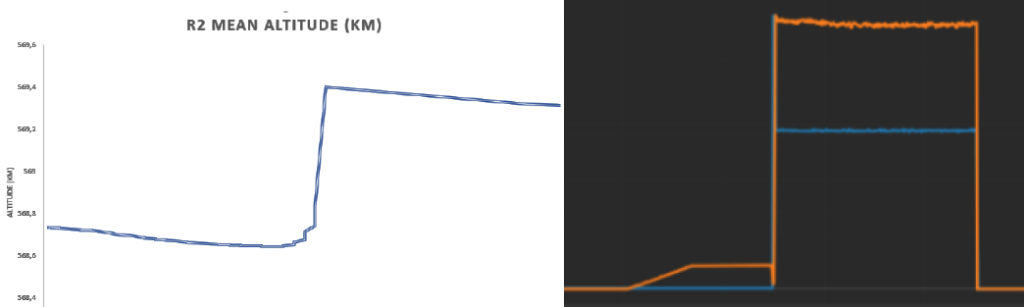
Left: Altitude change performed by R2 satellite – data coming from external sources
(Credits: Space-Track.org)
Right: Thruster parameters during ignition in space (voltage and current) which confirm the nominal behavior of the testing (Credits: Exotrail)
Left: The R2 satellite built by NanoAvionics and equipped with ExoMG™ on the ground
Right: In space seconds after launch. (Credits: NanoAvionics, ISRO)

This success marks a major milestone for Exotrail in the company’s journey to become a space mobility leader, allowing the company to validate in space its product building blocks dedicated to satellites ranging from 10 to 250 kilograms.

ExoMG™ electric propulsion system is being operated with ExoOPS™, Exotrail’s operation software, simultaneously validating not one but two products of the company. This mission opens up a new era for the space industry: ExoMG™ is the first ever Hall-effect thruster operating on a sub-100 kg spacecraft. This success is strengthened by the extremely short development timeframe, with less than a year from design to delivery. The pandemic and launch delays also caused one year of storage at the launch operator facilities without specific monitoring. This shows the extreme reliability of ExoMG™ product.

After concluding a first demonstration phase with an altitude change in December 2020, Exotrail will continue demonstrating additional capabilities of its solutions in 2021. Exotrail has already delivered ExoOPS™ software suite to various clients around the world as well as several flight-grade ExoMG™ propulsion systems to customers on two continents. Several additional propulsion systems are in production for institutional and commercial clients, such as ESA and AAC Clyde Space.

At least four mission shall fly with Exotrail product onboard in 2021 and more ExoOPS™ software deployed with new customers to be announced soon.

Hall-effect thrusters are mainly used on large satellites due to their superior efficiency compared to other electric propulsion technologies. Legacy systems, however, are the size of a fridge and require kilowatts of power. Exotrail’s smallsat thruster runs on 50 watts of power and is equivalent in volume to 2 liters of soda. On top of designing and packing world-leading innovations at the thruster level, Exotrail’s team managed the integration of the propulsion system inside the 10 kilograms spacecraft.

Another key element of innovation comes from the use of ExoOPS™, Exotrail’s constellation operation software. The software has been instrumental to the realization of the mission. Integrated seamlessly within NanoAvionics’ space infrastructure, ExoOPS™ allows to command the attitude and propulsion system of the spacecraft and to perform advanced and automatic maneuvers. ExoOPS™ can also provide capabilities such as orbit determination and propagation, ground station visibility planning or constellation management. The next steps will be dedicated to advanced maneuvering capabilities to demonstrate altitude change, inclination correction, station-keeping, anomaly and plane change, collision avoidance and de-orbit capability.

David Henri

“Everything worked better than anticipated. Some customers already told us we made history with that mission! Beyond these nice words – a true recognition of the hard work performed by all Exotrail team – it makes our strategy a reality: to operate a high-thrust and flexible electric propulsion system seamlessly with our operations software. We are beyond thrilled!” reported David Henri, Co-Founder and CEO of Exotrail. “We also want to claim the success of our mission showing tangible proofs based on real data. We are happy to report data from our ExoOPS™ software, but also external tracking elements.”

Jean-Luc Maria

“We have confirmed nominal operations of our electronics, our fluidics and our thruster head sub-systems. We are now gathering a lot of data to verify the impact of the space environment on our performances and operations. For now, we are very happy with the results as we exceeded our mission objectives.” said Jean-Luc Maria, Co-founder and CTO of Exotrail.

“We confirm that this testing was successful with nominal results at platform level and an altitude change. It has been great working with Exotrail on this journey,” said Arnoldas Pečiukevičius, Head of Systems Engineering at NanoAvionics, the smallsat manufacturing company who built the satellite in which ExoMG™ is included. “I would like to congratulate the whole Exotrail team on achieving this huge goal. Now that Exotrail’s technologies are space-proven, mobility solutions will be instrumental for a safer space.”

Filed Under: SmallSat, Spacecraft & Payload Technology Tagged With: Featured

L3Harris Demos Antenna Tech For USSF MILSATCOM

January 12, 2021

L3Harris Technologies (NYSE:LHX) has successfully completed a technology demonstration, under a Defense Innovation Unit prototype contract, for the U.S. Space Force satellite communication system to improve communications with the agency’s growing number of satellites.

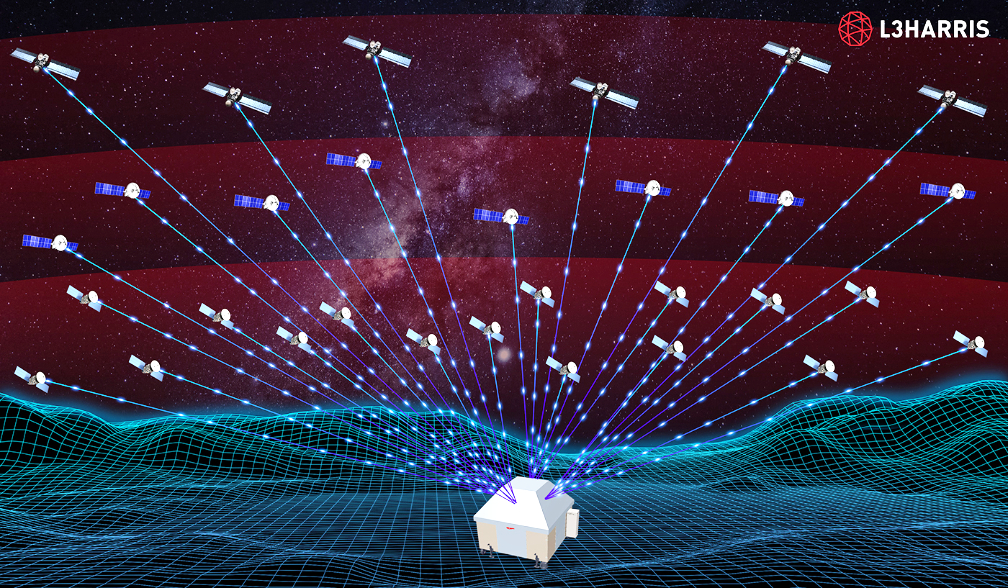
L3Harris developed a Multi-Band Multi-Mission (MBMM) phased array ground antenna system and integrated it with the Space Force’s Satellite Communication Network system in order to demonstrate multiple simultaneous satellite contacts. Traditional parabolic or radio antennas can contact only one satellite at a time.

The MBMM system’s all-digital architecture established 16 simultaneous contacts during the demonstration. The system can scale up to support hundreds of concurrent satellite connections from a single phased array antenna system, reducing the physical footprint needed for ground antennas and lowering the infrastructure cost per satellite contact.

The L3Harris demonstration successfully confirmed live contacts with Space Force satellites across multiple orbital regimes at Schriever Air Force Base in Colorado.

Ed Zoiss

“L3Harris developed an all-digital phased array antenna technology to meet the enormous ground system capacity demands created by the increasing number of satellite missions,” said Ed Zoiss, President, Space and Airborne Systems, L3Harris. “This successful demonstration from L3Harris readies our nation with a capable and affordable advanced satellite communications approach today for the further proliferation of satellites in the near future.”

Colonel Wallace
“Rhett” Turnbull III

“The MBMM demonstrations were a complete success that showcased the advancements in phased array technology and relevance for satellite command and control with live DOD systems. It has reinvigorated interest in the MBMM program as a key part of the overall space architecture,” said Colonel Wallace “Rhett” Turnbull III, Director, Cross Mission Ground and Communications Enterprise, Space and Missile Systems Center. “Capabilities like those recently demonstrated may play an important role in meeting the growing demand for satellite control capacity by providing more affordable and resilient access to Space Force satellite systems.”

L3Harris performed the successful demonstration with support from Kratos Defense & Security Solutions, Inc. and Mercury Systems.

Filed Under: National Security Programs, Spacecraft & Payload Technology Tagged With: Featured

  • « Go to Previous Page
  • Page 1
  • Interim pages omitted …
  • Page 159
  • Page 160
  • Page 161

Primary Sidebar

Coverage

  • Missions & Constellations
  • Business & Finance
  • Military & Defense
  • Launch
  • Software Automation & Ground Systems
  • Government & Regulation
  • Services & Applications

Most Read Stories

  • Proximus Global + Starlink to expand Direct-to-Cell satellite connectivity in Europe
  • Rohde & Schwarz acquires stake in Orbint GmbH for signal intelligence + reconnaissance from space
  • Congress desires LEO, but threats are real
  • FCC Opens Review for SpaceX’s 15,000-Satellite VLEO Constellation
  • USSF Awards Initial 'Golden Dome' Prototype Contracts, Signaling Strategic Shift to Space-Based Defense

About Satnews

  • Contacts
  • History

Archives

Secondary Sidebar

We use cookies to ensure that we give you the best experience on our website. If you continue to use this site we will assume that you are happy with it.
x
Sign up Now (For Free)
Access daily or weekly satellite news updates covering all aspects of the commercial and military satellite industry.
Invalid email address
Notify Me Regarding ( At least one ):
We value your privacy and will not sell or share your email or other information with any other company. You may also unsubscribe at anytime.

Click Here to see our full privacy policy.
Thanks for subscribing!