
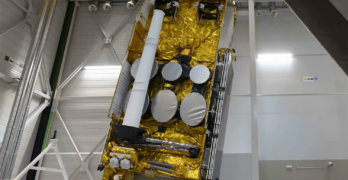
Indra Group has confirmed that the Spainsat NG-II secure communications satellite suffered a significant anomaly caused by an “external impact” while en route to its final geostationary orbital slot.
When AWS Grew Wings: The “Boring” Genius of Amazon Leo

Twenty years ago, Wall Street laughed at an online bookstore trying to rent out its excess server capacity. They called it AWS. Today, Amazon isn’t trying to win the space race for the headlines; they are trying to win the backend.
Starlink initiates orbital lowering of 4,400 satellites to mitigate debris risks

In a statement released via X, Michael Nicolls, Vice President of Starlink Engineering, announced a significant reconfiguration of the Starlink constellation, confirming plans to lower approximately 4,400 satellites from 550 […]
Globalstar Briefs FCC on $1B C-3 Network, Readies Legal Challenge to SpaceX
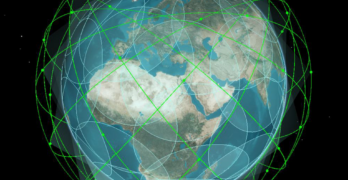
Globalstar executives met with Federal Communications Commission (FCC) leadership on Monday to advocate for the approval of its third-generation “C-3” mobile satellite service (MSS) system and to urge the regulator to protect the Big LEO spectrum band from competing proposals.
USSOCOM Explores Starlink and Starshield Integration for AC-130J Gunships

U.S. Special Operations Command (USSOCOM) has initiated market research to assess the feasibility of integrating SpaceX’s Starlink and Starshield satellite communications terminals onto the AC-130J Ghostrider fleet. In a Request for Information (RFI) released Dec. 30, the command outlined requirements for a “roll-on, roll-off” (RORO) system capable of delivering high-speed, low-latency connectivity in contested environments.
ESA Confirms Proba-3 Autonomous Formation Flying Milestone
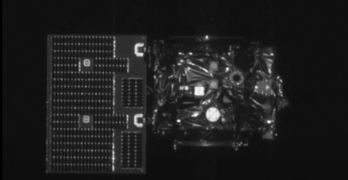
The European Space Agency (ESA) released footage December 18 confirming its Proba-3 mission successfully achieved autonomous formation flying with millimeter-level precision, marking a critical validation for the agency’s “virtual giant […]
Space Forge Ignites Orbital Furnace, Hits 1,000°C Milestone on ForgeStar-1
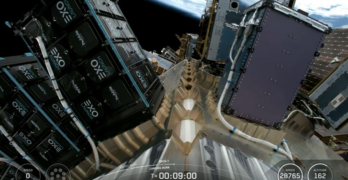
Space Forge has successfully activated the manufacturing furnace aboard its ForgeStar-1 satellite, generating plasma and reaching a temperature of 1,000°C in Low Earth Orbit (LEO). Confirmed by the company on Wednesday, the milestone marks a critical step toward the commercial production of “super materials” in space.
The Pentagon’s Real Estate Play to Break the West Coast Launch Monopoly
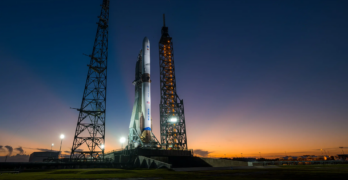
In a move that signals a shift in the Pentagon’s long-term orbital logistics strategy, Space Launch Delta 30 (SLD 30) released a Request for Information (RFI) soliciting industry interest in Space Launch Complex 14 (SLC-14) at Vandenberg Space Force Base.
NASA Shutters ‘The Earth Observer’ Publication; EOS Flagships Face 2026 Retirement

NASA announced on Monday, Dec. 29, that it will cease publication of The Earth Observer, the agency’s long-running Earth Science newsletter, effective Dec. 31, 2025. The closure of the 36-year-old publication marks a symbolic transition for the agency, which also confirmed plans to retire its three major Earth Observing System (EOS) flagship satellites—Terra, Aqua, and Aura—possibly as early as the end of 2026.
DoD Report: China’s ISR Fleet Swells to 510+ Satellites, ‘Informatized’ Warfare Accelerates

The Department of Defense (DoD) released its mandated “2025 Military and Security Developments Involving the People’s Republic of China” report on Tuesday, confirming that Beijing’s operational satellite fleet has expanded to more than 1,189 spacecraft, with a specific emphasis on space-based intelligence, surveillance, and reconnaissance (ISR).