
February 16, 2026 — In response to the rapid expansion of counter-space capabilities by regional adversaries, the Indian government has initiated a multi-layered overhaul of its orbital defense strategy.
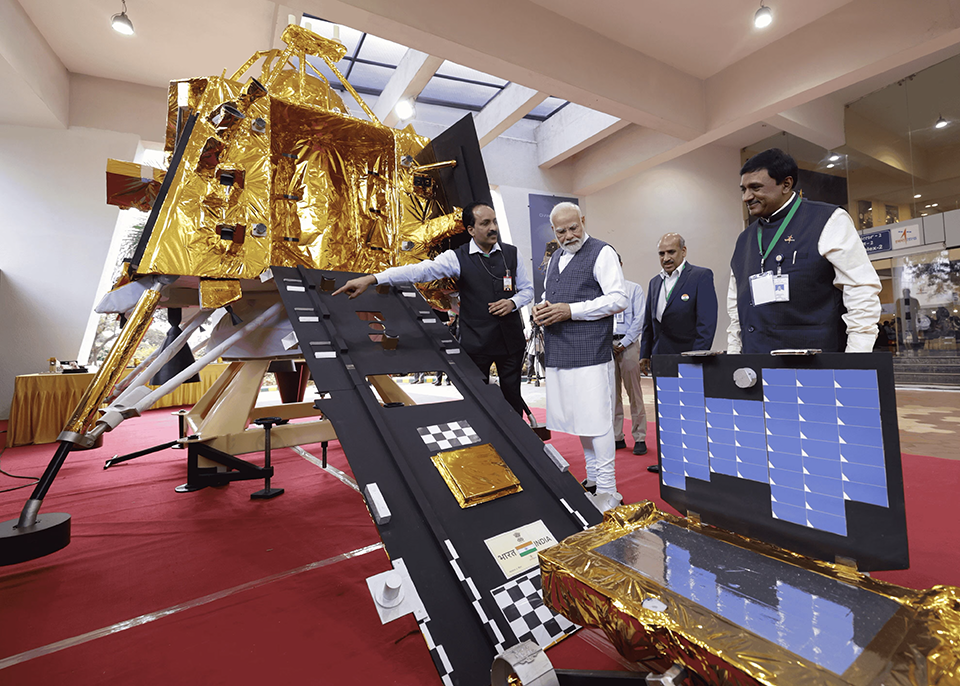
Following the Cabinet Committee on Security (CCS) approval of a 52-satellite surveillance constellation, the Ministry of Defence is pivoting toward a Proliferated Low Earth Orbit (pLEO) architecture to ensure resilient “eyes in the sky” for the Indian Armed Forces.
The Shift from Strategic to Tactical Space
For decades, India’s space assets were primarily civilian-centric. However, the emergence of sophisticated Chinese assets like the Yaogan-41—a high-orbit optical reconnaissance satellite—and Russia’s reported development of anti-satellite (ASAT) technologies have necessitated a shift. This evolution follows India’s own 2019 “Mission Shakti” ASAT test, which signaled the nation’s entry into the elite group of space-faring nations with offensive counter-space capabilities.
The current strategy focuses on high-revisit surveillance and secure communications. A cornerstone of this transition was the successful January 2025 launch of GSAT-20 (now CMS-03), a high-throughput communication satellite launched via a SpaceX Falcon 9. This mission marked the first time ISRO utilized a private American heavy-lift vehicle to deploy a critical national security asset, highlighting a pragmatic shift in launch procurement.
The 52-Satellite Constellation
The new defense constellation is designed to provide 24/7 continuous monitoring of the Indo-Pacific region. The architecture incorporates:
- Hybrid Imaging: A mix of Synthetic Aperture Radar (SAR) for all-weather/night vision and high-resolution optical sensors.
- SmallSat Proliferation: Moving away from large, “exquisite” targets toward smaller, mass-produced satellites that are harder to decapitate in a conflict.
- Mission DefSpace Challenges: Under the iDEX (Innovations for Defence Excellence) framework, private Indian startups are being tasked with developing dual-use technologies, including debris management and secure inter-satellite links.
Countering the “Contested Commons”
The militarization of LEO has altered the risk calculus for the Indian Space Research Organisation (ISRO). The defense establishment now views space not just as a support domain for terrestrial troops, but as a “contested commons” where assets must be capable of maneuvers to avoid electronic interference or physical kinetic threats.
The 52-satellite project serves as a strategic deterrent, ensuring that even if several nodes are neutralized, the remaining constellation can maintain a functional “common operating picture” for ground commanders.
The Strategic Outlook Toward 2030
As India moves toward the 2030 goal of establishing its own space station (Bharatiya Antariksh Station), the integration of defense protocols into civilian missions will increase. The focus is expected to shift toward “space situational awareness” (SSA) to track both orbital debris and adversarial maneuvers in real-time.
The upcoming “Space Policy 2026” revisions are anticipated to further deregulate the sector, allowing private firms to take a lead role in the manufacturing and maintenance of these military-grade constellations, mirroring the successful models seen in the Western commercial-defense nexus.