
By Abbey White, Staff Writer, SatNews
Dispatch from SmallSat Symposium. Coverage and analysis from across the conference, tracking the forces shaping the next phase of the SmallSat market.
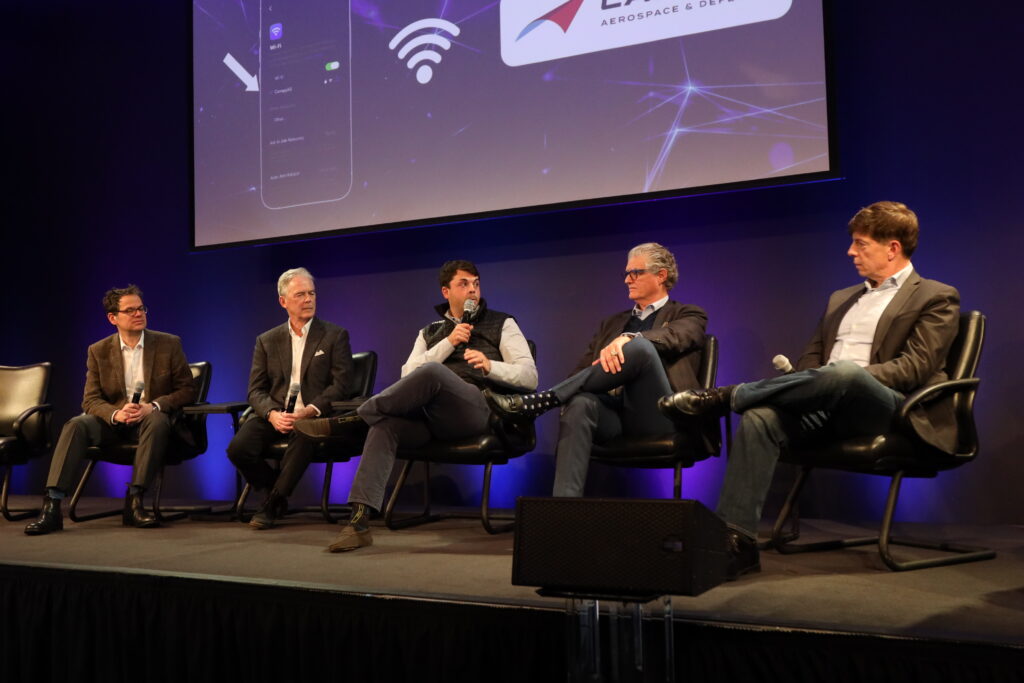
MOUNTAIN VIEW. The party continues at the SmallSat Symposium, but the guest list has evolved. Private equity sharks and defense-focused pragmatists now outnumber the starry-eyed founders. If the mood in 2022 was exuberant, for 2026 it’s one of ruthless efficiency.
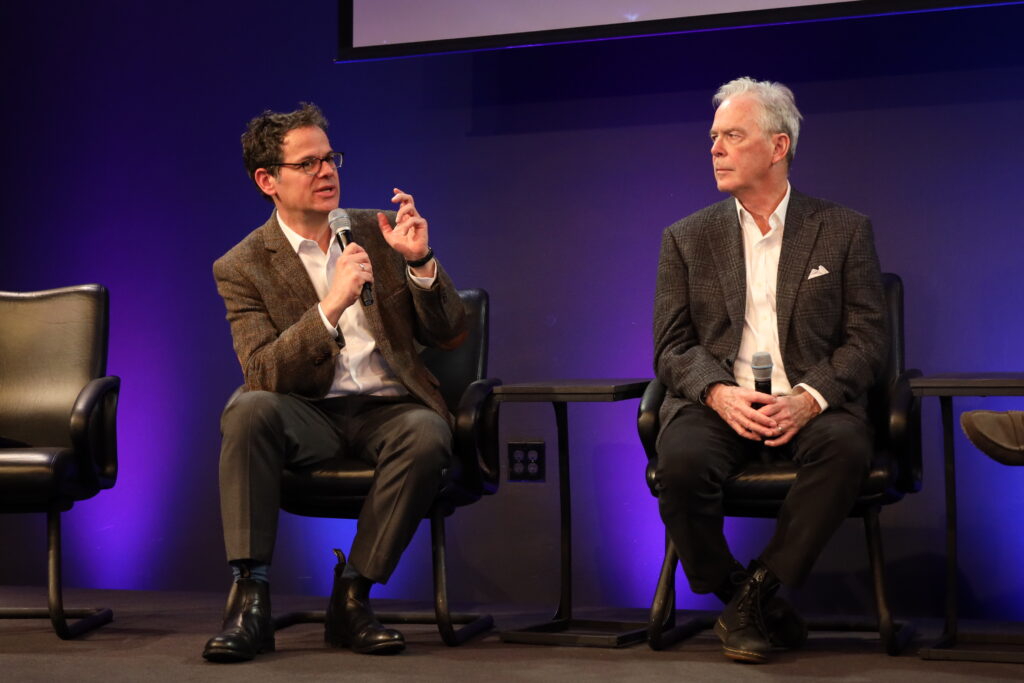
For the Space Industry Investment and Exit Strategies panel, a clear consensus emerged that the space sector has graduated from a science fair to a serious asset class. No one’s funding technology for technology’s sake anymore. Today, capital flows follow what insiders call the barbell market of recurring revenue, defense utility, and the ability to survive.
The Rise of the Virtual Prime
The most aggressive force reshaping the landscape is not a venture capitalist seeking a unicorn, but a private equity consolidator building industrial giants. Tyler Letarte, Principal at AE Industrial Partners, outlined his firm’s strategy to assemble massive, vertically integrated platforms. By combining launch provider Firefly Aerospace, manufacturer York Space Systems, and propulsion heritage from Rocketdyne, AEI has effectively constructed a Virtual Prime.
This strategy moves beyond placing small bets, instead focusing on owning the supply chain. Letarte explained the logic behind this aggressive consolidation: “We tried to incubate a supply chain through our larger portfolio companies. We did that, and there are clear winners. And now that there are clear winners within that supply chain, we would love to vertically integrate.”
This approach is as defensive as it is offensive. In a market where supply chains fracture under pressure to scale up from R&D to production, owning vendors remains the only formula to guarantee delivery. “It really opens up the door for a number of smaller players to see an exit that might not just be that perpetual raise and next raise and next raise,” Letarte observed.
Defense is the New Commercial
Geopolitical reality has usurped the industry narrative that commercial markets like space tourism and broadband would drive growth. The war in Ukraine and rising global tensions have turned space into a critical domain for national security—and investors have noticed.
Matt O’Connell, Operating Partner at DCVC and a veteran of the sector, highlighted this pivot: “Ukraine was a bad thing, but a lot of people realized we need to spend more on defense. So defense tech has gone up in the US, but also in Europe.”
This shift has fundamentally altered how companies are valued. Karl Schmidt, Managing Director at KippsDeSanto & Co., pointed out that profitability used to be the primary metric for middle-market deals, but now capability rules. “Defense tech is changing that,” Schmidt observed. “You’re looking at companies like Trillium, Zone 5, we just sold to Kongsberg, Kymeta… these companies are investing a ton of money, probably not cash-flow positive, yet the possibility for them going at really exciting revenue multiples is totally changing the way we’re looking at sell-side.”
The Barbell and the Squeeze
Despite the optimism around defense, the capital environment remains brutal for those caught in the middle. Market dynamics have shifted into a distinct barbell shape. On one end, seed-stage deep tech companies still attract funds for novel physics plays like optical computing. On the other hand, late-stage winners like Firefly and Stoke Space raise massive funds to scale operations.
Everyone else sits in the danger zone. The Series B crunch weeds out companies incapable of demonstrating a path to liquidity. Noel Rimalovski, Managing Director at GH Partners, advised founders to focus on businesses with recurring revenues that mitigate risk for the industry.
For those unable to bridge the gap, the exit ramp is narrow. It often leads to a distressed asset sale or a strategic acquisition by a larger entity looking to buy technology for pennies on the dollar. The days of easy money are gone. O’Connell joked about the current AI frenzy absorbing capital that might have once gone to space: “If your name has space in it, just spell it S-P-AI-C-E, and you will get a lot of money fast.”
The SpaceX Shadow
SpaceX’s dominance looms over every conversation in Mountain View. The company’s grip on launch and its expanding Starlink constellation create a monopoly that forces every other player to adapt. The panel discussed the recent announcement of orbital data centers, a move that could further entrench the lead held by SpaceX.
While some investors view this as a threat, others see opportunity in the supply and demand imbalance. The industry is desperate for a second reliable launch option to avoid total dependence on Elon Musk, with Letarte arguing, “The US government needs to spend a lot of time starting putting dollars towards the alternatives outside of SpaceX.”
The Exit Strategy
Ultimately, the game is about liquidity. The IPO window remains tight, with public markets wary of pre-revenue SPACs that burned investors in the previous cycle. Consequently, the new exit playbook involves selling to non-traditional buyers. O’Connell recounted selling Capella Space not to a defense prime, but to IonQ, a quantum computing company.
“We sold Capella to a quantum computer company,” O’Connell said. “And the thesis was, if you want to distribute quantum-encrypted keys simultaneously globally, satellite is the best way to do it.”
This represents the new reality of the space economy. It is no longer a distinct vertical but a horizontal enabler of the broader tech stack. Whether it is quantum key distribution, optical computing, or sovereign defense capabilities, space has become industrial infrastructure.
As the panel concluded, the message to the room was clear. To survive the next cycle, founders must stop selling dreams and start selling tollgates, infrastructure, and security. As Letarte bluntly put it: “Skip the banker and call me directly.”