
By Abbey White, Staff Writer, SatNews
Dispatch from SmallSat Symposium. Coverage and analysis from across the conference, tracking the forces shaping the next phase of the SmallSat market.
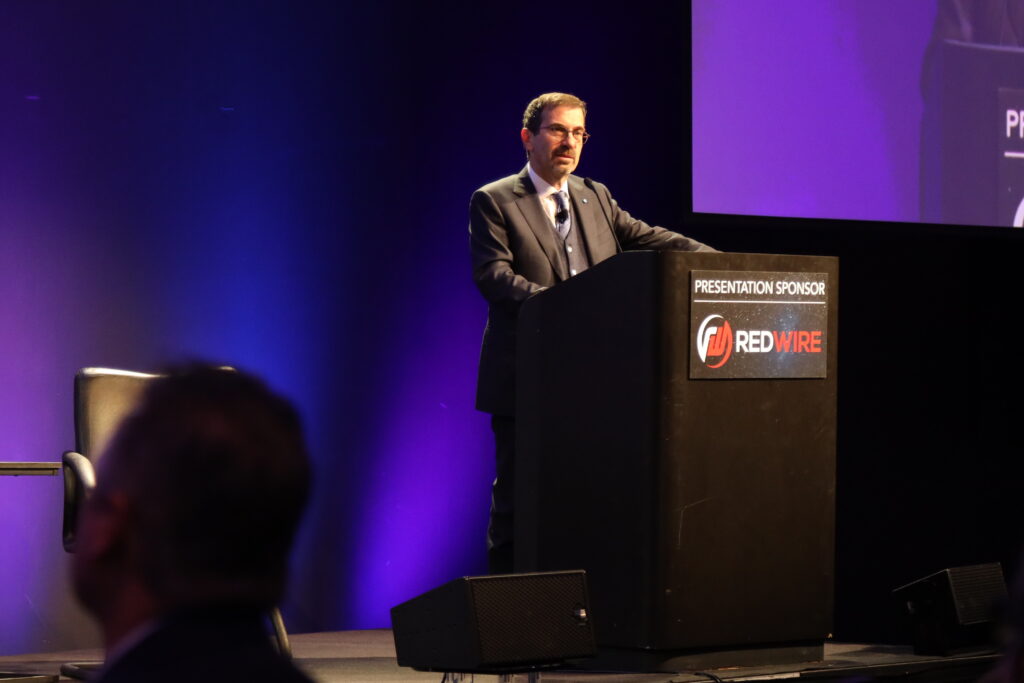
MOUNTAIN VIEW — Dr. Marco Brancati, newly minted Technical Director of the Leonardo Space Division, took the stage for the Keynote By Leonardo. Brancati didn’t come to Mountain View to talk about democratizing space but to describe a fortress under construction.
For the last decade, Europe has watched from the sidelines as SpaceX rewrote the rules of orbit. Now, with the continent’s three largest players (Leonardo, Airbus, and Thales) consolidating into a massive pan-European champion, the strategy has changed. The days of fragmented joint ventures are over. The new directive, Brancati made clear, postulates total sovereign control over the data chain, extending from the sensor in orbit to the shooter on the ground.
The Cloud is the Weapon
While the Valley obsessively tracks launch costs, Leonardo is betting the house on what happens after a rocket goes up. Brancati’s presentation centered on a radical shift: moving high-performance computing (HPC) directly into orbit.
Orbital HPC goes beyond faster internet. It concerns the Military Space Cloud Architecture (MILSCA). The goal is to stop treating satellites as dumb bent-pipe relays and start treating them as edge nodes in a military network. Brancati noted that the industry is pivoting because space and cybersecurity have become domains increasingly close to defense.
However brutal, the operational logic is sound. In a modern conflict, commanders cannot afford the latency of beaming terabytes of raw sensor data to a ground station for processing. They need the answer (tank detected, missile launch, flood inbound) generated in orbit and beamed directly to the user. To achieve this, Leonardo is deploying the davinci-2, a supercomputer upgrade that, Brancati confirmed, increases both computing power and storage capability.
A Sovereign Constellation
Leonardo’s decision to stop waiting for institutional contracts and build its own infrastructure marked the morning’s most aggressive reveal. Brancati announced an internal investment of nearly half a billion euros to deploy a proprietary constellation of about 20 satellites.
It represents a direct shot across the bow of commercial data providers. By manufacturing and operating its own assets, Leonardo is securing its supply chain against geopolitical shocks. “The goal is to show the customers and the market that Leonardo is now really able to deploy an end-to-end system,” Brancati argued, “and the best way to show that is to show you do believe in that because you do it for yourself first.”
The constellation utilizes a specific high-end architecture:
- Hybrid Sensors: Radar (SAR) and optical payloads on the same network.
- Optical Mesh: Inter-satellite links that allow data to move laterally in orbit, bypassing ground bottlenecks.
- On-Orbit Processing: Satellites that process their own data before downlink.
Such a constellation is not a commercial play for mass-market bandwidth but a bespoke intelligence machine designed to feed what Brancati calls digital platforms dedicated to maritime or defense intelligence.
The Politics of Project Bromo
A massive, looming merger between Leonardo, Thales, and Airbus, codenamed Project Bromo, provides the unspoken and perhaps uncertain context for this entire vision. Press releases may tout European unity, but the on-ground reality is a fierce tussle between France and Italy for industrial dominance.
Brancati’s technical roadmap effectively acts as Italy’s insurance policy. By locking in proprietary technologies like the Space Cloud and the davinci supercomputer, Leonardo ensures it will not be relegated to a junior partner role when the new entity forms. The emphasis on Italian-built assets, specifically the smart digital factory in Italy capable of churning out two satellites per day, serves as a reminder to their French partners (and German rivals) that Rome controls the manufacturing floor.
The timeline is aggressive. Brancati confirmed that for their new proprietary constellation, they are targeting Critical Design Review by June with launches slated for late 2027.
The Bureaucratic Question
Skepticism in the room remains palpable. Europe has a history of announcing grand sovereign projects that get bogged down in bureaucratic infighting and workshare disputes. Merging three state-backed giants into the single entity of Project Bromo to fight SpaceX sounds like a strategy from 1990, not 2026.
Dismissing Leonardo, however, would be a mistake. The shift Brancati outlined, from simple connectivity to orbital computation, is the correct strategic move. While the commercial market commoditizes bandwidth, secure on-orbit intelligence remains a premium defense product.
Leonardo is betting that, in a volatile world, governments will pay a premium for a cloud they can control, one built by a company they can sanction and operating on a network that doesn’t route through a commercial provider. As Brancati put it, they are moving from a traditional way to perform space to an end-to-end role.