
By Abbey White, Staff Writer, SatNews
Dispatch from SmallSat Symposium. Coverage and analysis from across the conference, tracking the forces shaping the next phase of the SmallSat market.
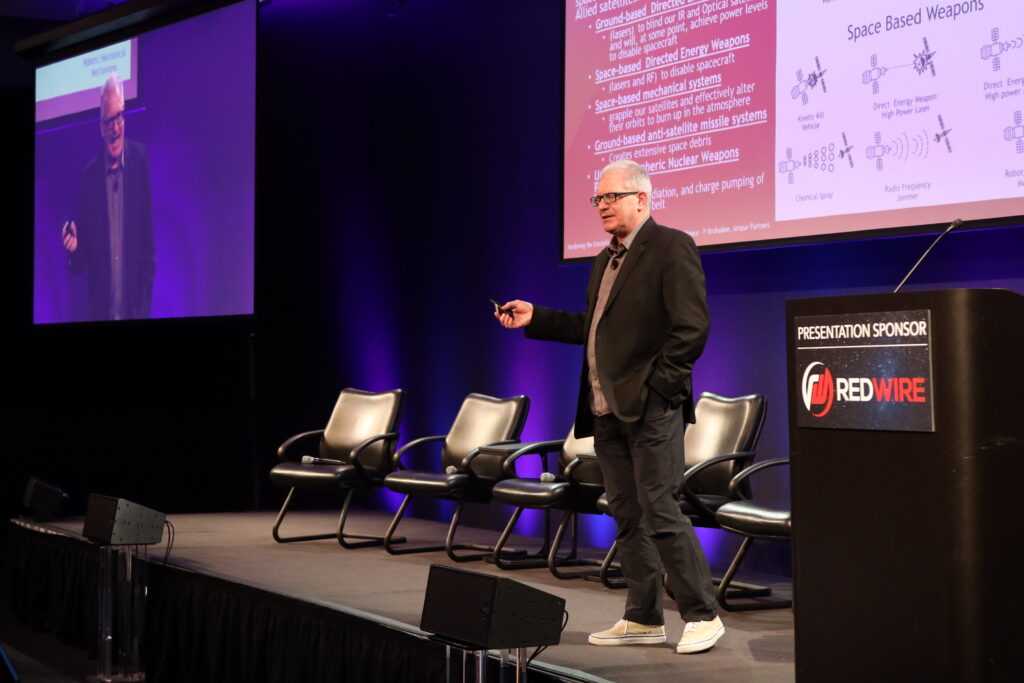
MOUNTAIN VIEW. For the past decade the SmallSat industry operated under a comforting delusion that low Earth orbit was a sanctuary where commercial operators could move fast, break things, and prioritize automotive-grade electronics over military-grade hardening. Dr. Paul Struhsaker, CEO of Arrasar Partners, with the precision of the former NSA intelligence analyst and Navy submarine officer that he is, exposed and dismantled that illusion during the session Orbital Assets: Contested and Congested.
Struhsaker’s message to the packed room was not about market caps or launch cadence. It was a warning. The commercial space sector no longer simply observes geopolitics from above but is a participant—and its adversaries are shooting back.
The Spoiler in the Sky
While the defining narrative of the last few years has been the democratization of space, that concept carries a dark side. Threats once reserved for superpowers are now aimed squarely at commercial constellations. Struhsaker identified the ongoing conflict in Ukraine as the inflection point where commercial assets became military targets.
He was blunt about the geopolitical aggressor. “Russia has been constantly playing the spoiler,” Struhsaker said. “The biggest amount of their anger really is with Starlink. They have been trying to jam Starlink. They have been trying to do almost anything they could, interrupt ground service operations, cyber attacks, you name it.”
This isn’t theoretical. Research backing this session paints a grim picture of the last 12 months. In July 2025, a global outage took Starlink offline for hours, revealing the fragility of centralized command and control systems. Meanwhile, GPS jamming in the Baltic Sea has surged, disrupting thousands of vessels and civil aviation corridors.
Struhsaker argued that Russia’s behavior is driven by the collapse of its own space supremacy. “It’s sad but true: the Russian space program is essentially failing,” he noted, adding that even New Zealand now beats Russia in launch numbers. This decline makes them dangerous because a failing power doesn’t compete; instead, it denies.
The Nuclear Option and the Zone Effect
The session’s most chilling moment likely arrived when Struhsaker addressed headlines regarding Russian nuclear capabilities in space. He dismissed the idea of a simple bomb-on-satellite attack. Instead, he described a scorched-earth strategy designed to render orbit unusable for everyone.
“What they really were threatening was a recreation of events of the 1960s where both Russia and the United States exploded nuclear weapons at high altitude,” he explained, referencing the 1961 Hardtack Orange tests that killed contemporary satellites and knocked out power grids in Hawaii.
The modern threat, however, is the zone effect. Struhsaker detailed a scenario where adversaries release high-density debris into specific orbital planes. “It would slowly create a shell in which no other space flights or space missions could get through,” he said. “It’s an almost suicidal, indiscriminate set of weapons.”
This is the nightmare scenario for the New Space economy. You cannot insure against a physics-level denial of service.
Security Debt is Due
While kinetic weapons grab headlines, the silent killer is what analysts call security debt. The industry spent the last decade accumulating vulnerabilities by prioritizing speed over security. Now, with the emergence of AI-driven malware like Promptlock and the exposure of supply chain weaknesses, the bill is coming due.
Struhsaker emphasized that the sheer volume of objects in orbit creates a chaotic environment where situational awareness is nearly impossible. Projections suggest 72,000 active satellites within the next five years. “Space is contested and dangerous just by the act of operating,” he said.
Reliance on fail-operational strategies—the idea that if one satellite dies, another takes its place—is hitting a wall. We are facing a Physics Cliff as Solar Cycle 25 subjects commercial-grade components to radiation levels they were never designed to withstand. We see irreversible damage to satellites daily, not just from solar flares but from electronic warfare. Struhsaker noted. “We are already having a great deal of irreversible shenanigans going on with our satellites.”
Armor and Swarms: The New Table Stakes
So, how does the industry survive? Struhsaker’s solution is a pivot to Deterrence by Denial. If you cannot stop the attack, you must make the attack futile.
This requires a fundamental redesign of the satellite bus. It means armor. “It’s like Plastics, son. Plastics,” Struhsaker quipped, referencing The Graduate. “Everything is about to need armor, just because of the amount of debris up there.” He highlighted new composite materials that can absorb impact without creating more debris, a critical innovation if we are to avoid the Kessler Syndrome of cascading satellite collisions exponentially increasing space debris.
But armor is passive. The active defense is the swarm. Struhsaker pointed to the Space Development Agency’s Proliferated Warfighter Space Architecture and the Golden Dome concept as the future of resilience. By launching bundles of satellites that communicate and reconfigure autonomously, operators can create a network that heals itself faster than an adversary can break it.
“They don’t need as much ground station help,” Struhsaker explained regarding these swarms. “The software is smart enough to allow them to intercommunicate, reconfigure, . . . and maintain mission resilience.”
The Bottom Line
The takeaway from Mountain View is clear. The holiday from history is over. The commercial space sector is being drafted into a conflict it didn’t ask for but cannot escape.
For years, investors asked about price-per-bit and latency. Now, the questions focus on shielding, jamming resistance, and autonomous reconstitution. “If you don’t understand all that,” Struhsaker warned, “it’s probably one of the most important things you could understand.”
The companies that recognize this shift, that treat their satellites as assets in a contested domain, will define the next decade. Those that continue to build fragile toys for a benign environment will find their constellations turned into very expensive debris.