
By Abbey White, Staff Writer, SatNews
Dispatch from SmallSat Symposium. Coverage and analysis from across the conference, tracking the forces shaping the next phase of the SmallSat market.
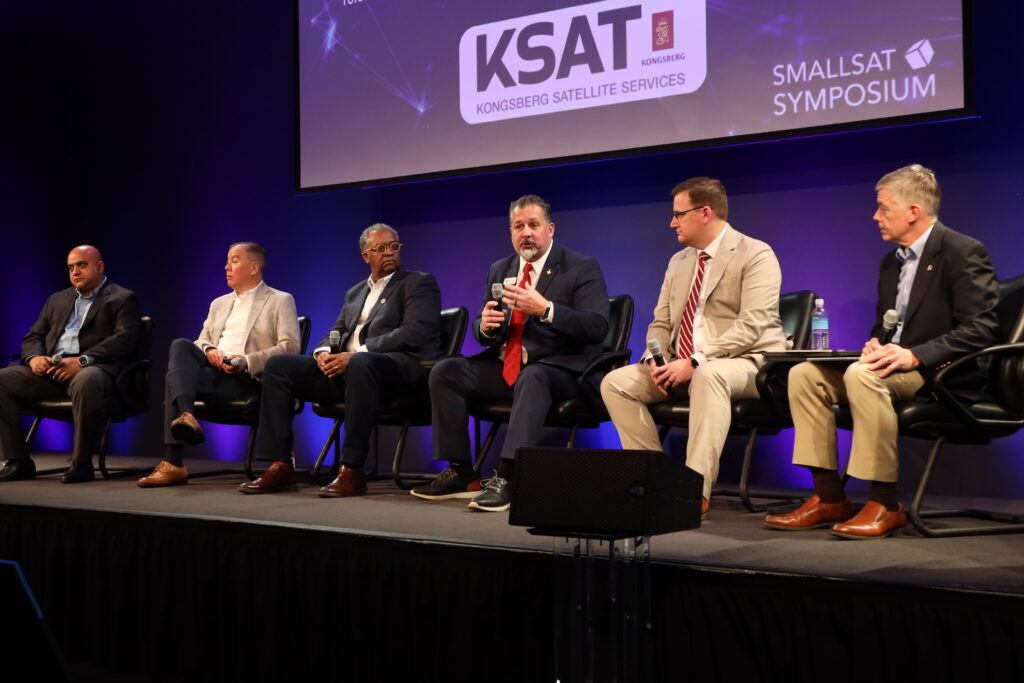
MOUNTAIN VIEW. The air conditioning hums in the main hall of the SmallSat Symposium, but the chill in the room has nothing to do with the temperature. Even here in the heart of Silicon Valley, the conversation has pivoted aggressively toward the Pentagon. The topic is the Golden Dome, the administration’s missile defense architecture mandated by Executive Order 14186 and funded at $175 billion.
On paper, the session promised a clear roadmap for coordinating agile satellite systems. In person, it delivered a stark portrait of an industry caught between the gravitational pull of massive defense spending and a vacuum of clear information. The government is writing checks, yet as of this morning, most people in the room still do not know what they are building.
Chris Quilty, the industry’s leading financial realist and panel moderator, wasted no time cutting through the defense jargon. He opened with a blunt assessment of the program’s opacity.
“We’re a year out and we still don’t have a good idea of what Golden Dome is,” Quilty told the packed room.
That tension pervades the conference. The administration has shifted from the limited concept of an Iron Dome for America to a global shield against hypersonic threats. However, the program’s leader, General Guetlein, has pulled the curtains tight, moving the entire initiative behind a classified wall to thwart foreign hacking. The result is a confused supply chain where vendors guess at requirements, hoping their technology fits a lock they are not allowed to measure.
The Anyone but Musk Doctrine
SpaceX, the only entity currently capable of launching the volume required for the Golden Dome’s thousands of interceptors, was conspicuously absent. Instead, the panel featured Naveen Kachroo from Amazon Project Kuiper.
This exclusion is deliberate. Following the public fallout between the White House and Elon Musk in mid-2025, the Department of Defense is aggressively manufacturing a second industrial base to avoid reliance on SpaceX’s Starshield, with Amazon the anointed alternative.
Kachroo’s presence confirms that Golden Dome will rely on Hybrid Space Architecture, which stitches together commercial transport layers to create a sovereign network. Describing Amazon’s role carefully, he focused on infrastructure rather than politics.
“We think the optical backplane in space is a critical component but you’ve got to marry that with everything else we said,” Kachroo stated. He emphasized that Amazon is designing a system to meet the needs of diverse customers, including consumer, enterprise, and government entities.
Onstage confidence masks a technical crisis, however. A Government Accountability Office report released this month indicates that the Space Development Agency has yet to successfully demonstrate an optical link between two different vendors in space. The mesh network, intended to act as the nervous system of the entire Golden Dome, remains a series of disconnected stovepipes. When Moderator Quilty pressed on how these disparate systems would communicate, answers retreated to high-level abstractions about digital engineering and interfaces.
The K-Shaped Recovery
Far from lifting all boats, Golden Dome capsizes the weak and propels the strong. The panel’s interests made a microcosm of this divergence.
Redwire, represented by Mark Hanson, sits on the prosperous side of the divide. The company is riding high on the Under Layer requirements. Redwire’s SabreSat, a VLEO platform capable of air-breathing propulsion, is exactly the kind of hard tech the Pentagon needs to track hypersonic glide vehicles in the upper atmosphere. Hanson projected the confidence of a prime contractor with a swelled backlog.
“I’m actually optimistic that, given the technologies and systems we have today, we can actually do it,” Hanson said. He rejected the timelines modeled by old defense procurement practices. “Golden Dome, you can’t take 10 years to have a full set of requirements and then try to field something because you’ll already be at least five generations behind.”
Momentus occupies the other side of the chasm. Its CEO, John Rood, a former Under Secretary of Defense, is fighting a defensive war for his company’s survival. Momentus executed a brutal 1-for-17.85 reverse stock split in December to stay listed on the Nasdaq, where it currently operates under going concern warnings.
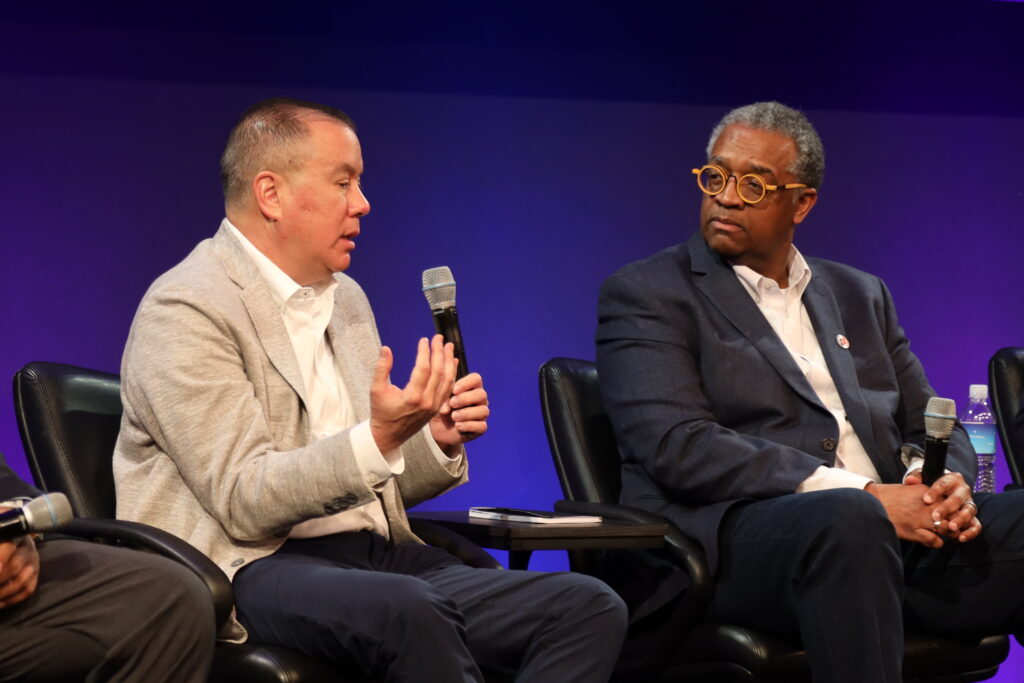
Rood’s pitch was existential. Golden Dome cannot rely on static assets, he argued, positioning his company’s orbital tugs as essential for maneuverability—a capability he termed the speed of relevance.
“The speed of relevance is not how fast you’re going, it’s how fast the person you’re racing with is going,” Rood said. He warned that without agility, the US loses the cycle time war. “We need to reduce our cycle times from conception of idea to development time to fielding . . . because the speed at which we’re implementing those in our system is not fast enough relative to what the adversary is doing.”
However valid a strategic point, in the context of his company’s liquidity crisis his analysis sounded like a plea for a bailout disguised as doctrine.
The Interceptor Fantasy
Space-Based Interceptors, the most radical components of Golden Dome, remain the most elusive. They resurrect the Brilliant Pebbles concept of satellites shooting down missiles during their boost phase.
Quilty, playing the provocateur, pushed the panel for a hard date on when the industry would see a kinetic intercept from space. The answers revealed the massive uncertainty plaguing the program. Kachroo estimated 2030 or later. Hanson countered with 2029, while Voyager Space’s John Vargas asserted 2028.
Piting Price Is Right rules, Chris Daywalt of Loft Orbital joked, “I’ll do 2032.”
The spread of these dates is telling. Despite a $25 billion down payment, prime contractors cannot within a four-year window agree on when the primary weapon system will actually function.
The Software Gap
While hardware manufacturers debated launch dates, a deeper fissure emerged regarding the software required to run this architecture. Vargas, a former F-16 pilot, brought operational grit to the discussion. He argued that the difference between success and catastrophic failure is a matter of “one-one-thousand, two-one-thousand”
Current human-in-the-loop structures are insufficient for hypersonic defense, Vargas insisted, noting that the answer regarding how AI will empower Golden Dome is a variation of “yes, yep, or yeah.” He described a future where AI handles the OODA loop to queue fire control solutions, moving humans to a supervisory role on the loop rather than in the loop.
Rood pushed back, citing the hesitation of military leadership to trust algorithms with kinetic authority. “Decision-makers are uncomfortable fully automating decisions like that,” he cautioned, recalling his time in government. “There was a discomfort about . . . making those automatic decisions without rule sets . . . because as a general rule . . . there are always many factors beyond what are anticipated.”
The Bottom Line
As the session concluded, the mood in Mountain View remained unsettled. Golden Dome is a $175 billion reality reshaping the capitalization of every company in the room.
The disconnect remains palpable. The administration demands a shield provided by Anyone-But-Musk. The industry demands clarity on requirements that remain classified. The physics of optical mesh networks demand a level of interoperability that the GAO says does not yet exist.
For companies like Redwire and Voyager, the Golden Dome is a pipeline of endless growth. For distressed players like Momentus, it is a final lifeline. For the American taxpayer, though, the question remains whether we are building a resilient defense system or just a very expensive, fragmented constellation of pilot programs.
Quilty summarized the confusion best. A full year after its announcement, “The answer is, I think we’re a year out and still don’t have a good idea of what Golden Dome is.”
Until the Pentagon opens the black box, the industry is flying blind at 27,000 kilometers per hour.