
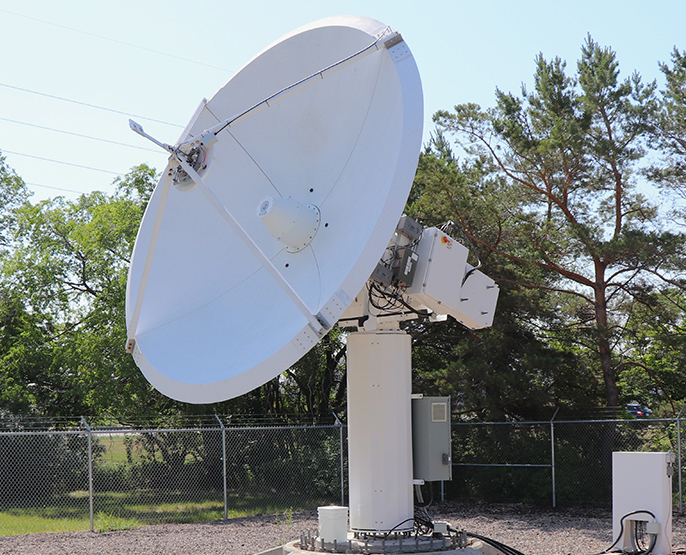
Steißlingen, Germany – SatService GmbH, a subsidiary of Calian Group Ltd. (TSX: CGY), has been awarded a contract by the German Federal Ministry of Defence to deliver a full-service Q/V-band satellite ground station.
Announced on Tuesday, Feb. 10, the project will be executed through the University of the Federal Armed Forces in Munich (Universität der Bundeswehr München – UniBw M).
The new station will be integrated into the university’s terrestrial laboratory to support scientific research and modern military satellite communications (SATCOM).
Expanding the Munich Center for Space Communications
The University of the Federal Armed Forces in Munich currently operates one of Germany’s most versatile research facilities for over-the-air testing. While the existing infrastructure at the Munich Center for Space Communications supports UHF, C, X, Ku, and Ka-band frequencies, it currently lacks Q/V-band capabilities.
This contract marks a significant expansion for the facility, enabling research into higher frequency ranges that offer larger bandwidths for feeder links and high-bit-rate data links—a critical requirement for the next generation of Very High Throughput Satellites (VHTS).
Technical Specifications
SatService is tasked with the end-to-end design, manufacturing, and testing of the ground station. Key technical parameters include:
- Antenna System: A high-performance 4-meter antenna tailored for precision tracking.
- Frequency Range: Operation in the Q/V-band (approximately 40 to 75 GHz), optimized for geostationary orbit (GEO) applications.
- Architecture: The delivery includes the company’s proprietary sat-nms monitoring and control system, hardware, and a cyber-secure network architecture.
- Support Functions: The system is designed to support Command, Control, Communications, Computers, Cyber, Intelligence, Surveillance, Reconnaissance, and Targeting (C5ISRT) functions.
Leadership Perspective
The investment aligns with broader European initiatives to secure sovereignty in space communications by diversifying frequency band access.
“Germany and the EU are heavily investing in satellite communications capabilities to secure and defend their sovereignty, and access to multiple frequency bands is a critical part of their initiative,” said Wilfried Megger, Managing Director, SatService GmbH. “Our team will combine decades of engineering experience with our system integration capabilities to deliver a SATCOM solution that is tailor-made to meet their needs.”
Operational Training and Scientific Outlook
Beyond its role as a research tool, the ground station will serve as an educational platform for German Armed Forces trainee officers. It will provide hands-on experience with high-throughput connectivity and demonstrate the operational benefits of geostationary orbit, such as continuous regional coverage and improved resilience against electronic interference.
Following the manufacturing and testing phase in Steißlingen, the system is expected to be delivered and commissioned at the Munich campus later this year.