
By Abbey White, Staff Writer, SatNews
Dispatch from SmallSat Symposium. Coverage and analysis from across the conference, tracking the forces shaping the next phase of the SmallSat market.
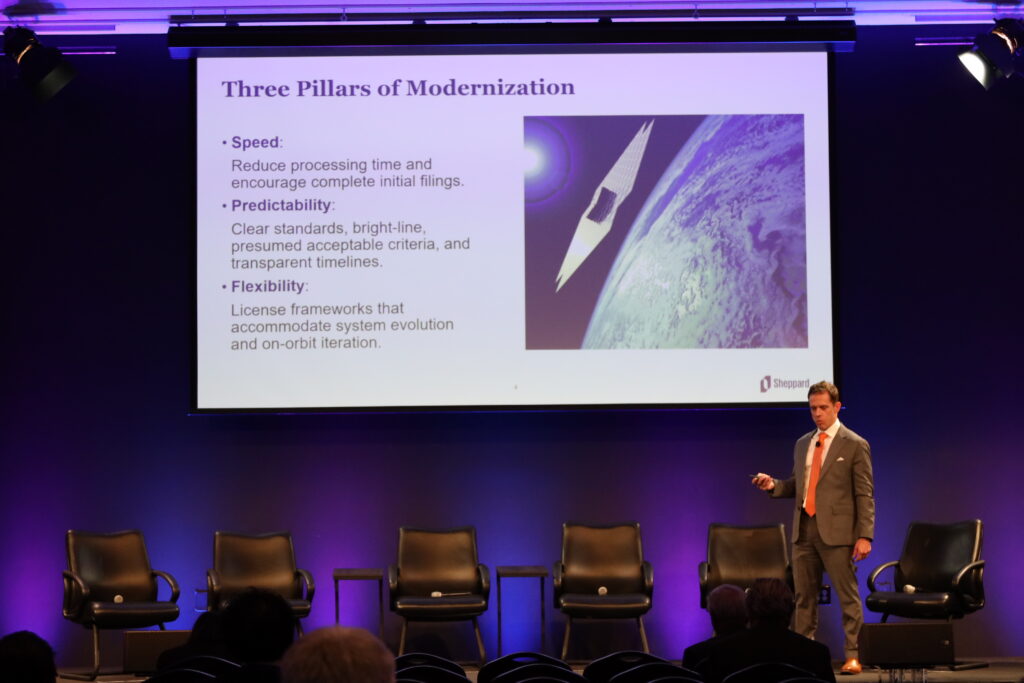
MOUNTAIN VIEW, California. The regulatory framework governing the U.S. commercial space industry is poised for a historic overhaul. Speaking at the SmallSat Symposium, Sheppard Mullin partner Drew Svor outlined the Federal Communications Commission’s plan to retire legacy Part 25 rules in favor of a modular system under Part 100. This proposal seeks to modernize a licensing process that has struggled to keep pace with soaring application volumes and increasingly complex mission profiles.
During a market briefing on these changes, Svor detailed the Space Modernization for the 21st Century Notice of Proposed Rulemaking (NPRM). This initiative arrives as industry activity accelerates exponentially, a trend underscored by a recent SpaceX filing for a constellation of up to one million satellites.
From Monolith to Modular Components
At the heart of the proposal lies a pivot from narrative-based applications to a standardized, component-based architecture. Svor characterized the incumbent process as “a blob“ comprised of a primary form and a behemoth of attachments such as technical narratives and interference studies.
The new Part 100 framework introduces a licensing assembly line. Rather than a single, all-or-nothing review, applications will be separated to modular components (including debris mitigation, spectrum usage, and ownership) that can be independently certified. This structure allows for a presumed acceptable standard. “If you can make these certifications,” Svor noted, “your application is going to get processed much more quickly.”
Aggressive New Timelines
To resolve the counting backwards dilemma where operators face uncertain regulatory horizons, the proposed rules introduce strict processing deadlines. Compliant applications would be placed on public notice within 30 days of filing. Furthermore, the public comment window would shrink to just 7 days for applications meeting all bright-line criteria, a sharp reduction from current standards.
Crucially, the proposal forces prompt agency action. Once the public notice period closes, the FCC aims to act on the application within 60 days or justify the delay, with Svor noting, “Predictability, or the lack thereof, is what really I think is driving a lot of the FCC’s efforts.”
Adapting to New Mission Profiles
The rulemaking reform also categorizes emerging technologies that defy traditional geostationary or non-geostationary definitions. Svor pointed to the new Variable Trajectory Spacecraft System category, which is designed specifically for dynamic missions like on-orbit servicing and manufacturing.
Because these missions do not maintain fixed orbits, they currently require waivers. The new category, Svor explained, would allow operators to update trajectory data dynamically without bureaucratic friction: “There would no longer be the need to justify why your mission profile doesn’t quite align with the same application that an NGSO FSS provider with a huge constellation is filing.”
Financial barriers for smaller operators are also addressed. The FCC intends to eliminate surety bond requirements for constellations with fewer than 200 satellites, provided they are not part of a specific processing round.
The Ground Segment Shift
The NPRM extends its deregulatory reach to earth stations, moving toward a nationwide license model similar to the management of terrestrial microwave bands. Under this system, operators would receive a blanket license and, upon deployment, simply register individual antenna sites in a database.
This eliminates the need to apply for new licenses for each location. “You can bring on or file registrations for additional sites under that license without having to go through what people go through now,” Svor said. The change directly supports the Ground-Station-as-a-Service model, enabling infrastructure providers to rapidly activate sites to meet customer demand.
Context: The Million-Satellite Question
While Part 100 focuses on administrative efficiency, it lands during a surge in orbital density. This January 30, SpaceX filed a modification request for a constellation of one million satellites to support an Orbital Data Center network. Accepted for comment just days before the symposium, this filing places the FCC assembly line concept under immediate pressure.
Simultaneously, the industry must navigate new national security mandates. On January 29, the FCC adopted a Foreign Adversary Reporting Regime requiring license holders to disclose ownership interests of 10% or more held by entities from specific nations, including China and Russia. Licensing mechanics may be accelerating, Svor underscored, but the compliance landscape for ownership and security is becoming significantly more rigorous.