
JIUQUAN, China – The China Manned Space Agency (CMSA) has completed an “extraordinary” integrated flight test involving its next-generation Mengzhou crew capsule and the Long March 10 (CZ-10) reusable rocket.
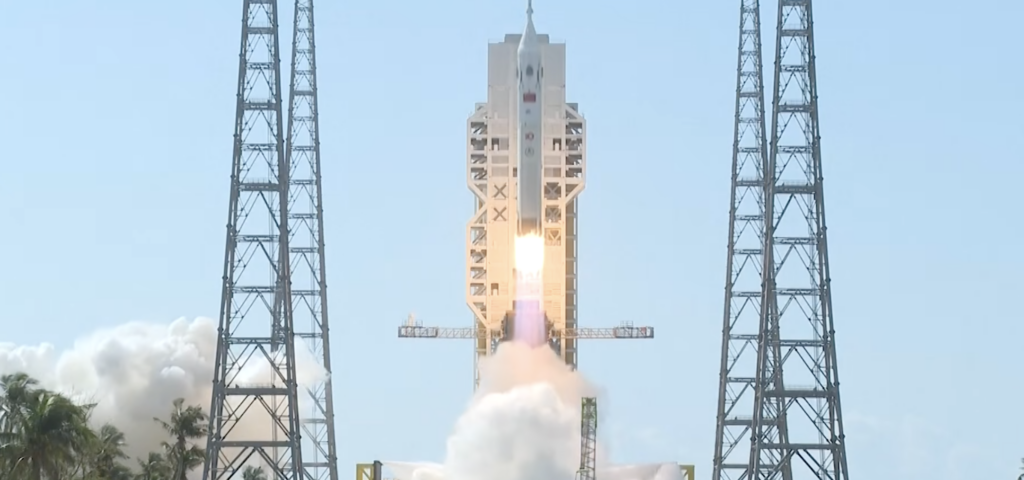
The mission, conducted on Tuesday, Feb. 10, simultaneously validated a high-altitude launch abort system (LAS) and a controlled, propulsive landing of the rocket’s first stage—technologies critical for China’s goal of landing astronauts on the Moon by 2030.
This test marks the first time China has publicly demonstrated a full-scale integration of its lunar-class hardware in a high-dynamic flight environment.
Context: The Sovereign Lunar Path
The Long March 10 is a clean-sheet design tailored specifically for deep-space exploration. Unlike the current Long March 5, the CZ-10 features a reusable first-stage architecture similar to the SpaceX Falcon 9 but optimized for the high-thrust requirements of a lunar trajectory.
The successful recovery of the test booster via grid fins and a propulsive burn signifies that China has successfully closed the technical gap in vertical takeoff, vertical landing (VTVL) capabilities. This is a vital component of the “Sovereign-Commercial Nexus,” as China seeks to lower launch costs through reuse while maintaining strict state control over its lunar infrastructure.
Technical Specifications: Mengzhou and CZ-10
The integrated test provided new data on the performance of China’s “Moon Ship” and its heavy-lift booster:
- Mengzhou Crew Capsule: A modular design capable of carrying three astronauts to the Moon or seven to the Tiangong Space Station. The test verified the rapid separation of the capsule from the booster under simulated emergency conditions.
- Long March 10 (Lunar Variant): Features three 5-meter diameter cores with a combined liftoff thrust exceeding 2,600 tons. The variant tested was the “short” version intended for LEO and technology validation.
- Landing System: Utilized four foldable grid fins for aerodynamic steering and a throttlable YF-100K engine for the final landing burn.
Strategic Rationale: Decoupling and Dominance
The test confirms China’s intent to decouple from Western aerospace standards and dependencies. By developing a reusable heavy-lift vehicle independently, CMSA is ensuring that its mission cadence to the International Lunar Research Station (ILRS)—a joint project with Russia and other partners—remains unaffected by international sanctions or supply chain volatility.
“This success demonstrates that the foundational technologies for our manned lunar landing are now entering a stage of high-level maturity,” said Zhang Hailian, Deputy Chief Designer of the CMSA, in a post-test briefing. “We are no longer just planning; we are flight-validating the hardware that will carry Chinese citizens to the lunar surface.“
Outlook: The Road to 2030
Following this successful recovery, the CMSA is expected to move toward the first full-duration static fire of the Long March 10’s triple-core configuration later in 2026. If the current pace holds, a debut orbital flight of the full-scale lunar rocket is projected for 2027. This timeline puts China in a direct race with NASA’s Artemis program, which is currently targeting a similar window for its crewed lunar landing (Artemis III).