
By Abbey White, Staff Writer, SatNews
Dispatch from SmallSat Symposium. Coverage and analysis from across the conference, tracking the forces shaping the next phase of the SmallSat market.
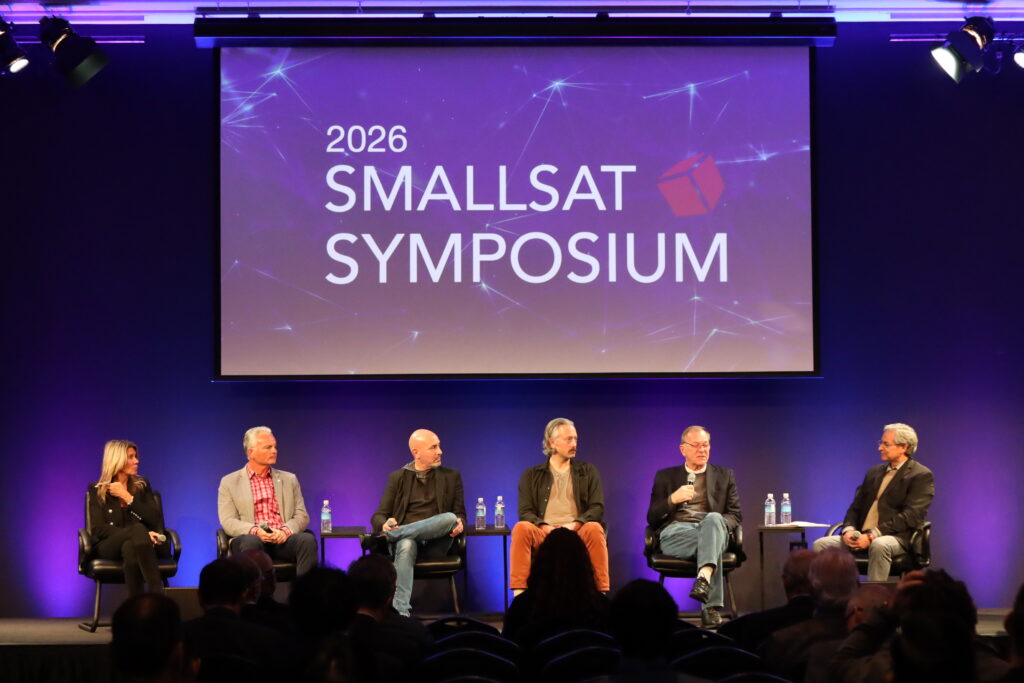
MOUNTAIN VIEW — Attendees at the SmallSat Symposium might have envisioned a future Space Data Layer as a seamless optical-mesh network capable of near-instant data transmission. During the symposium’s Edge of Orbit session, however, participants scrutinized the mechanics available to make that ideal materialize quickly. Attendees backed off from that theoretical end-state to debate the practical complexities and significant labor required to make this revolution operational.
Industry narratives have long painted low Earth orbit as an extension of the terrestrial internet—a high-speed, interoperable cloud above the clouds. Yet, when pressed on this unified network’s timeline, the panel’s optimism collided with engineering constraints. Carol Craig, CEO of Sidus Space, spoke plainly. While startups pitch immediate real-time capabilities to investors, she argued, “I think it’s still a good 10 years out when you talk about that full space data layer.” That assessment challenges a sector addicted to the concept of now. She attributed the delay to a fragmented landscape where commercial and defense priorities pull companies in different directions, creating what she termed “distractions.”
The Death of the CubeSat
The session also confirmed the demise of the form factor that gave this conference its name: the CubeSat. For a decade, shoebox-sized satellites costing less than a San Francisco condo defined the smallsat revolution. That era is over. The high-power optical terminals and onboard computer of the Space Data Layer simply cannot fit in a 3U box.
Beau Jarvis, Chief Revenue Officer at Kepler Communications, provided tangible evidence of this shift. Kepler, an early darling of the nanosatellite crowd, has radically upsized its architecture. Jarvis detailed their latest deployment: “This past January we launched ten 300-kilogram spacecraft that form the first tranche of our commercial constellation.”
This pivot represents a massive departure from the industry’s roots. As noted in research, Kepler’s shift requires a mass increase of over 2,000% from their original designs to accommodate the power-hungry realities of optical data relays. Building the internet in space cannot happen on disposable hardware, Jarvis posited. Larger satellites are necessary to form an always-on ring of connectivity—a feat impossible with the power budgets of the past.
Thermodynamics vs. The Pitch Deck
The most contentious subtext revolved around orbital data centers. Rob DeMillo, CEO of Sophia Space, pitched a vision where server racks migrate to orbit to escape terrestrial resource constraints. “We consider ourselves an orbital computer company,” DeMillo said, describing a modular tile system for processing data in the vacuum of space.
But this vision faces the elephant in the room: heat. While DeMillo argued that the move to orbit is as inevitable as the transition from dial-up to broadband, the thermal engineering community remains skeptical. On Earth, data centers use massive water loops and airflow to cool high-performance chips. In the vacuum of space, convection does not exist. Heat can only be rejected via radiation, a notoriously inefficient process.
Despite the polite tone of the panel, the gap between DeMillo’s vision of orbital data centers and the current reality of low-power edge processing was palpable. Planet’s David Marvin grounded the discussion in what is currently possible. He advocated using onboard NVIDIA chips, not to replace Amazon Web Services but to act as a filter. He described a scenario where a satellite tips off a wildfire commander with vector data layers rather than raw imagery. “Sending down a few megabyte package . . . is a huge advantage,” Marvin said. Smart filtering, not floating server farms, represents a realistic near-term future.
The Walled Garden Problem
Beyond the physics, the panel highlighted a looming market failure in the lack of a common language. Richard Hadsall of Integrasys, a veteran of the ground segment, warned that without a unified software layer, the industry is just launching expensive, deaf noise. “They’re not talking to one another,” Hadsall noted, estimating that it will take another three to five years just to get constellation-based spectrum data sorted.
The threat of proprietary walled gardens, networks that don’t play nice with others, also loomed large. With Starlink and Amazon Kuiper building closed loops, the rest of the industry is scrambling to survive by banding together under open standards like those set by the Space Development Agency.
Jarvis was explicit about this divide. “Starlink and Amazon are obviously massive companies able to scale quickly,” he said, “but they’re doing it in a proprietary fashion—which is a choice.” European and defense customers are recoiling from that monopoly risk, however, instead seeking interoperability and trust over raw scale.
The Bottom Line
The Edge of Orbit session clarified that the Space Data Layer is inevitable, but not imminent. The technology is transitioning from experimental validation to a messy, capital-intensive operational deployment.
The winners in this next phase won’t be the ones with the best PowerPoint slides about orbital clouds. Instead, success belongs to those who, like Kepler, accept the physical reality that moving data requires power and mass—ones like Planet who focus on delivering trust in the data rather than raw pixels. As the panelists stepped off the stage, the consensus was clear. The days of the cheap, simple CubeSat are behind us. The future is heavy, hot, and expensive.