
By Abbey White, Staff Writer, SatNews
Dispatch from SmallSat Symposium. Coverage and analysis from across the conference, tracking the forces shaping the next phase of the SmallSat market.
MOUNTAIN VIEW, Calif. — For the past decade, the commercial space sector has benefited from a benign era defined by a quiescent sun and the protective magnetosphere of Low Earth Orbit (LEO). This stability allowed companies to prioritize speed and commercial off-the-shelf (COTS) components over traditional radiation hardening. Yet, as the industry pivots toward sustained lunar operations under the Artemis program, engineers face a steep physics cliff. The fail-operational strategies that built the LEO economy simply cannot withstand the harsh radiation environment of deep space.
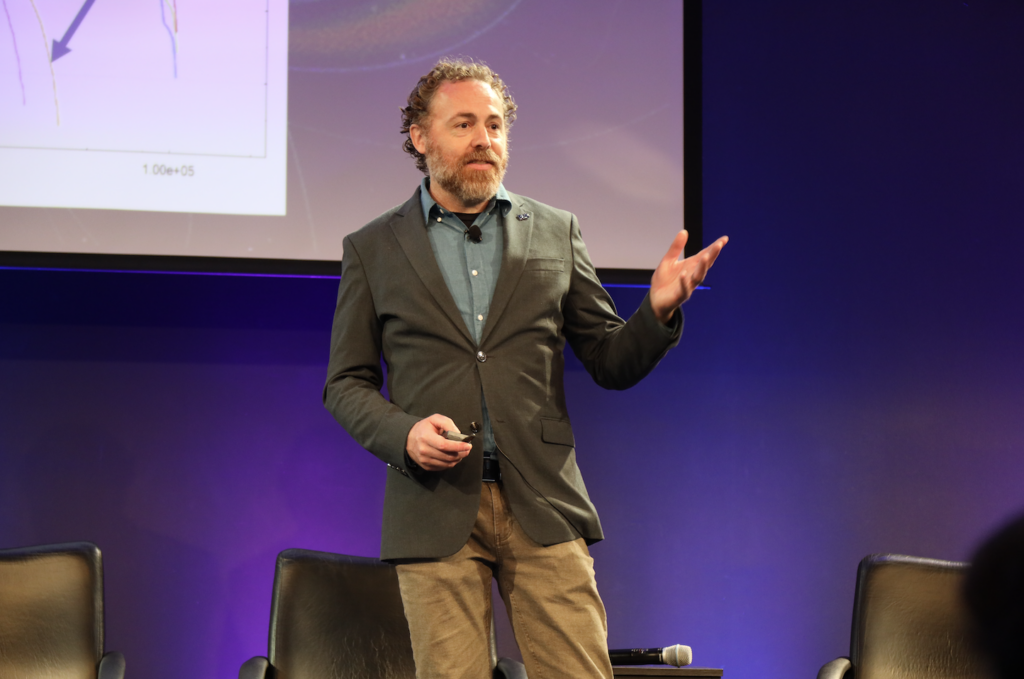
Merek Chertkow, CEO of The Radiation Team, outlined this structural disconnect at the symposium’s recent technical session, From LEO to Lunar. Mega-constellations like Starlink normalized use of automotive-grade electronics through redundancy and rapid replacement. In contrast, lunar infrastructure (gateways, rovers, and habitats) must operate for years without de-orbiting options or easy repairs. This shift coincides with the peak of Solar Cycle 25. Industry analysis suggests recent solar storms exposed significant margins of error in radiation resilience among many operators, effectively auditing the actuarial tables of the commercial sector.
Moving Beyond Component Testing
Chertkow identified a fundamental flaw in the mission lifecycle rather than just component selection. Traditional workflows treat radiation as a final verification step where parts are tested for survival. A global shortage of heavy-ion testing facilities is causing this model to collapse. The industry currently faces a 5,000-hour annual deficit in beam-time at premier labs such as the NASA Space Radiation Laboratory and CERN.
Relying solely on testing creates a bottleneck that current schedules cannot accommodate. Chertkow noted that waiting until part selection to address radiation forfeits valuable business optimization trades. “If you wait until you’re selecting parts in a design to start working on radiation problems, you’ve already forgone a ton of trades that you could do to optimize your business model,” he said. He advocated for shifting radiation engineering to the concept and design phase. Here, system-level mitigations, including circuit modifications, software error correction, or orbital timing adjustments can solve problems that component selection cannot.
System-Level Hardening Strategies
Transitioning to the lunar surface exposes electronics to Galactic Cosmic Rays (GCRs) and Solar Particle Events (SPEs), threats largely deflected by Earth’s magnetic field in LEO. The Radiation Team proposes a middle-ground approach called System-Level Hardening to bridge this gap without reverting to the prohibitive costs of fully rad-hard military-grade components.
This methodology accepts that individual silicon gates will fail but designs architectures to tolerate these failures without ending the mission. For instance, one mission faced a critical failure mode in an engine controller due to radiation exposure in the Van Allen Belts. Instead of a costly hardware redesign, engineers adjusted the Guidance, Navigation, and Control (GNC) profile. By executing the engine burn five minutes earlier, they statistically reduced the radiation exposure to an acceptable level.
The Economic Reality of Deep Space
The economic divergence between the volume market of LEO constellations and the value market of deep space assets drives the push for modernization in radiation hardening. LEO operators can accept a fail-operational model where the system works even if nodes fail, but lunar missions often require a fail-safe reliability standard closer to heritage specifications.
Demand for high-performance computing on the Moon forces designers to use modern process nodes (7nm, 5nm) that are inherently soft to radiation. Chertkow emphasized that radiation must be treated as a core design parameter (like mass, power, or thermal budgets) rather than a risk to be eliminated entirely. “Radiation engineering should be thought of as what trades can be made to optimize and meet mission success,” he stated.
Future Outlook
As the industry prepares for the sustained lunar presence required by Artemis III and beyond, reliance on automotive-grade parts remains a point of contention. Proponents argue that automotive standards like AEC-Q100 provide high reliability against wear-out, but critics note these standards do not require radiation testing. This leaves components vulnerable to the stochastic nature of heavy ion strikes.
Chertkow suggested the path forward involves a nuanced strategy of necessary and sufficient assurance. This means testing only to the specific limits required by the mission’s environment rather than to arbitrary standards. Such a data-driven approach enables use of modern processors in deep space by quantifying risk rather than attempting to eliminate it. This capability is critical as the sector faces the ongoing intensity of the current solar maximum.