
By Abbey White, Staff Writer, SatNews
Dispatch from SmallSat Symposium. Coverage and analysis from across the conference, tracking the forces shaping the next phase of the SmallSat market.
MOUNTAIN VIEW. Rockets still make a lot of noise, but the revolution visible at the SmallSat Symposium moves silently, digitally, and at the speed of code. For decades “metal benders”—those massive aerospace conglomerates that first weld titanium and then figure out the flight computer—have defined the space industry. That era is officially obsolete.
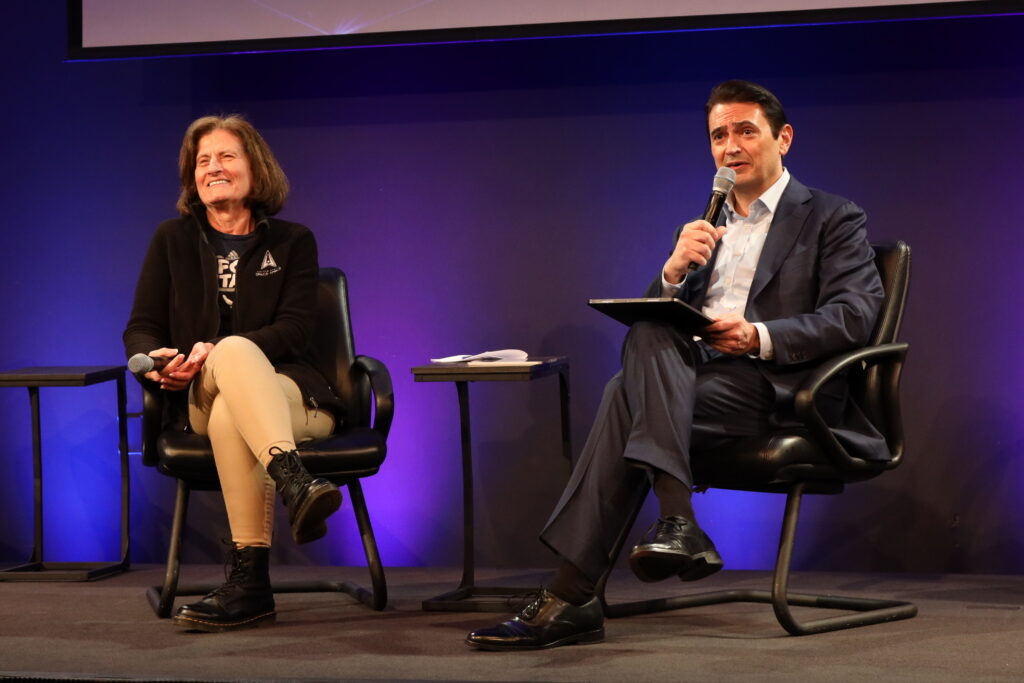
During a riveting Fireside Chat between Milbank partner Dara Panahy and Victoria Coleman of the Berkeley Space Center, the industry received a new engineering manifesto. The breakthrough isn’t a new propulsion system or a lighter alloy but a fundamental inversion of a design process that no longer builds hardware that happens to have software but instead deploys orbiting servers wrapped in solar panels.
The Software-First Paradigm
Coleman, an innovation veteran whose career spans the Air Force, DARPA, and Intel, pinpointed exactly why Silicon Valley is overtaking the traditional defense base. The secret sauce isn’t just capital; it is the mindset of the software engineer applied to the unforgiving physics of space.
“In the Valley here, what we’re going to build is a hub for new space tech,” Coleman declared. “Where we build the software first and put metal around it, versus the other way around, which is what’s being done by our colleagues in Southern California. I think there is magic in that.”
This is the transformation Panahy asked for, a radical shift allowing for iteration speeds previously thought impossible in aerospace. By prioritizing software-defined architectures, companies can update capabilities on orbit, patch vulnerabilities in real time, and integrate AI-driven decision-making at the edge. It creates the difference between a flip phone and an iPhone: one is a static tool, the other an evolving platform.
Solving the Speed Limit
This engineering philosophy is the only reason the Pentagon’s ambitious Golden Dome missile defense architecture has a fighting chance. Research briefings reveal a staggering $175 billion earmarked for missile defense over the next three years. Yet money alone can’t buy speed. The traditional acquisition cycle, often taking ten years to deliver a perfect satellite, is incompatible with the modern threat environment.
The solution is the unapologetically commercial approach pioneered by the Space Development Agency (SDA) and championed by Coleman. Instead of bespoke Ferraris, the industry is building reliable, software-driven Fords capable of deployment in swarms.
“The SDA was first and foremost unapologetically commercial,” Coleman noted.
This technical breakthrough—specifically, the ability to proliferate rapid commercial-grade hardware—is solving the industry’s biggest bottleneck: resilience. By leveraging the speed of commercial innovation, the US is finally building an architecture that can survive a punch. The Golden Dome isn’t just a shield. It is a distributed network of commercial innovation plugged directly into national defense.
The Reactor Core
To make this vision operational, the industry is building a physical engine. The Berkeley Space Center, a $2 billion collaboration between UC-Berkeley and NASA Ames, represents the engineering puzzle’s final piece: “the collision space.”
Innovation doesn’t happen in a vacuum. It happens when you crash a doctoral student in AI into a startup founder and a Space Force procurement officer. Coleman described the center not just as a campus but as a translation layer designed to bridge the gap between cool tech and mission utility.
“We bring the students, we bring the faculty, we bring the startups, we bring the established companies,” Coleman explained.
This ecosystem approach is designed to bypass the infamous Valley of Death not by throwing money at the problem but by ensuring that technology is hardened, relevant, and integrated from day one. It creates a feedback loop where academic brilliance is immediately tested against commercial reality.
The Future is Bright (and Fast)
The mood in Mountain View is electric. The old guard’s monopoly on status quo operations has been shattered by a new generation that views a satellite as just another node in a network. Hardware is getting cheaper, software is getting smarter, and the innovation Coleman predicted is already visible on the show floor.
The industry is moving toward a future with “a little bit more coherence” and limitless potential, Panahy concluded. The sky is no longer the limit. The sky is just the next server room, to which Silicon Valley for the first time holds the keys to the door.