
Chris Forrester — SpaceX has filed an application with the FCC for 1 million additional orbiting satellites. The aim is to use the new fleet as orbiting computing and data centres in order to power AI, according to the filing.
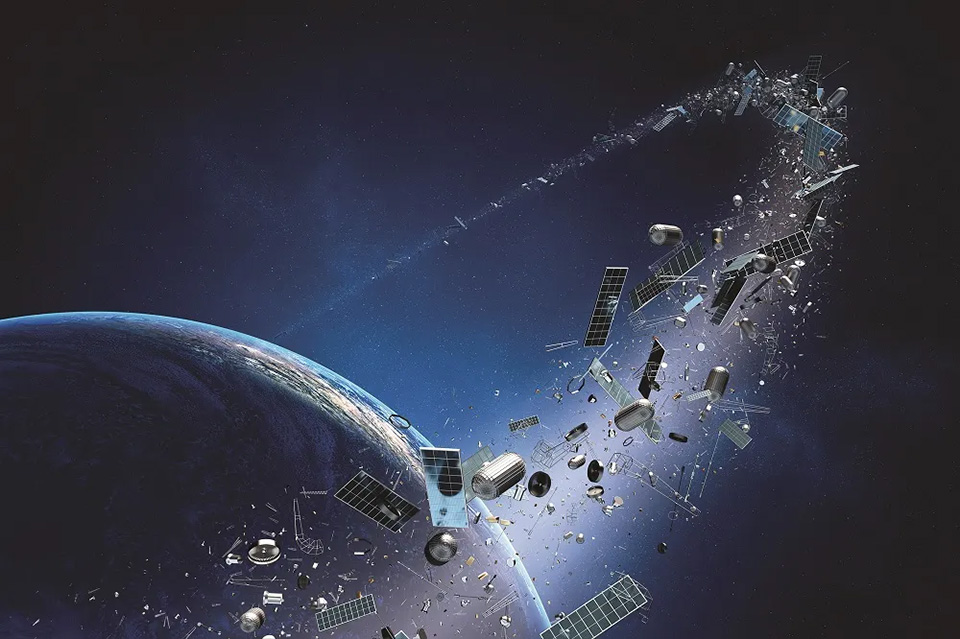
SpaceX says in its filing: “Launching a million satellites that operate as orbital data centers is a first step towards becoming a Kardashev II-level civilization—one that can harness the Sun’s full power-while supporting Al-driven applications for billions of people today and ensuring humanity’s multi-planetary future amongst the stars.”
The plan, if the FCC accepts it, is to operate each satellite in narrow orbital shells and with each craft 50 kms away from its neighbor. The orbits will operate between 500 and 2000 kms. They will each be fitted with laser optical links.
This highly controversial scheme, however, is just the latest in the slew of ambitious filings sitting in the FCC’s or International Telecommunications Union’s applications for satellite capacity.
A few days ago we featured a report from Evan Grey, SatNews’s Legal Contributor, who examined in detail China’s 200,000 satellite filings with the International Telecommunications Union (ITU) for two LEO constellations.
The problem is that these latest Chinese filings are just the tip of an iceberg. Jonathan McDowell, an astrophysicist and very detailed observer of all things satellite, has analysed the filing ‘in tray’ of the ITU and – with some reservations – says that the total of applications to launch satellites numbers lodged with the ITU now numbers 746,909 craft. Now, the ITU must add SpaceX’s application.
The numbers are staggering, and if all the filings happen then the skies will certainly be filled with smallish satellites.
But many, many, of the plans have yet to happen, and some cases will not happen.
For example, McDowell says that Greg Wyler, a serial satellite entrepreneur (and original founder of OneWeb and O3b) and enthusiastic supporter of Rwanda’s E-Space/Semaphore system (of 116,640 satellites), and the separate Cinnamon-937 system (of 337,323 satellites), is not now expected to go ahead. But the filings remain and have not been cancelled.
China, as we have mentioned, is also extremely vigorous with its satellite planning. China’s CTC1 constellation covers 96,714 satellites. CTC2 includes planning for another 96,714 craft. China’s HH3/Hongqing Tech Honghu-3 system covers 10,000 satellites, while Chinese Guowang Constellation has filings for 12,992 craft. China’s Xingwang plans 970 satellites of which 183 are launched and 103 operational. China’s Galaxy Space Yinhe constellation plans 1000 satellites of which just 8 are launched. China’s Xingwang plans 970 of which 103 are operational. China’s Quinfan has 78 operational satellites.
Most of the proposed ITU constellations were filed by China (about 65) and the United States (about 45); however, very large (>10,000 satellite) constellations have also been filed by Rwanda, Germany, Spain, Norway, France, and Solomon Islands. The ‘operating agencies’ for the 20 largest constellations come from nine nations and include well-established satellite companies, start-ups, and government agencies, according to the Outer Space Institute (OSI) and its examination of the problem.
The OSI data tends only to include those constellations over 300 craft.
South Korea’s telephony giant conglomerate Hanwha wants 2000 satellites.
The other filings are perhaps more robust and well understood. This includes Elon Musk’s Starlink systems, as follows:
Starlink Gen-1: 4408 planned, 2906 operational as at last week
Starlink Gen-2a: 6720 planned, 5377 operational
Starlink Gen-2b: 30,456 planned. Non launched as yet
Back in October 2025 Starlink achieved more than 10,000 of its satellites launched.
The other major players in McDowell’s comprehensive list include:
OneWeb: 643 operational
Kuiper: 3232 planned (104 operational)
Starshield: 135 operational
Lynk: 2000 planned 6 are operational
TeraWave: 5408 planned, non yet launched
Astra: 13.620 planned, non yet launched
Telesat: 300 planned, non yet launched
Hughes HVNet: 1440 planned, non yet launched
SpinLaunch: 1190 planned, non yet launched
Globalstar: 3080 planned, non yet launched
As the OSI points out, the growth of objects in LEO has potentially dangerous consequences. “The environment already contains considerable mass from thousands of operational satellites and tens of thousands of pieces of tracked debris, including defunct satellites and abandoned rocket bodies. It is estimated that there are millions of pieces of smaller, untracked and potentially dangerous debris.
The addition of hundreds of thousands of new satellites would greatly increase the complexity of operations and the risk of on-orbit collisions. Moreover, re-entries from medium-to-large satellites and the rocket bodies used for launches would pose a growing risk to people on the ground, at sea and in aircraft. Light reflecting off satellites would continue to disrupt astronomy through streaks and glints, while radio astronomy would become further limited by transmissions and electronics noise.
Elon Musk’s SpaceX has stressed the number of orbital manoeuvres his Starlink satellites have had to make. In the half-year to November 30 there were 148,696 collision manoeuvres. Indeed, SpaceX listed its “Table of Shame” of alleged errant operators and reported the problem to the FCC.
“The inconsistent availability of high-quality ephemerides, particularly from operators of manoeuvring satellites, increases overall collision risk,” SpaceX said in its December 31 2025 update to the FCC. Quite what an extra 1 million craft would do the risk analysis is just about anyone’s guess.
The problem – perhaps for both the ITU and FCC – is that neither organisation has any real teeth to clamp down on these problem operators.
An orbital collision, especially in a well-populated orbit, would be catastrophic for operators, and their ground-based clients.