
HAWTHORNE, California – In a move that significantly expands its orbital footprint, SpaceX submitted an application to the Federal Communications Commission (FCC) on Friday, January 30, to deploy a massive constellation of up to one million satellites dedicated to space-based data processing.
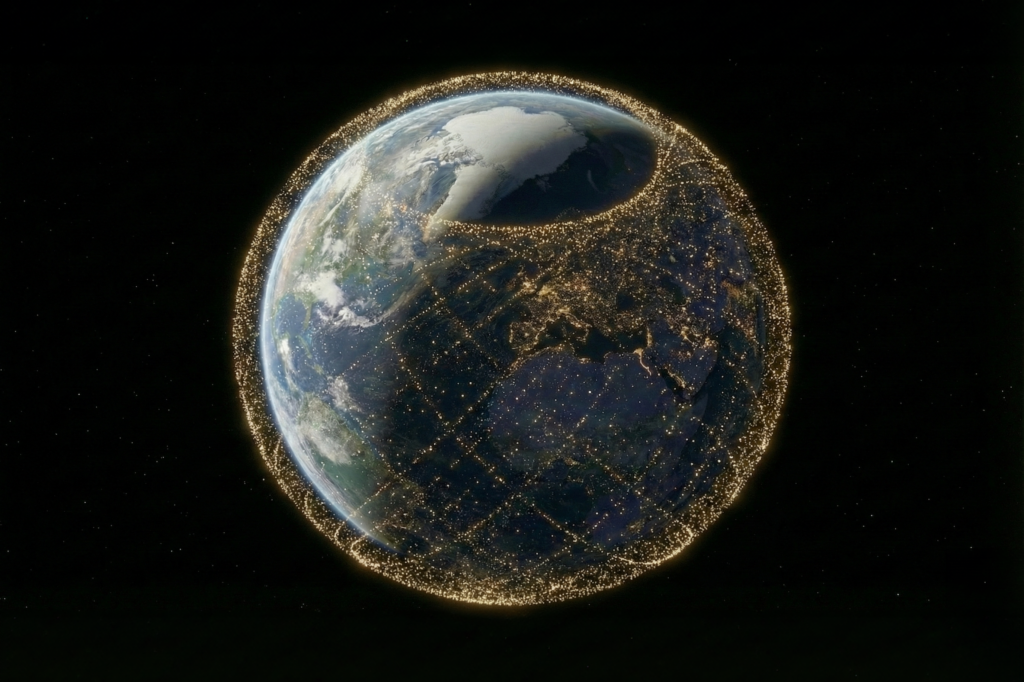
The proposed Orbital Data Center network is designed to mitigate the power and cooling constraints facing terrestrial AI infrastructure by leveraging near-continuous solar energy in Low Earth Orbit (LEO). This filing follows a period of rapid growth for the company’s existing broadband division, which recently celebrated its 11,000th Starlink satellite launch.
Shift Toward In-Orbit AI Compute
The application describes a system of satellites acting as distributed processing nodes, specifically optimized for large-scale AI inference. By moving compute-heavy workloads to orbit, SpaceX aims to bypass the rising electricity costs and grid limitations that have begun to hamper the expansion of terrestrial data centers.
The filing suggests the constellation will utilize narrow orbital shells, each approximately 50 km thick, at altitudes between 500 km and 2,000 km. This modular architecture is intended to minimize interference with existing LEO operators while maximizing solar exposure for hundreds of gigawatts of potential compute capacity.

Convergence with xAI and Strategic IPO Plans
The timing of the FCC filing aligns with industry reports of a potential merger between SpaceX and Musk’s artificial intelligence venture, xAI. According to regulatory documents surfaced earlier this week, the combined entity would integrate Starlink’s laser-mesh networking with xAI’s Grok models to provide a vertically integrated space-cloud service.
Tim Farrar, President of TMF Associates and a moderator for the upcoming SmallSat Symposium, characterized the filing as “quite rushed” and likely a narrative tool for SpaceX’s upcoming IPO. Farrar argued the move targets the massive capital needs of xAI rather than broadband expansion, highlighting the technical advantage of SpaceX’s modular Starlink V3 bus over the massive platforms proposed by rivals. He noted the timing helps quiet questions on growth potential as the company eyes an $800 billion valuation.
Technical Infrastructure and Specs
| Specification | Target Parameter |
| Total Satellites | Up to 1,000,000 |
| Orbit Type | LEO (Inclined & Sun-Synchronous) |
| Altitude Range | 500 km – 2,000 km |
| Shell Thickness | 50 km per shell |
| Primary Power | Solar (High-Efficiency Arrays) |
| Backhaul | Optical Laser Inter-Satellite Links (ISLs) |
Executive Perspective
“Space-based compute represents the most efficient path forward for the next generation of artificial intelligence. By utilizing unlimited solar power and the natural cooling of the vacuum, we can deliver processing power that is decoupled from Earth’s increasingly strained energy grids.” — Elon Musk, CEO of SpaceX.
Regulatory and Competitive Landscape
The proposal faces immediate scrutiny from the FCC, now led by Chairman Brendan Carr. Historically, the agency has been cautious with mega-constellation approvals, often granting licenses in smaller tranches, such as the 7,500-satellite authorization granted to SpaceX earlier this month, to monitor collision risks and debris mitigation.
The filing also places SpaceX in direct competition with Blue Origin’s orbital data center initiative, which was unveiled in late 2025. While Blue Origin has focused on radiation-hardened edge compute for government clients, SpaceX’s million-satellite scale signals an intent to capture the broader commercial AI market.
Timeline for Deployment
Pending FCC approval, SpaceX intends to utilize its Starship launch vehicle to deploy the initial shells of the data center constellation. While a specific start date for the million-satellite phase has not been disclosed, the company is expected to begin pilot testing of on-orbit compute nodes on standard Starlink V3 hardware later this year.