
On January 28, 2026, Terran Orbital, a Lockheed Martin Company, announced it has been selected to provide its Nebula satellite bus for the Mitsubishi Electric LEO Demo Mission.
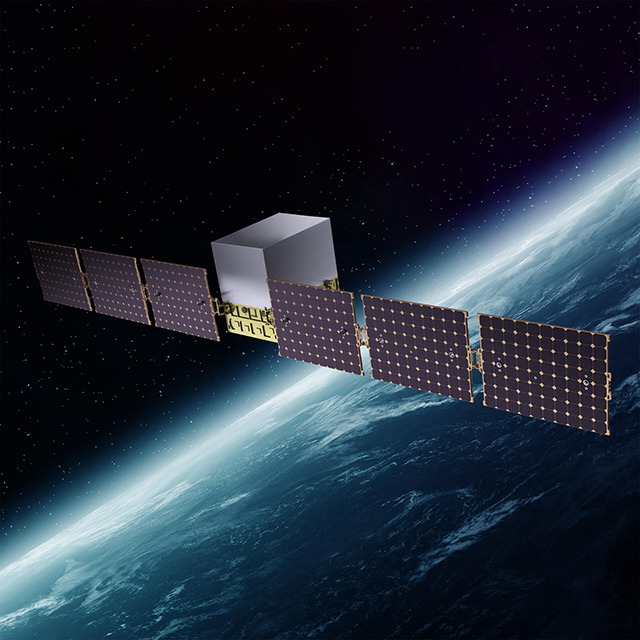
The state-of-the-art project is a collaboration between Mitsubishi Electric Corporation, Mitsubishi Electric US, and the National Institute of Information and Communications Technology (NICT) of Japan.
Advancing Quantum Key Distribution in LEO
The primary objective of the mission is the on-orbit demonstration of a Quantum Key Distribution (QKD) and Optical Terminal payload. This Japanese-led initiative aims to establish provably secure communication links between ground stations and Low Earth Orbit (LEO) satellites by leveraging the principles of quantum mechanics.
The demonstration is a critical step toward the realization of a global quantum internet, addressing the potential vulnerabilities of current encryption methods to future quantum computing attacks.
“This project highlights our commitment to pushing the boundaries of space technology and delivering unmatched solutions for our clients,” stated Peter Krauss, CEO of Terran Orbital.
The Nebula Platform: Versatile and Agile
The mission will utilize Terran Orbital’s Nebula platform, a high-performance microsatellite bus designed for rapid delivery and constellation scalability. The Nebula was previously utilized to fulfill the platform requirements for the Space Development Agency’s (SDA) Tranche 0 Transport Layer.
- Mass Capacity: Supports a wet launch mass of up to 250 kg and available payload mass of up to 130 kg.
- Agility: Equipped with oversized reaction wheels to maintain high-precision pointing accuracy (10 to 50 arcseconds) during optical downlinks.
- Power & Propulsion: Features a 66V power system capable of providing up to 1 kW of solar array power and an integrated Hall-effect propulsion system for station-keeping and disposal.
Timeline to 2029 Operations
The project follows a strict 18-month delivery timeline from the Authorization to Proceed (ATP) agreement. Terran Orbital is scheduled to deliver the completed satellite bus in 2027, with the tentative launch window currently set for 2029.
The collaboration reinforces the growing trend of Western satellite manufacturers supporting sovereign Japanese mission requirements as the APAC region accelerates its adoption of secure, optical-based space architectures.