
Dr. Gladys West, the visionary mathematician whose complex calculations of the Earth’s shape provided the essential foundation for the Global Positioning System (GPS), passed away on January 17, 2026, at the age of 95. Her work in satellite geodesy at the Naval Surface Warfare Center (NSWC) in Dahlgren, Virginia, converted raw satellite data into the high-precision mapping models now used by billions of devices worldwide.
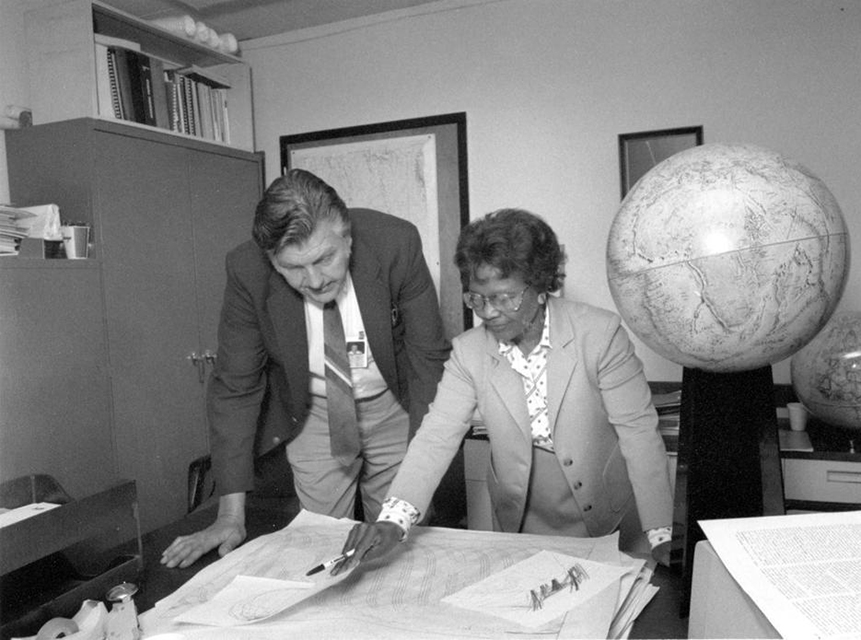
A Legacy of Precision at Dahlgren
Dr. West joined the Naval Proving Ground in 1956 as only the second Black woman hired as a mathematician at the facility. Over a 42-year career, she transitioned from a “human computer” performing hand calculations to a lead programmer for some of the military’s most advanced computing systems.
In the early 1960s, she contributed to a landmark study on the regularity of Pluto’s motion relative to Neptune. However, it was her subsequent leadership on the Seasat and GEOSAT programs that cemented her role in satellite navigation.
The Mathematical Backbone: Creating the Geoid
The primary challenge in developing GPS was that the Earth is not a perfect sphere. Centrifugal force causes it to bulge at the equator and flatten at the poles, creating an irregular shape known as a geoid. To make satellite positioning accurate, West developed algorithms to account for:
- Gravitational Variations: Non-uniform mass distribution across the planet.
- Tidal Forces: The influence of the moon and sun on Earth’s crust and oceans.
- Atmospheric Drag: Forces that slightly shift satellite orbits.
Using the IBM 7030 “Stretch” computer, West and her team delivered the precise mathematical representation of the Earth’s surface required to synchronize satellite signals with ground coordinates.
“When you’re working every day, you’re not thinking, ‘What impact is this going to have on the world?‘” West remarked in a 2018 interview. “You’re thinking, ‘I’ve got to get this right‘”.
Recognition and Industry Impact
Often referred to as a “Hidden Figure” of the space race, Dr. West’s contributions were largely unrecognized by the public until the 2010s. In 2018, she was inducted into the Air Force Space and Missile Pioneers Hall of Fame, one of the service’s highest honors.
Her legacy continues to support the multi-billion dollar geospatial industry, from precision agriculture to autonomous vehicle navigation. Organizations such as the Trimble Foundation have established scholarships in her name at Virginia State University and other institutions to support the next generation of STEM leaders.