
Targeting a growing gap between commercial LEO deployment and space sustainability, a new study led by the International Astronomical Union (IAU) has found that Amazon’s Project Kuiper (Amazon Leo) satellites currently exceed brightness recommendations intended to protect ground-based astronomy.
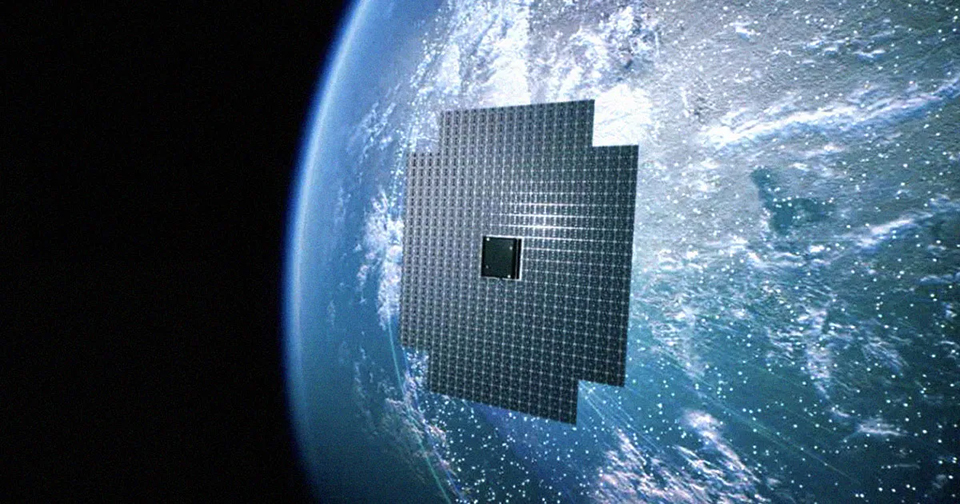
Analyzing nearly 2,000 observations as of January 2026, researchers concluded that 92% of the satellites in their operational phase are brighter than the IAU’s “research limit”.
The IAU Research Limit and Ground-Based Impact
The IAU’s Centre for the Protection of the Dark and Quiet Sky (CPS) established a standardized formula for satellite luminosity: $MV > 7.0 + 2.5 \cdot \log_{10}(\text{altitude} / 550)$. For Amazon’s fleet operating at 630 km (391 miles), this places the acceptable “research limit” at approximately magnitude 7.15.
However, the study found a mean apparent magnitude of 6.28, with approximately 25% of observations recording satellites bright enough to be seen with the unaided eye in dark-sky locations. This level of brightness is particularly disruptive to wide-field surveys like those conducted by the Vera C. Rubin Observatory, where satellite streaks can saturate sensitive digital sensors and permanently corrupt data.
Technical Mitigation: Mirror Films vs. Earth’s Shadow
Amazon has engaged with the astronomical community early in its design phase, employing several mitigation strategies:
- Dielectric Mirror Films: The underside of the spacecraft is coated with a mirror-like film designed to reflect sunlight away from Earth rather than scattering it toward the ground.
- Component Orientation: Adjusting the attitude of the satellite to minimize the surface area of sunlit components visible from the ground.
In contrast, while Starlink satellites are physically larger and orbit at lower altitudes (~550 km), they benefit from being in the Earth’s shadow for a larger portion of their orbit. Amazon’s higher altitude keeps its satellites illuminated for longer periods during twilight—the most critical window for astronomical observations.
Rationale: Regulatory Warfare and Sustainability
As the “Regulatory Warfare” trend intensifies, these findings provide ammunition for groups seeking stricter FCC and international licensing requirements for large-scale constellations. While Amazon’s engineers have successfully reduced reflectivity compared to early prototypes, the sheer volume of the planned 3,236-satellite fleet remains a point of contention for environmental stewardship.
Outlook: Altitude Shifts and Future Visibility
Amazon plans to lower the altitude of future Kuiper satellites to approximately 590 km (366 miles). While lower altitudes decrease the time a satellite is visible during a single pass, they paradoxically increase the apparent brightness for observers directly beneath the orbital path. The IAU and NSF NOIRLab are expected to continue monitoring the constellation as Amazon ramps up its launch cadence toward the FCC’s mid-2026 deployment milestone.