
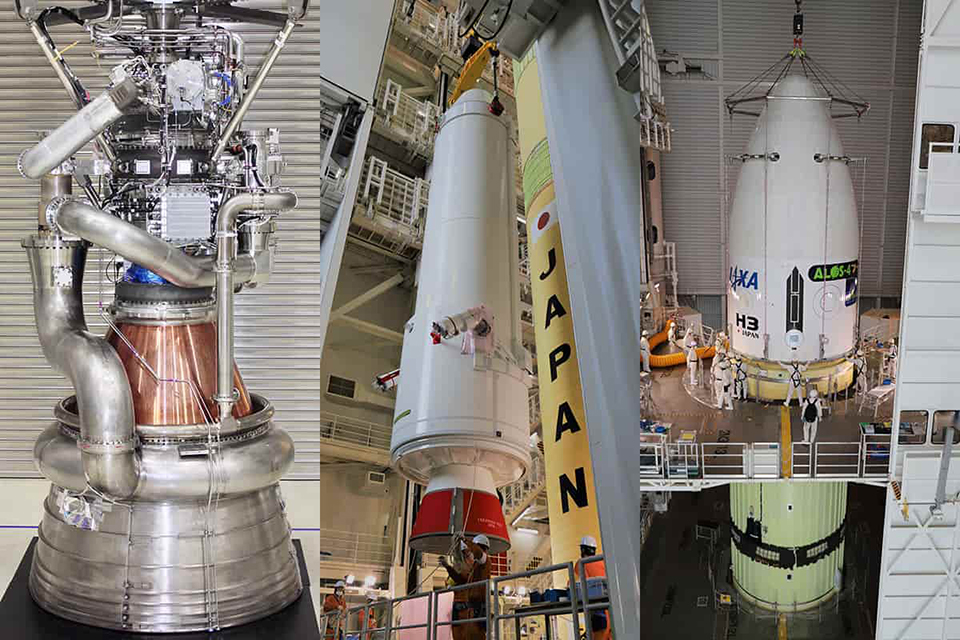
On January 20, 2026, the Japan Aerospace Exploration Agency (JAXA) released a progress report identifying a payload fairing separation anomaly as the root cause of the December 22, 2025, failure of the eighth H3 launch vehicle (H3 F8).
Investigative data suggests that during the fairing separation phase, physical contact or debris damaged the section where the Michibiki No. 5 (QZS-5) positioning satellite was mounted. This mechanical interference subsequently caused the satellite to detach prematurely and inflicted damage on the second-stage engine’s fuel tubing, leading to an early combustion cutoff.
Context: A Critical Blow to Japan’s “Core Rocket” Strategy
The loss of H3 F8 is the second major failure for the flagship series following its 2023 debut, though it follows a string of six successful missions in 2024 and 2025. The failure is particularly significant because it leaves Japan without a high-capacity “core rocket” for immediate service, as the predecessor H-IIA was retired in June 2025. The loss of the Michibiki No. 5 satellite also stalls Japan’s efforts to achieve a seven-satellite sovereign Positioning, Navigation, and Timing (PNT) network, originally slated for completion by March 2026 to reduce reliance on the U.S. GPS system.
Technical Specifications and Damage Assessment
The H3 24L configuration used for the F8 mission was designed to place the 4,000 kg Michibiki satellite into a specific transfer orbit. Telemetry and on-board camera footage confirmed that the first-stage separation proceeded as planned. However, about 3 minutes and 20 seconds into flight, pressure dropped in the second-stage hydrogen fuel tank. JAXA investigators noted that the damage to the mounting section prevented the satellite from remaining attached during the second-stage burn. Both the satellite and the first stage are believed to have impacted the Pacific Ocean near Minamitorishima.
Rationale and Next Steps for the 2026 Manifest
“We want to make every possible effort to determine the cause and use our findings to resume launches soon,” stated JAXA President Hiroshi Yamakawa during a press conference. The agency has suspended all upcoming H3 launches, including the 9th flight (H3 F9) which was scheduled to carry Michibiki No. 7. This suspension poses a high risk to the Martian Moons eXploration (MMX) mission, a high-priority sample-return project currently manifested for a late 2026 launch window. JAXA and Mitsubishi Heavy Industries (MHI) are now focusing on re-engineering the fairing separation mechanism to prevent similar mechanical interference on future flights.