
In a strategic expansion that shifts its focus from launch services to orbital infrastructure, Blue Origin announced on Wednesday, January 21, 2026, the development of “TeraWave”—a multi-orbit satellite communications network.
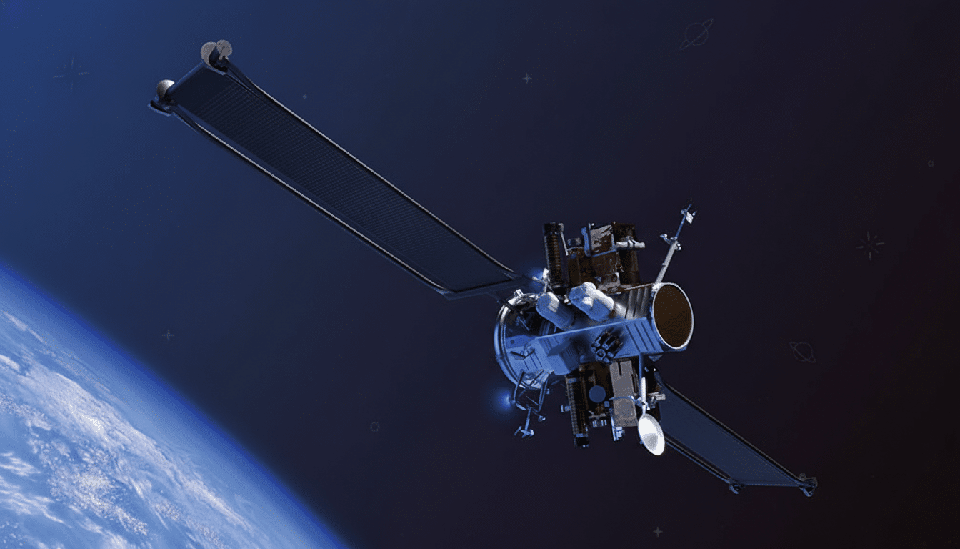
Designed to deliver symmetrical data speeds of up to 6 terabits per second (Tbps), the system targets the high-end backbone needs of data centers, enterprise cloud providers, and government agencies. This initiative marks the first major constellation project under Blue Origin CEO Dave Limp and follows the company’s recent move to scale its national security operations.
A Hybrid Architecture for Massive Data Trunking
Unlike consumer-focused Low Earth Orbit (LEO) constellations, TeraWave utilizes a hybrid orbital strategy to maximize throughput and minimize latency. The system architecture, detailed in Blue Origin’s January 21 announcement, consists of 5,408 optically interconnected satellites.
- LEO Layer: 5,280 spacecraft operating at altitudes between 520 and 540 kilometers. These units will utilize Q/V-band radio frequency (RF) links to provide individual customer connections of up to 144 Gbps.
- MEO Layer: 128 high-capacity satellites positioned in Medium Earth Orbit (MEO) across five altitude shells (8,000 to 24,200 km). This layer serves as the constellation’s optical backbone, capable of handling 6 Tbps for massive data replication and inter-cloud transfers.
Strategic Context: Beyond the Consumer Market
The TeraWave filing explicitly positions the network as an “enterprise-grade” service, distinguishing it from Amazon’s Amazon Leo (formerly Project Kuiper), which is tailored for residential broadband. While Amazon Leo targets 1 Gbps downlink speeds, TeraWave is engineered for 6,000 times that capacity. The timing of the reveal coincides with the December 2025 appointment of former ULA CEO Tory Bruno to lead Blue Origin’s National Security Unit, signaling a direct challenge to SpaceX’s Starshield and specialized government secure-link offerings.
The Rationale for Symmetrical Connectivity
A core differentiator for TeraWave is its focus on symmetrical upload and download speeds—a critical requirement for real-time Internet of Things (IoT) data transfers, AI-driven edge computing, and predictive maintenance in remote industrial sites. By utilizing laser inter-satellite links (ISLs) to move data across the constellation rather than routing through ground stations, Blue Origin aims to bypass terrestrial fiber bottlenecks and provide “route diversity” for global hubs.
Deployment Timeline and Launch Strategy
Deployment of the first TeraWave satellites is scheduled to commence in the fourth quarter of 2027. Blue Origin intends to leverage its heavy-lift New Glenn vehicle, which features a 7-meter fairing capable of housing larger satellite batches compared to current industry standards. According to CEO Dave Limp, the network is designed for “rapid global deployment” and will limit its initial user base to approximately 100,000 high-capacity customers to ensure sustained performance without the congestion issues often associated with residential megaconstellations.