
KENT, Wash. — Blue Origin has successfully completed direct field acoustic testing (DFAT) on its Blue Moon MK1 lunar lander, a critical flight-qualification milestone that validates the vehicle’s ability to withstand the intense sound pressure of launch on the New Glenn rocket.
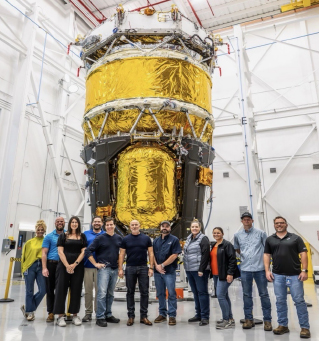
The campaign, confirmed last week by Blue Origin CEO Dave Limp, utilized a portable, high-intensity loudspeaker array to simulate the ascent environment, replacing traditional shaker-table methods for the massive lunar vehicle.
The testing was conducted on a fully integrated Blue Moon MK1 in a “flight-like” configuration, with tanks pressurized using helium and nitrogen, batteries powering the vehicle, and active avionics and guidance systems. This qualification step is essential for the MK1, which is slated to support NASA’s commercial lunar payload needs and future Artemis logistics.
Replacing the Reverberant Chamber
Historically, spacecraft acoustic testing required transporting hardware to large, fixed concrete reverberant chambers. To accommodate the scale of the Blue Moon lander, Blue Origin utilized Direct Field Acoustic Testing (DFAT), a method where the test facility is effectively built around the spacecraft.
According to MSI-DFAT, the company that pioneered the technology with NASA in 1999, the setup involves a modular Noise Generation System (NGS) composed of portable loudspeaker towers. A closed-loop control system continuously monitors sound pressure via microphones distributed around the test article, adjusting loudspeaker output in real-time to match the required launch spectrum.
Bradley Hope of MSI-DFAT noted that this method allows for on-site testing inside existing Assembly, Integration, and Test (AIT) facilities. “Clients don’t want a drill – they want a hole,” Hope said, emphasizing that the primary value is eliminating the transportation risk and schedule delays associated with moving fragile, high-value hardware to offsite chambers.
Test Specifications and Execution
For the Blue Moon MK1 campaign, the lander was surrounded by a ring of 34-foot tall loudspeaker towers designed to generate a near-diffuse acoustic field. The system produced an Overall Sound Pressure Level (OASPL) exceeding 138 decibels, matching the acoustic environment inside the New Glenn payload fairing.
- Instrumentation: 43 triaxial accelerometers measured the vehicle’s response during a two-minute exposure at proto-qualification levels.
- Capacity: Current DFAT systems can generate peak sound pressure levels of approximately 151 dB, limited primarily by loudspeaker mechanics and physics.
- Frequency Range: The technology covers high-intensity vibro-acoustic testing from frequencies below 20 Hz to above 28,000 Hz.
Acoustic Loads vs. Shaker Tables
The industry is increasingly moving away from shaker-table vibration testing for large structures where the primary environmental driver is acoustic energy.
“Because the lander’s vibration environment is driven by acoustic loads, this test replaces traditional shaker-based vibration testing and more accurately represents ascent conditions,” said Dave Limp, CEO of Blue Origin.
MSI-DFAT indicated that direct field testing also allows for the generation of non-diffuse or tailored acoustic fields, which can reproduce specific zonal differences on a spacecraft—a capability difficult to achieve in reverberant chambers where sound waves bounce uncontrollably off walls.
Future of Vibration Testing
The qualification of the Blue Moon MK1 highlights a broader shift in spacecraft verification toward portable, software-driven systems. Future innovations in the sector include the use of Multi-Input Multi-Output (MIMO) narrowband control and the integration of “digital twins,” where numerical models and real-time test data are linked to accelerate qualification.
Following the acoustic campaign, the Blue Moon MK1 will proceed to thermal vacuum chamber testing at NASA’s Johnson Space Center.