
SatNews Editorial Analysis
Executive Summary
The Event: The FCC’s December 16, 2025, grant of the SpaceX/T-Mobile Supplemental Coverage from Space (SCS) license officially graduated Direct-to-Device (D2D) from a beta experiment to a commercial utility.
The Trigger: The license authorizes a Power Flux Density (PFD) of approximately -110.6 dBW. This is a “signal punch” necessary for indoor connectivity, significantly “louder” than the conservative -120 dBW baseline that incumbents fought to maintain.
The War: The legal battle for access is over, but the enforcement war has just begun. The core conflict has shifted: it is no longer about whether the signal is too “loud” in theory, but whether SpaceX’s adaptive beamforming can coexist with the “static” reality of competitor networks.
The Deafening Silence of Success
The champagne corks popped in Bellevue and Hawthorne on December 16, 2025. But SpaceX’s victory came with a catch: to make Direct-to-Device work indoors, the FCC had to let them “shout”—authorizing -110.6 dBW/m²/MHz, roughly 10x louder than the limit competitors claimed was safe.
This decision marks the end of the permission phase of the D2D revolution and the beginning of the enforcement phase. The battle is no longer about getting to the launchpad; it is about whether smart beamforming can actually cheat the traditional laws of interference, or if physics will force a retreat.
The Decibel Dilemma: Safety Shield or Competitive Moat?
For years, the baseline assumption for SCS was a PFD limit of -120 dBW/m²/MHz. Incumbents like AT&T and Verizon championed this “whisper” standard as essential to protect their networks. However, insiders have long argued this limit was less about safety and more about a “poison pill” designed to keep satellite competitors out of the indoor market.
Physics is stubborn: a -120 dBW signal loses 20-30 dB passing through modern building materials, rendering indoor service impossible without line-of-sight. By strictly enforcing this limit, incumbents ensured D2D remained a niche, outdoor-only novelty.
By authorizing the higher -110.6 dBW limit, the FCC didn’t just turn up the volume; they rejected that gatekeeping. They effectively sided with the “Un-carrier” philosophy, betting that the noise floor isn’t a glass ceiling that shatters when touched, but a flexible barrier that can be managed with advanced technology.
The Gamble: Smart Beams in a Crowded Room
Critics describe the new power limit as shouting in a library, but SpaceX engineers argue they are using a sniper scope, not a megaphone.
Unlike the dumb broadcast satellites of the past, Starlink’s Gen2 satellites use advanced beamforming and dynamic power control. They don’t flood the entire 1.9 GHz band indiscriminately; they aim energy precisely at the subscriber. Theoretically, a Starlink satellite can shout at a user in a basement while whispering to a Verizon tower three miles away.
But this is where the gamble lies. This dynamic management requires perfection. If a side-lobe (energy leaking from the edge of the beam) sweeps across a sensitive urban cell tower, or if the beam fails to dim instantly when a tower is detected, that sniper shot becomes a chaotic burst of noise. The FCC is betting on SpaceX’s software; the incumbents are betting on the chaos of reality.
The Enforcement Trap: Weaponizing the “Kill Switch”
The opposition has shifted tactics from blocking licenses to weaponized compliance. The new license contains a standard but potent clause: SpaceX must cease operations immediately if harmful interference occurs. Expect 2026 to be defined by how incumbents exploit this single sentence.
The war will be fought over the definition of “harm.” Modern terrestrial networks are resilient; technologies like Hybrid Automatic Repeat Request (HARQ) allow them to heal corrupted data packets instantly. A millisecond of satellite noise might go unnoticed by a user, but it will be logged by a Verizon spectrum analyzer. Competitors like Viasat and DISH are already positioning to claim that even a 1% drop in throughput constitutes exclusionary interference, effectively trying to trigger the kill switch on technicalities.
It would be a mistake to assume AT&T and Verizon are helpless targets. Both have their own orbital plays—AT&T with AST SpaceMobile and Verizon with its recent AST deal—but their architectures are fundamentally different. AST’s massive phased arrays (like the recently launched BlueBird 6) rely on sheer antenna gain rather than the raw transmit power SpaceX uses. This allows them to argue they are operating “cleanly” while accusing SpaceX of “shouting.”
The conflict is best visualized in a scenario like downtown Chicago: A Starlink satellite train passes overhead every 90 minutes. Even if SpaceX’s adaptive beams work 99% of the time, a 1% error rate could mean dropped calls for 7 minutes. The question isn’t whether this could happen—it’s whether the FCC will blame SpaceX for the noise or tell Verizon their network should be tougher.
The Uncertainty Principle
The honest answer? We have left the realm of theory. SpaceX’s interference models promise perfect coexistence through “adaptive” physics. AT&T’s models predict the noise floor will be overwhelmed.
But the real gamble isn’t just about whether the technology works; it is about what we are willing to tolerate. By siding with New Space, the FCC has likely authorized a controlled degradation of terrestrial networks. They are betting that a minor rise in the noise floor, invisible to users but painful to carrier capacity, is an acceptable trade-off for universal coverage. We are now in a live experiment with millions of American smartphones as the test subjects.
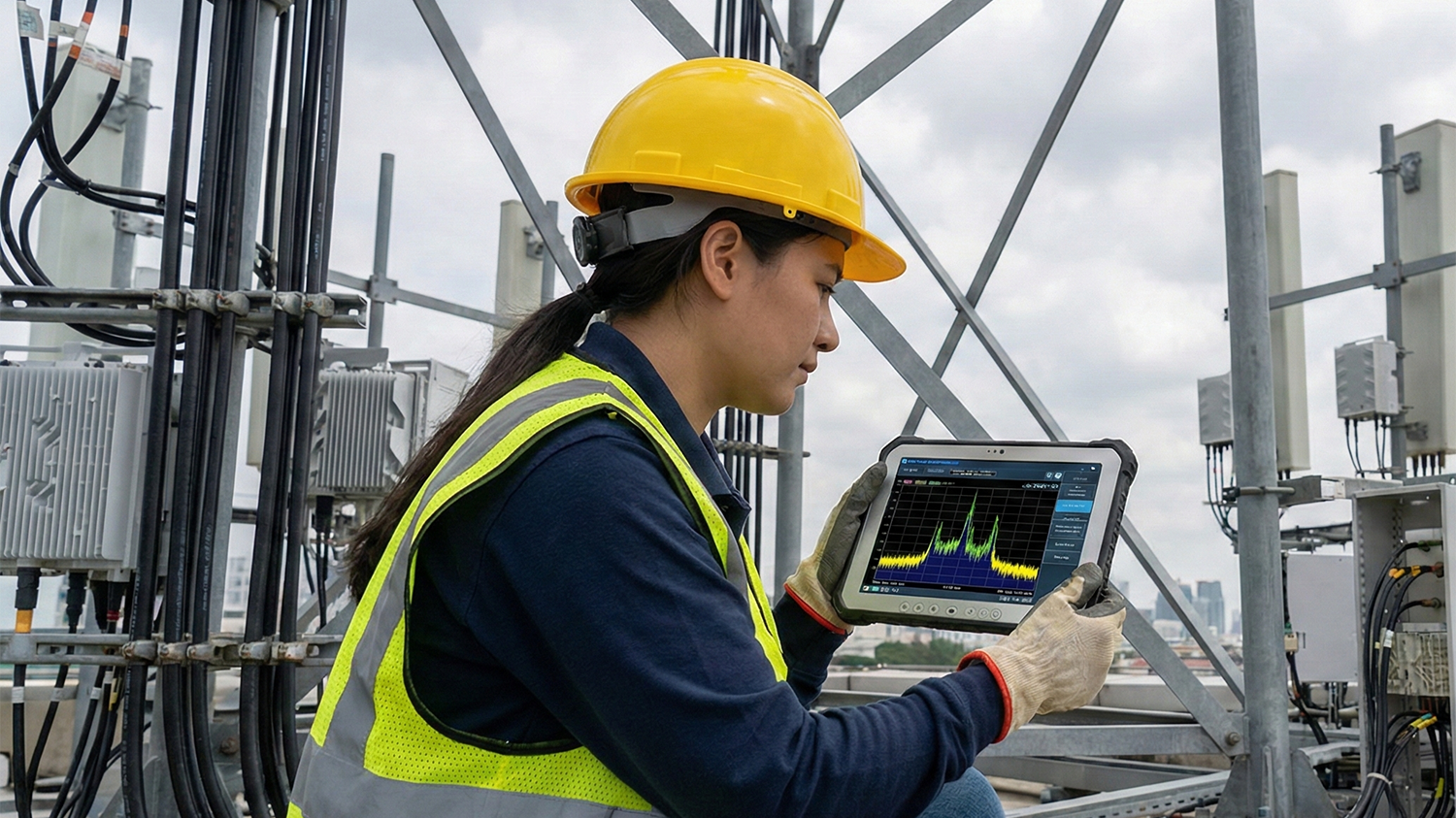
The verdict won’t be decided in a hearing room. It will be decided by the spectrum analyzers on cell towers across America. If the adaptive beams hold the noise to a manageable whisper, we enter a new era of dynamically shared spectrum. But if the degradation spirals beyond controlled into chaotic, the enforcement war will be swift and brutal.
Forecast: The Year of the Noise Floor
Watch for three flashpoints in 2026. First, the initial harmful interference complaint, likely from Verizon in Q1 as T-Mobile’s service density increases. Second, the technical battle over HARQ data, where SpaceX will claim the networks are healing themselves while competitors claim the noise floor is rising. Third, AST SpaceMobile’s competing launch—if their low-power approach works, it undermines SpaceX’s entire justification for the higher PFD limit.
The FCC has opened the door. Now, physics and technology get the final vote.