

CAMBRIDGE, Mass. — Diffraqtion, an MIT and University of Maryland spinout, announced on Tuesday, January 13, 2026, that it has raised $4.2 million in combined pre-seed funding and a DARPA SBIR Phase 2 contract.
The capital will accelerate the development of the company’s novel “quantum camera” technology, designed to provide high-resolution imaging and Space Domain Awareness (SDA) capabilities that bypass traditional optical limits.
The company is currently collaborating with the U.S. Space Force’s Apollo Accelerator and the Space Systems Command (SSC) TAP Lab to integrate its sensor data into military space defense architectures.
Overcoming the Diffraction Limit in Orbital Imaging
Current satellite and telescope systems are constrained by the “diffraction limit,” a physical boundary that dictates the maximum resolution a lens can achieve based on its size. To see smaller objects, traditional satellites require increasingly large and expensive mirrors.
Diffraqtion’s quantum camera utilizes photon-counting sensors and proprietary AI algorithms to extract up to 95% more information from incoming light than standard CMOS or CCD sensors. This allows for:
- Super-Resolution Imaging: Achieving high-fidelity details from significantly smaller and lighter payloads.
- Low-Light Performance: Capturing clear images in extreme low-light environments, such as the Moon’s shadowed regions or high-altitude orbits.
- Real-Time On-Orbit Processing: Moving from raw data downloads to localized “Orbital Edge AI” to provide immediate actionable intelligence.
Strategic Rationale and Military Applications
The $1.5 million DARPA contract specifically funds “on-sky” demonstrations using ground-based telescopes, a precursor to deploying the technology on a dedicated satellite constellation. This capability is of high interest to the Department of Defense for Space Domain Awareness (SDA), where identifying and tracking small or stealthy objects in crowded orbital shells is critical for mission survival.
The company’s technology is also being evaluated for the Habitable Worlds Observatory, the planned successor to the James Webb Space Telescope, illustrating the broad applicability of quantum sensing in both national security and deep-space exploration.
Executive Perspective on Quantum Sensing
“Our goal is to change how we see and understand space by moving beyond the constraints of classical photography,” said Johannes Galatsanos, Co-Founder and CEO of Diffraqtion. “By combining quantum mechanics with advanced AI at the orbital edge, we are providing the high-resolution ‘answers’ that operators need, rather than just raw images that require hours of ground-side processing.”
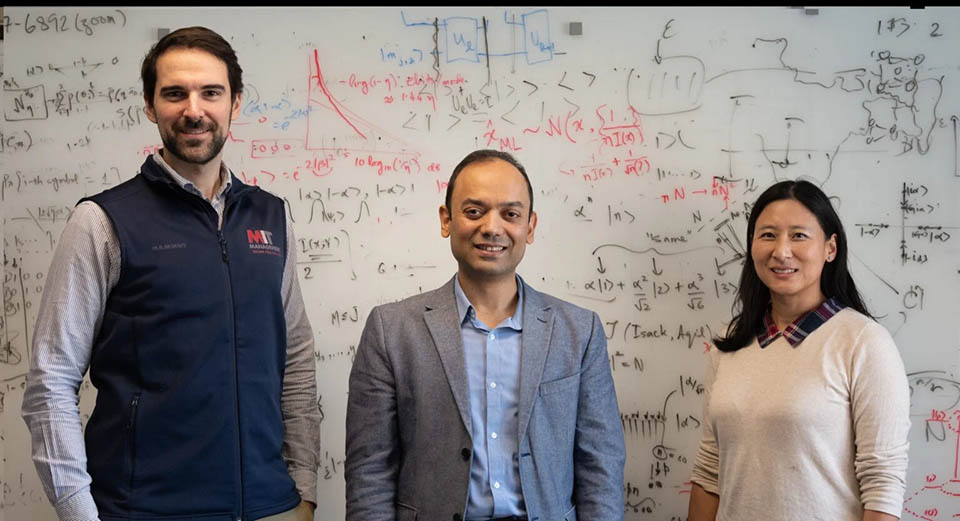
Galatsanos, an MIT and Oxford graduate, emphasized that the current pre-seed round will allow the company to expand its engineering team in Cambridge and prepare for initial orbital flight tests.
Outlook for 2026–2030 Deployment
Following the completion of the two-year DARPA contract in 2027, Diffraqtion plans to transition its quantum cameras from ground-based demonstrators to a pilot satellite mission. The company aims to have its first tranche of quantum camera-enabled satellites in orbit by 2030, potentially setting a new standard for Earth observation and tactical reconnaissance.
Further demonstrations are scheduled for next month to validate the core hypothesis of the quantum imaging system under atmospheric turbulence, a key hurdle for ground-to-space SDA applications.