
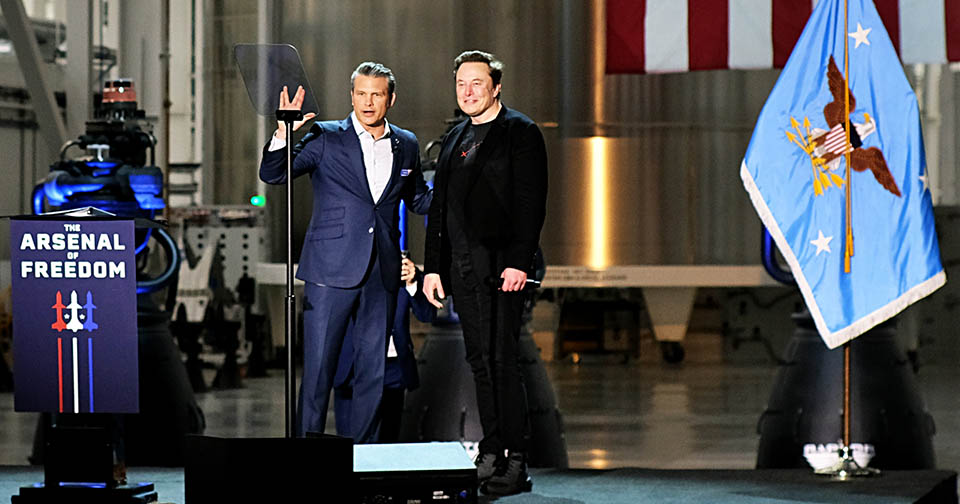
BROWNSVILLE, Texas — Secretary of Defense Pete Hegseth visited the SpaceX Starbase facility on Tuesday, January 13, 2026, to announce a fundamental restructuring of the American military’s technological procurement.
Speaking alongside SpaceX CEO Elon Musk, Hegseth outlined an “AI-first” transformation designed to operate at wartime speed, explicitly citing SpaceX’s rapid prototyping and “fail fast” methodology as the new blueprint for the Department of War.
The visit is a centerpiece of the “Arsenal of Freedom” industry tour, which included a stop at Lockheed Martin’s F-35 facility in Fort Worth just 24 hours prior. During the Starbase event, Hegseth confirmed the appointment of Emil Michael as the department’s sole Chief Technology Officer (CTO), tasked with dismantling the “bureaucratic underbrush” that has historically slowed the deployment of space and AI assets.
Transition to the Warfighting Acquisition System
The visit marks the operational phase of the Warfighting Acquisition System, a policy overhaul announced by the Department of the Air Force on January 8. This mandate shifts the acquisition culture from compliance-based oversight to a dynamic model that prioritizes the speed of delivery over “exquisite” multi-decade development cycles. Under this new framework, Program Executive Officers have been redesignated as Portfolio Acquisition Executives (PAEs), granted the authority to make immediate trades between cost and performance to meet urgent warfighter needs.
This structural shift aligns with the administration’s broader “Golden Dome” initiative, which seeks to field a proliferated layer of space-based interceptors and sensors. By leveraging commercial manufacturing scales seen at Starbase, the Department of War aims to bypass legacy prime contractors that Hegseth characterized as “risk-averse.”
Deployment of Grok and Gemini Military AI
A critical technical pillar of the Starbase announcement is the immediate integration of xAI’s Grok and Google’s Gemini into military networks. Hegseth directed the Chief Digital and Artificial Intelligence Office (CDAO) to enforce “data decrees” that will make combat-proven intelligence available across federated IT systems for AI exploitation.
Technical specifications for the AI rollout include:
- Security Clearance: Deployment at Impact Level 5 (IL5), enabling the secure handling of Controlled Unclassified Information (CUI).
- Network Reach: Integration across both unclassified and classified Pentagon networks by the end of January 2026.
- Operational Intent: Utilizing Grok’s “anti-woke” architecture to provide tactical analysis without the ideological constraints found in rival consumer-grade models.
Perspective on Bureaucratic Disruption
“Winning requires a new playbook. Elon wrote it with his algorithm—question every requirement, delete the dumb ones, and accelerate like hell,” said Secretary Pete Hegseth. “In modern warfare, the fastest innovator and iterator will be the winner, and no one can out-innovate an American entrepreneur who has been liberated from the constraints of cycling bureaucracy. We are clearing the debris, Elon-style, with a chainsaw.”
Hegseth’s remarks underscored a pivot toward the “Musk Stack”—a vertically integrated approach to defense where launch, connectivity, and intelligence are treated as a singular, rapidly evolving ecosystem rather than isolated government programs.
Outlook for National Security Space Launch
As the Department of War moves to operationalize these reforms, industry watchers are focusing on the 2027 “fly-off” for the next generation of space-based interceptors. The Starbase visit reinforces the military’s intent to utilize Starship as the primary heavy-lift platform for the 480-satellite MILNET constellation, a partnership intended to secure American orbital dominance.
The successful integration of commercial AI into the Pentagon’s core signifies a permanent shift toward the “sovereign-commercial nexus,” where the distinction between private innovation and national defense continues to blur.