
VANDENBERG SFB, Calif. — On Sunday, January 11, 2026, SpaceX successfully launched the “Twilight” rideshare mission, delivering a diverse manifest of commercial and government payloads to a dawn-dusk Sun-Synchronous Orbit (SSO).
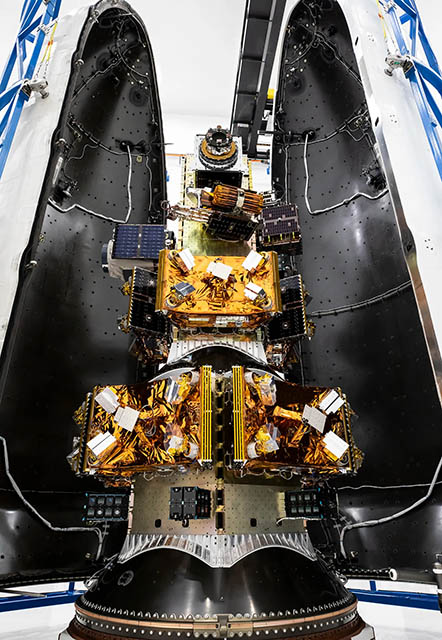
The Falcon 9 rocket lifted off from Space Launch Complex 4E at 5:44 a.m. PT, marking a major initial milestone for the 2026 small satellite launch calendar.
Berlin-based Exolaunch coordinated the deployment sequence for 22 spacecraft, representing the integrator’s 42nd mission to date. The deployment phase commenced approximately one hour after liftoff, successfully separating payloads for several high-profile constellation operators.
Strategic Dawn-Dusk Orbital Regime
The mission targeted a specific dawn-dusk SSO, an orbital regime where satellites ride the terminator line between day and night. This positioning ensures near-continuous sunlight for solar power generation, which is essential for energy-intensive operations.
Satellites in this orbit benefit from:
- Continuous Power: Steady solar exposure for high-performance payloads.
- Thermal Stability: Reduced thermal cycling compared to standard LEO orbits.
- Mission Optimization: Ideal conditions for synthetic aperture radar (SAR) and optical communications systems.
Payload and Manifest Breakdown
The manifest included critical infrastructure for four major organizations, ranging from industrial telecommunications to exoplanet research:
- Kepler Communications: Launched its first tranche of 10 optical relay satellites to establish a real-time, SDA-compatible data network.
- HawkEye 360: Deployed “Cluster 13,” a trio of formation-flying satellites designed for global radio frequency (RF) geolocation and ISR requirements.
- DCUBED: Launched Araqys-D1, a 3U CubeSat intended to demonstrate in-space manufacturing by constructing a 30-centimeter truss in orbit.
- NASA: Deployed the Pandora SmallSat, a mission dedicated to studying the atmospheric compositions of exoplanets.
Perspective on In-Space Manufacturing
The DCUBED demonstration represents a technical shift toward orbital construction capabilities. By manufacturing structural components in space, the industry aims to bypass the size constraints imposed by rocket fairings.
“We want to make unlimited power in space a reality,” said Thomas Sinn, CEO of DCUBED. “That’s the whole idea: to bring the dollar per watt down into the double digits“.
Post-Deployment and 2026 Outlook
Following the successful separation, mission operators have established contact with their respective assets and commenced the commissioning phase. Kepler Communications confirmed that its initial 10 optical satellites are healthy and transitioning into operational service.
Exolaunch has indicated that this mission is the first of more than 20 deployments planned for its 2026 manifest. The company is currently scaling its Berlin operations to accommodate the increasing global demand for rideshare launch slots.