
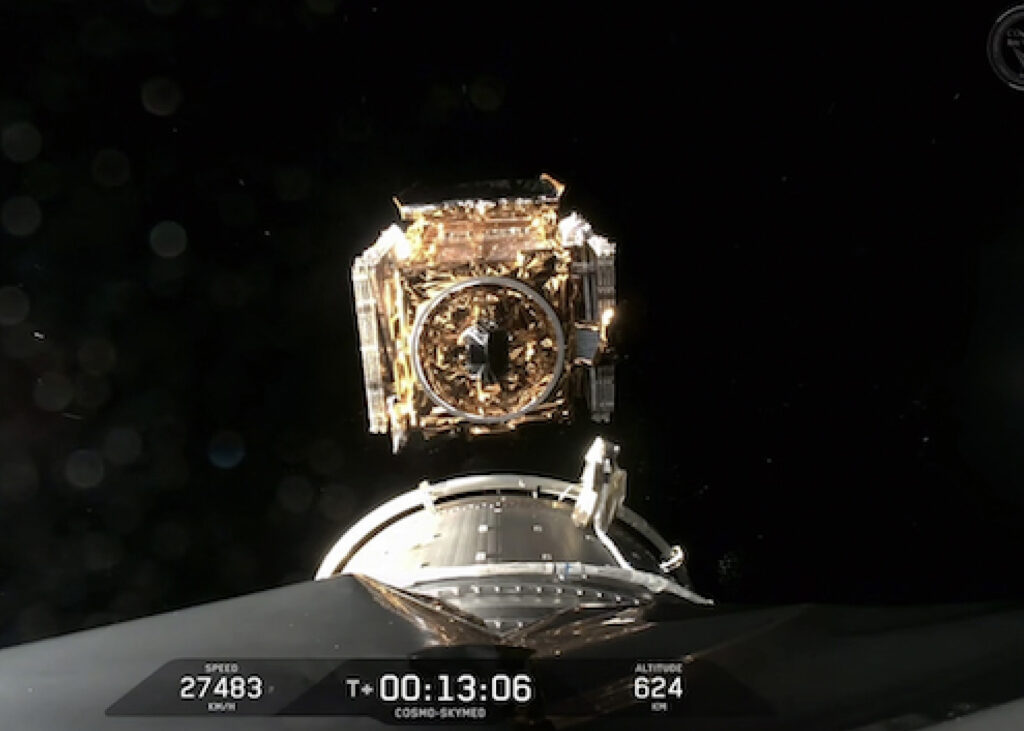
January 3, 2026 — The third satellite of the COSMO-SkyMed Second Generation (CSG) constellation was successfully launched on January 3, 2026, at 2:09 AM UTC (January 2, 6:09 PM PT) from Vandenberg Space Force Base in California. The satellite, built by Thales Alenia Space for the Italian Space Agency (ASI) and the Italian Ministry of Defense, was carried into orbit aboard a SpaceX Falcon 9 rocket.
Control of the spacecraft was established 59 minutes after separation when its signal was acquired by Telespazio’s Fucino Space Centre in Abruzzo, Italy. The successful deployment marks the third of four planned second-generation radar satellites designed to provide high-resolution Synthetic Aperture Radar (SAR) data for dual-use civil and military applications.
Technical Specifications and Capabilities
The CSG satellites are based on the PRIMA platform and are designed to progressively replace the first-generation COSMO-SkyMed system, which has been operational since 2007.
Key technical features of the CSG-3 satellite include:
- Payload: An X-band SAR instrument with a maximum radar bandwidth of 400 MHz.
- Resolution: The system offers multiple imaging modes, including a military-only “Spotlight-1” mode and a “Spotlight-2” mode providing sub-metric resolution (0.3m x 0.5m).
- Orbit: Circular sun-synchronous dawn-dusk orbit at a nominal altitude of 619 kilometers and an inclination of 97.86 degrees.
- Daily Capacity: Capable of collecting up to 450 to 520 images per day per satellite.
- Mass: Approximately 2,240 kilograms.
Strategic Context and Program Management
The COSMO-SkyMed Second Generation program is a flagship of the Italian space industry, reflecting a collaborative effort between institutional owners and industrial partners. Thales Alenia Space, a joint venture between Thales (67%) and Leonardo (33%), serves as the prime contractor responsible for the entire system. Telespazio (Leonardo 67%, Thales 33%) is responsible for the ground segment and orbital operations.
“Being responsible for the overall COSMO-SkyMed Second Generation program, Thales Alenia Space is extremely proud of this successful launch,” said Giampiero Di Paolo, CEO of Thales Alenia Space in Italy. “Once fully deployed with its four satellites, it will provide substantial technological and performance progress, strengthening Thales Alenia Space’s global leadership in space-based Earth observation infrastructure”.
The system supports a wide range of applications, including environmental monitoring, disaster response via the European Copernicus Emergency Rapid Mapping service, and national security operations. To date, the constellation has archived more than 4.3 million radar images over nearly two decades of operation.
Timeline and Future Milestones
The CSG-3 satellite is now entering its Launch and Early Orbit Phase (LEOP), which is expected to last approximately nine days. During this period, engineers at the Fucino Space Centre will perform critical system checks, deploy the SAR antenna, and begin the In-Orbit Testing (IOT) and commissioning phases.
The final configuration of the second-generation system will feature four satellites phased in the same orbital plane. The fourth and final satellite of the CSG constellation is currently in production and is expected to complete the deployment, further enhancing revisit times and imaging flexibility for global users.