
By Abbey White, Staff Writer, SatNews
Executive Summary
- Strategic Expansion: Space Launch Delta 30 (SLD 30) has issued a Request for Information (RFI) for Space Launch Complex 14 (SLC-14), explicitly seeking a “heavy or super-heavy” launch provider.
- The “Not-SpaceX” Clause: The solicitation prioritizes increasing the “pool of Launch Service Providers (LSPs)” and targets vehicles “not currently operational at VSFB,” signaling a clear intent to diversify away from total reliance on the Falcon ecosystem.
- Timeline Reality: With requirements for a full Environmental Impact Statement (EIS) and infrastructure development on raw land, operational capability is likely pushed to the late 2020s.
The Signal
In a move that signals a shift in the Pentagon’s long-term orbital logistics strategy, Space Launch Delta 30 (SLD 30) released a Request for Information (RFI) soliciting industry interest in Space Launch Complex 14 (SLC-14) at Vandenberg Space Force Base.
While ostensibly a standard real estate transaction, the document serves as a strategic roadmap for the US Space Force’s (USSF) efforts to secure heavy-lift capacity for polar orbits while reducing its exposure to a single vendor. The RFI explicitly calls for a “heavy or super-heavy” launch vehicle, defined as capable of lifting 20,000 kg to over 50,000 kg, and demands that the tenant be capable of commencing operations within five years.
Breaking the Vertical Monopoly
The timing of this solicitation aligns with broader industry anxieties regarding the consolidation of defense capabilities into a single “verticalized” stack. The Department of Defense is increasingly wary of vendor lock-in, where a single entity controls the value chain from launch to satellite bus.
The RFI language is unusually transparent regarding this friction. It states that the nation benefits from “diverse launch systems… to mitigate the impact of vehicle/infrastructure anomalies, work stoppages, and supply chain disruptions”. To achieve this, SLD 30 aims to allocate the site to a vehicle “not currently operational at VSFB”.
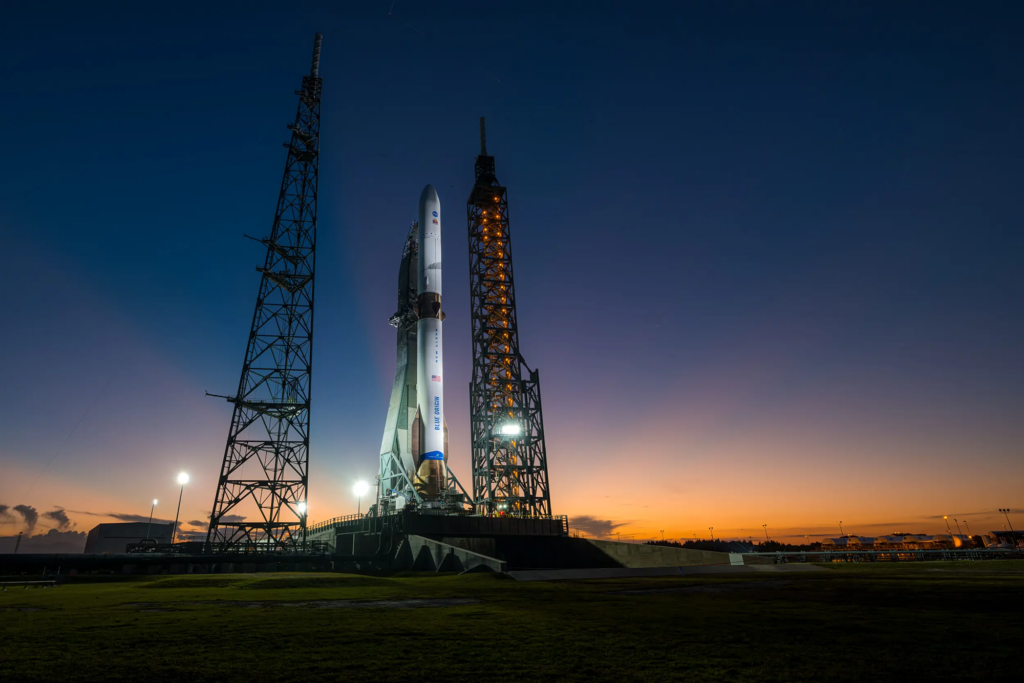
This clause effectively categorizes the opportunity. With the incumbent’s Falcon 9 dominance already established on the West Coast (via SLC-4E and the leased SLC-6), the RFI appears structured to attract a heavyweight competitor, likely Blue Origin’s New Glenn or a distinct heavy-lift configuration from United Launch Alliance (ULA), to balance the strategic scales.
The Heavy-Lift Gap
The requirement for “Heavy” (20k–50k kg) and “Super Heavy” (>50k kg) lift classes highlights a critical gap in the USSF’s current West Coast architecture. While the commercial market has focused on medium-lift constellations, the national security sector requires massive throw-weight for next-generation intelligence and optical platforms.
- The Competitors: The criteria favor technically mature vehicles. This places Blue Origin in a strong position, as New Glenn fits the heavy-lift profile and requires a West Coast home to fulfill NSSL Phase 3 Lane 2 contracts.
- The Challenger: While the incumbent’s super-heavy vehicle fits the lift definition, allocating SLC-14 to them would contradict the RFI’s stated goal of increasing the “pool of LSPs” to enhance resilience.
- The Outliers: Emerging players like Rocket Lab (whose Neutron rocket is slated for ~13,000 kg) may find themselves undersized for this specific solicitation unless upsized variants are proposed.
A Regulatory Moat
The document introduces a significant sobering factor: SLC-14 is essentially a “Greenfield” project in regulatory terms. The RFI notes the site is an undeveloped area and anticipates the need for a full Environmental Impact Statement (EIS) and Record of Decision (ROD).
In the context of California’s stringent environmental regulations, an EIS process can consume 24 to 36 months before ground is even broken. This confirms that SLC-14 is a long-term hedge for the 2030s, not a solution for the current bottleneck delaying commercial constellations today.
Turning the Map Blue?
We expect strong interest from Blue Origin, for whom a Vandenberg complex is an existential necessity to compete for high-value national security payloads that require polar injection. However, the financial maturity requirements, demanding “private capital at risk,” suggest that only Super-Prime entities with deep liquidity will be able to sustain the years of capital expenditure required before the first revenue-generating launch occurs.
Meanwhile, United Launch Alliance faces a sharp tactical paradox: while acquiring SLC-14 would effectively wall off the West Coast from new entrants, the company’s capital is currently held hostage by the immediate imperative to certify its existing SLC-3E pad and execute the delayed Amazon Leo backlog. For the legacy prime, the choice is between playing defensive real estate tycoon or focusing entirely on survival in the high-cadence era.