
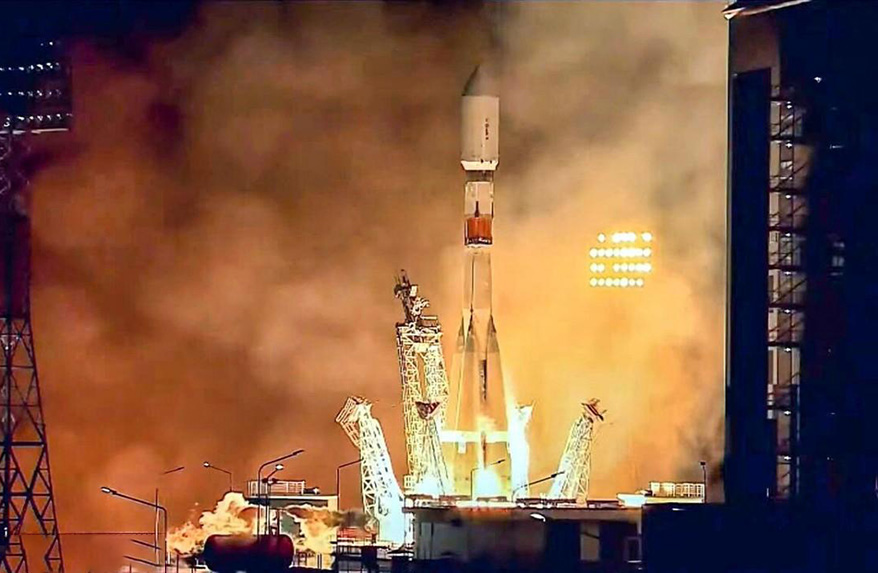
On Sunday, December 28, 2024, the Iranian Ministry of Information and Communications Technology (ICT) confirmed the successful reception of the first signals from three domestically developed satellites: Zafar-2, Paya, and Kowsar. The confirmation marks the official commencement of the operational phase for these assets following a successful orbital insertion earlier that day.
Orbital Deployment and Mission Manifest
The satellites were launched via a Russian Soyuz launch vehicle from the Vostochny Cosmodrome in eastern Russia. The mission, managed by Russia’s state space corporation Roscosmos, deployed the trio into a low Earth orbit (LEO) at an altitude of approximately 500 kilometers.
Roscosmos reported that the launch was executed according to the mission plan, which included a total of 52 satellites. Among the secondary payloads were the Ionosfera-M Earth-observation satellites, designed for digital modeling of the Earth’s ionosphere and surface. The three Iranian payloads were integrated as part of this broader multi-satellite manifest, highlighting a continuing launch services relationship between Tehran and Moscow.
Technical Specifications: Paya, Zafar-2, and Kowsar
The Paya satellite represents the 18th satellite deployed under Iran’s national space program. According to the head of the Space Group at Iran’s Ministry of Defense Electronics Industries, Paya belongs to a new class of satellite platforms designed for broader geographic coverage. Its successful signal reception validates the readiness of this new operational platform for its primary mission phases.
While technical details on Kowsar and Zafar-2 remain focused on their Earth-observation and data-relay capabilities, the ICT Minister noted that the success of this initial stage provides the necessary foundation for ongoing technical monitoring and orbital stabilization. These satellites are expected to contribute to Iran’s growing requirement for high-resolution imagery and data connectivity.
National Strategy: The Shahid Soleimani Constellation
The ICT Minister framed this launch as a stepping stone toward the Shahid Soleimani satellite constellation. He emphasized that because individual LEO satellites cannot remain stationary over a single territory, a robust constellation is required to provide uninterrupted, real-time connectivity.
“Within this framework, the Shahid Soleimani satellite constellation is being pursued as a key national project aimed at ensuring continuous communications coverage across different regions,” stated the Minister during a press briefing in Tehran.
The Iranian Space Agency (ISA) highlighted that these achievements are being realized through high efficiency and modest expenditures compared to global space programs. The ISA leadership maintains that these domestic technical capabilities are driving transformation across multiple high-technology sectors within the country.
Regional Context and Strategic Implications
This mission signals Iran’s move from experimental satellite launches to the development of operational constellations with practical applications in both communications and environmental monitoring. The successful deployment of Zafar-2, Paya, and Kowsar underscores Iran’s sustained presence in the space domain and its reliance on international launch infrastructure at Vostochny to bypass domestic launch vehicle constraints.
The operationalization of these assets is expected to bolster Iran’s position among emerging spacefaring nations, providing the state with independent data streams for disaster management, agricultural monitoring, and national security.
Timeline for Mission Stabilization
Following the initial signal reception, the satellites will undergo a period of orbital characterization and system health checks. The ISA plans to commence the subsequent mission phases, including high-resolution imaging and transponder testing, once the orbits are fully stabilized and ground station handovers are synchronized.