
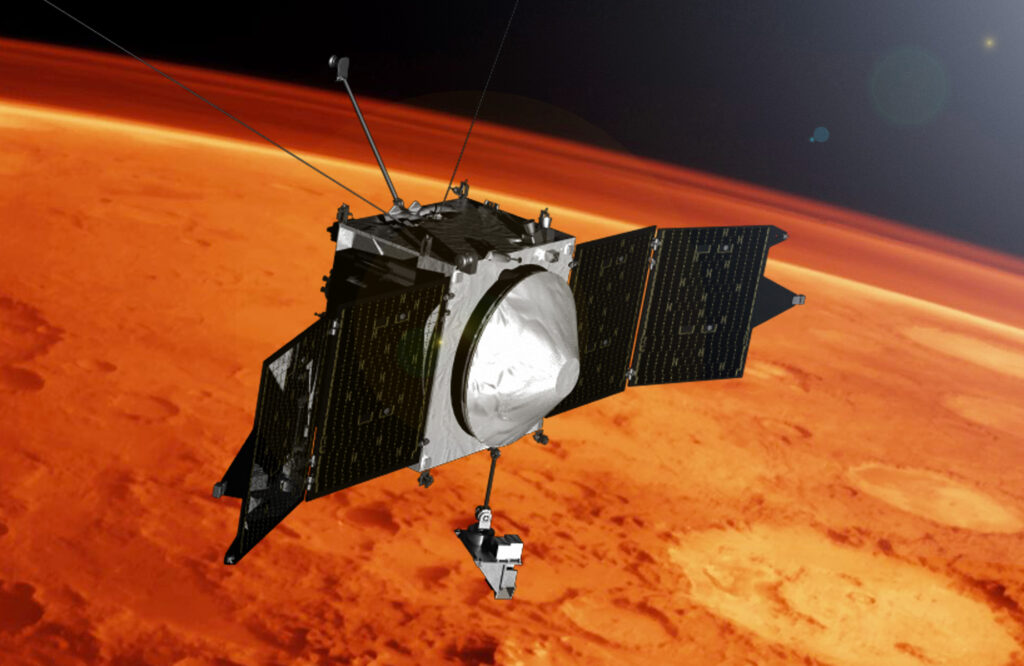
NASA’s Mars Atmosphere and Volatile EvolutioN (MAVEN) spacecraft has remained silent since December 6, 2025, after contact was lost during a routine orbital pass behind the Martian disk.

The communication lapse coincides with a public clarification by Professor Brian Cox regarding the interstellar object 3I/ATLAS, which recently generated viral speculation concerning potential non-natural radio emissions.
In a report first detailed by the International Business Times, researchers confirmed that nine candidate signals initially flagged during observations of the Manhattan-sized comet 3I/ATLAS were identified as terrestrial radio interference. Cox emphasized that these “mysterious” signals were “human noise” produced by passing Earth satellites and ground-based transmitters rather than the interstellar visitor.
Deep Space Communication and Signal Interference
The identification of these signals as human-made highlights the increasing complexity of Space Traffic Management (STM) as orbital density rises. The interference, classified as Equivalent Power Flux-Density (EPFD) disruptions, underscores the challenge of isolating high-value deep-space data from the growing volume of low-Earth orbit (LEO) radio traffic.
While 3I/ATLAS continues its trajectory through the inner solar system, NASA engineers are concurrently attempting to restore telemetry with MAVEN. The orbiter, which has conducted atmospheric science at Mars for over 10 years, failed to re-establish a link following a standard occultation period. NASA has not yet confirmed if the anomaly is related to a hardware failure or a synchronization error within the Deep Space Network (DSN).
Mars Mission Context and Technical Parameters
The MAVEN mission was designed to study the Martian upper atmosphere, ionosphere, and interactions with the sun and solar wind. Since its arrival in 2014, the spacecraft has provided the following data:
- Mission Duration: 11 years (active).
- Primary Objective: Characterizing the loss of volatile compounds from the Martian atmosphere to space over time.
- Current Status: Silent; last successful telemetry packet received December 6, 2025.
Regulatory and Scientific Implications
Professor Brian Cox’s intervention serves to decouple the MAVEN anomaly from the interstellar transit of 3I/ATLAS. “The reality of space exploration is often found in the mundane challenges of physics and orbital mechanics,” Cox stated during a recent scientific address. He noted that the “human noise” masking the comet’s signature is a direct result of the lack of stricter EPFD limits and sustainability metrics for commercial satellite constellations.
Timeline for Recovery Efforts
NASA’s Jet Propulsion Laboratory (JPL) is expected to attempt a high-gain antenna (HGA) reset during the next optimal alignment window. If the spacecraft does not respond to “blind” commanding by early January 2026, the agency may reclassify the mission’s operational status.