
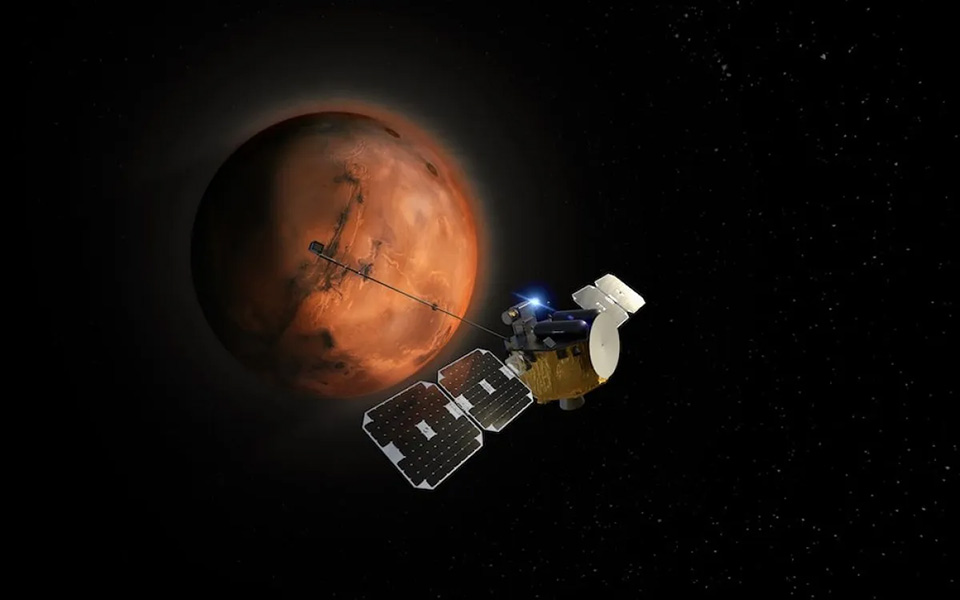
As previously reported on SatNews, the Space Development Agency (SDA) awarded $3.5 Billion in contracts for a Tranche 3 Missile Tracking Constellation. On December 19, 2025 two of those agreements totaling $1.6 Billion to build and operate 36 satellites for the Proliferated Warfighter Space Architecture (PWSA) have been awarded to Rocket Lab and Northrop Grumman.
The contracts were announced by the SDA as part of its “spiral development” strategy to deploy new batches of space technology every two years. Under the firm-fixed-price agreements, Rocket Lab USA will receive $805 million and Northrop Grumman will receive $764 million to each deliver 18 space vehicles.
Strategic Expansion of the Tracking Layer
The Tranche 3 Tracking Layer is designed to enhance the Pentagon’s ability to detect and track advanced missile threats, including hypersonic glide vehicles. This latest round of awards triples the volume of the previous Tranche 1 Tracking Layer, which consisted of 28 satellites.
The procurement follows the restoration of $1.2 billion in funding by Congressional negotiators in the Fiscal Year 2026 National Defense Authorization Act (NDAA). This funding was critical to ensuring production continuity after a proposed pause by the Space Force.
Technical Specifications and Sensor Payloads
The 36 satellites will utilize different sensor configurations to meet SDA requirements:
- Rocket Lab: Tasked with providing 18 Missile Warning, Tracking, and Defense (MWTD) satellites. These vehicles will feature the company’s “Phoenix” infrared sensor payload, designed to generate fire-control quality tracks for missile defense.
- Northrop Grumman: Awarded 18 Missile Warning and Missile Tracking (MW/MT) space vehicles. These units focus on wide-field-of-view detection and persistent tracking of maneuvering targets.
All vehicles will be equipped with optical inter-satellite links to integrate with the PWSA Transport Layer, a low-latency mesh communication network that relays data directly to tactical warfighters. Rocket Lab will build its satellites on the Lightning platform at its Long Beach facility, while Northrop Grumman will utilize its Space Park campus in Redondo Beach.
Vertical Integration and Prime Contractor Status
For Rocket Lab, the $805 million award represents the largest single contract in the company’s history and solidifies its transition to a vertically integrated space prime.
“This is more than just a contract. It’s a resounding affirmation of our evolution from simply a trusted launch provider to a leading vertically integrated space prime contractor,” said Peter Beck, founder and CEO of Rocket Lab.
Northrop Grumman’s award brings its total satellite commitments for the PWSA to 150 vehicles, having participated in both the Transport and Tracking layers of previous tranches.
Timeline to 2029 Deployment
The SDA is currently managing the launch campaign for Tranche 1 operational vehicles, which began in late 2025. The newly awarded Tranche 3 satellites are scheduled to begin their three-year production cycle immediately, with the first orbital planes slated for launch in fiscal year 2029.