
The edge of space is not a sharp line, but rather a fading gradient where the Earth’s atmosphere becomes progressively thinner until it eventually merges with the vacuum of the interplanetary medium.
While the official boundary of space is often cited at the Kármán line—100 kilometers above sea level—satellites operating in Low Earth Orbit (LEO) remain deeply immersed in the outermost layers of our planet’s gaseous envelope. Between altitudes of 200 and 600 kilometers, the air is billions of times thinner than at sea level, yet it remains dense enough to exert a relentless force known as atmospheric drag. This residual atmosphere, primarily composed of atomic oxygen and molecular nitrogen, acts as a subtle but inescapable brake on any object traveling at the orbital velocities required to stay aloft.
For a satellite to maintain its orbit, it must travel at approximately 7.8 kilometers per second. At these extreme speeds, even the most infrequent collisions with sparse air molecules create a cumulative resistance. This drag converts the kinetic energy of the spacecraft into heat, causing the satellite to lose velocity. As the satellite slows, Earth’s gravity pulls it into a lower, tighter orbit. The paradox of orbital mechanics dictates that as the satellite drops, it actually speeds up due to the conservation of angular momentum, but this descent also moves the craft into denser regions of the atmosphere. This creates a feedback loop: lower altitudes contain more molecules, which generate more drag, which further lowers the altitude. Without active propulsion to “re-boost” its position, the satellite enters a terminal spiral.
The density of this residual atmosphere is not constant; it is highly volatile and influenced heavily by solar activity. During periods of high solar flux, the Sun emits intense ultraviolet and X-ray radiation that heats the thermosphere, causing it to expand outward like a balloon. This expansion pushes denser air into higher altitudes where it previously did not exist.
A satellite that was relatively safe during a solar minimum may suddenly find itself “plowing” through a much thicker medium during a solar maximum. Such events can increase drag by a factor of ten or more in a matter of hours, leading to the premature and rapid deorbiting of entire constellations if they lack the fuel to fight back.
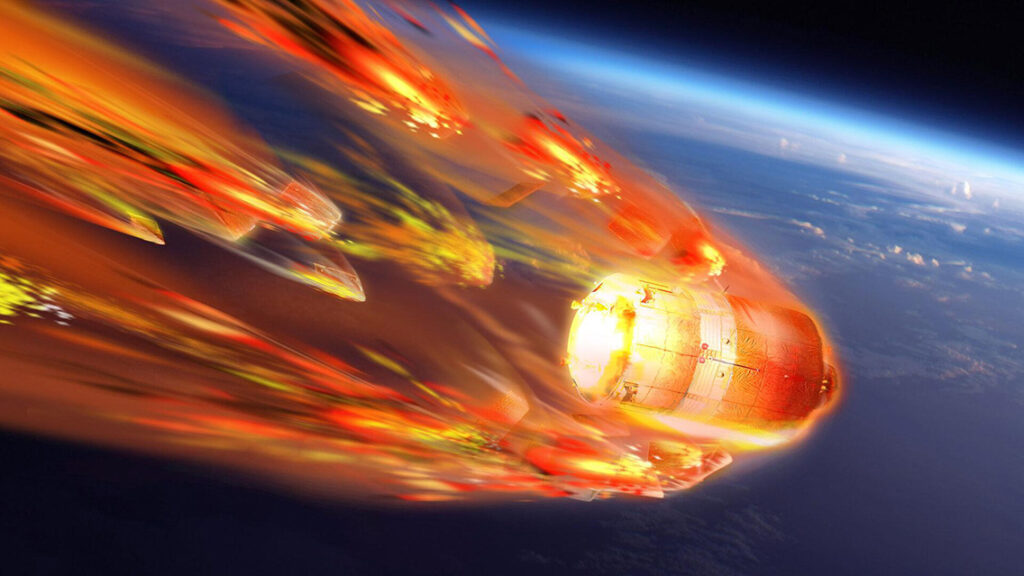
Once the satellite descends below the 200-kilometer threshold, the atmosphere becomes thick enough that the drag force becomes overwhelming. The structural integrity of the spacecraft is challenged by both mechanical stress and the intense thermal energy generated by friction. At this stage, the process of orbital decay transitions into a fiery reentry.
The satellite, having lost the battle against the lingering molecules of Earth’s atmosphere, eventually disintegrates and burns up, highlighting the fact that the “void” of space is, in reality, a very crowded and resisting medium. This phenomenon remains the primary challenge for long-term mission planning in LEO, necessitating a constant balance between orbital height, fuel reserves, and solar cycle predictions.
Satellite Orbital Lifespan: Solar Minimum vs. Solar Maximum
| Altitude | Solar Minimum Lifetime | Solar Maximum Lifetime | Impact of Solar Activity |
| 200 km | 1–2 days | < 1 day | Extremely rapid decay; terminal reentry. |
| 300 km | 1–2 years | 1–3 months | Lifespan reduced by up to 90% during solar max. |
| 400 km | 10–20 years | ~1 year | The ISS altitude; requires frequent re-boosting. |
| 500 km | 50+ years | 5–10 years | Critical threshold for “natural” debris mitigation. |
| 600 km | ~100+ years | 25–50 years | Atmosphere is thin but still exerts long-term drag. |
| 800 km | Many centuries | 100+ years | Drag is minimal; orbits are stable for generations. |