
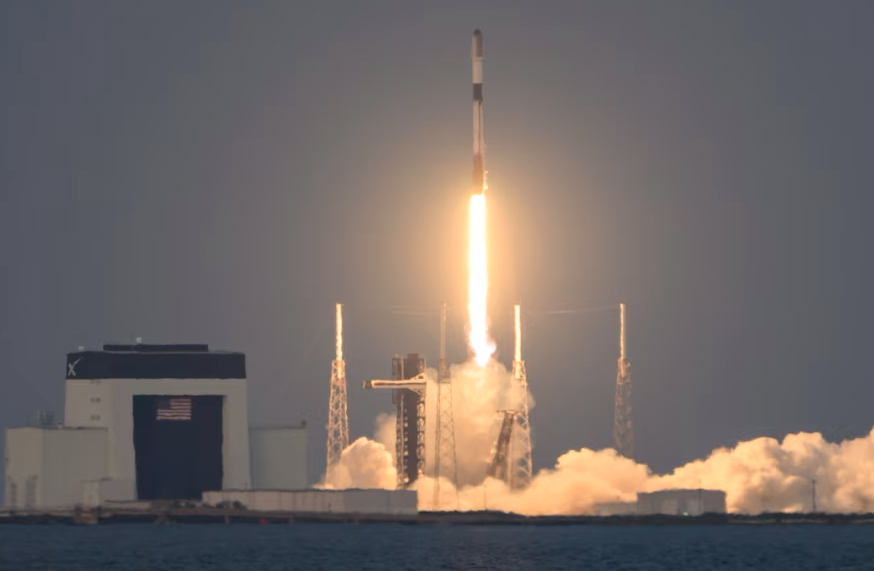
Multiple industry sources report that SpaceX has taken concrete steps toward an initial public offering, initiating a formal “bake-off” to select Wall Street banking partners. This strategic move positions the commercial launch and satellite giant for a potential public listing in 2026. Market analysts suggest this transition could result in a market capitalization exceeding $800 billion, a development expected to fundamentally alter the capital structure and investment landscape of the broader aerospace and defense sector. This potential valuation clarifies a previously reported IPO as reported in SatNews
The Valuation Hierarchy and Market Divergence
The proposed $800 billion valuation for SpaceX creates an unprecedented divergence in the aerospace sector, positioning the company to eclipse the combined market capitalization of its largest competitors. While RTX Corporation leads the traditional defense sector with a valuation of approximately $239.5 billion, followed by Boeing at $155.3 billion and Lockheed Martin at $111.1 billion, SpaceX represents a new class of financial asset. The starkest contrast appears against Northrop Grumman, valued at $87.2 billion; despite Northrop’s critical role in strategic deterrence, the market values SpaceX nearly ten times higher. This disparity highlights a fundamental shift where investors are pricing SpaceX not as a standard aerospace contractor, but as a technology monopoly with a valuation multiple of roughly 50 times sales, compared to the 1.5x to 3.0x multiples typical of legacy Primes.
The “Tech” vs. “Industrial” Spread
This massive valuation anomaly stems from investors categorizing SpaceX alongside high-growth technology platforms like NVIDIA or Amazon rather than industrial manufacturers. Legacy Primes such as Lockheed Martin and Boeing are valued primarily on EBITDA and steady dividend yields, with growth ceilings dictated by federal defense budget cycles that typically expand by only low single digits annually. In contrast, SpaceX is being priced on Total Addressable Market dominance, assuming “infinite growth” potential. The market views the company as a dual-monopoly, controlling both the primary global transport layer for the space economy through Starship and a global utility service through Starlink.
The Revenue Engine: Utility Economics Over Hardware
Although the Falcon and Starship launch vehicles generate significant media attention, the $800 billion valuation is driven almost entirely by the Starlink business unit. The launch division functions effectively as a loss leader to deploy infrastructure, characterized by high capital expenditures and lower margins. Starlink, conversely, operates with software-like margins once the assets are in orbit. With an estimated 8.5 million subscribers generating over $10 billion annually in recurring revenue, Starlink provides the cash flow engine that justifies the aggressive valuation multiples, distinct from the transactional nature of selling aircraft or missiles.
Strategic Implications and Forward Outlook
The emergence of an $800 billion public juggernaut will likely force a structural reckoning for legacy Primes. Facing a severe capital disadvantage where SpaceX can raise billions for R&D without significant dilution, traditional contractors may be compelled to break up or pursue aggressive mergers and acquisitions. We assess a high likelihood that companies like Lockheed Martin or Northrop Grumman may spin off their space divisions to merge with smaller NewSpace entities in an attempt to unlock similar “tech” valuations. Furthermore, a SpaceX IPO would trigger a massive rebalancing of major aerospace ETFs, forcing funds to sell off legacy stocks to acquire SpaceX shares, potentially depressing traditional defense stock prices even further.