
By Sean Payne, SatNews Events
ORLANDO, Fla. — Moving to solidify the cultural shift from a support service to a warfighting branch, Chief of Space Operations Gen. Chance Saltzman unveiled the first official names for U.S. Space Force (USSF) weapon systems during the Space Force Association’s Spacepower Conference on Thursday.
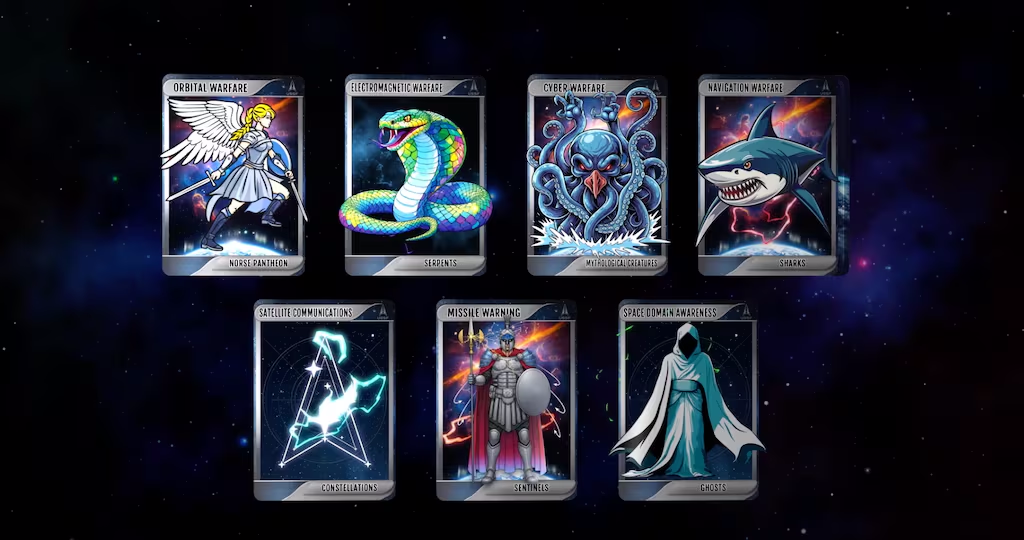
Addressing Guardians just days before the service’s sixth anniversary, Saltzman declared that the USSF has successfully transitioned from “peacetime space operations to combat force generation.” The announcement marks a psychological and doctrinal pivot, assigning distinct identities to classified and unclassified systems to foster unit cohesion and clarify mission intent.
New Nomenclature The naming convention, developed through a service-wide initiative, aligns specific mission areas with thematic archetypes.
- Orbital Warfare: Systems will draw names from the Norse Pantheon. Saltzman revealed two specific designations: “Ursa Major” and “Bifrost.”
- Electromagnetic Warfare (EW): Systems will be categorized under the theme of “Serpents,” reflecting the silent, striking nature of electronic attack and defense.
This branding effort follows the service’s broader strategic realignment. In April 2025, the USSF released its first Space Warfighting Framework, which established the “Competitive Endurance” doctrine and codified the requirement for space superiority.
From Concept to Combat Saltzman emphasized that the service’s organizational changes are now yielding operational results. He highlighted the graduation of the first Officer Training Course (OTC) class—80 officers specifically educated in space warfare tactics rather than general support.
The CSO also pointed to Resolute Space 25, a recently concluded exercise involving more than 700 Guardians across 55 locations. The drill tested the service’s ability to integrate with coalition partners, reflecting the priorities outlined in the International Partnership Strategy.
“We needed a new category of Guardians: multi-disciplinary critical thinkers, ready to deliver combat wins at the pace of the threat,” Saltzman said. “Our combat space forces are better prepared, fully integrated, and ready to respond to any threats to our missions.”
The ‘Invisible’ War Despite these advancements, leadership acknowledged the difficulty in communicating the urgency of the space domain to the broader public. Saltzman noted that unlike air or land campaigns, space superiority battles often occur without visual spectacle.
“I’ll be the first to admit our work can sometimes feel invisible,” Saltzman told the audience. “But we provide vital capabilities that enable our security and our way of life… We will continue to stand on the invisible front line.”
The conference also featured remarks from Secretary of the Air Force Troy E. Meink, who affirmed the Department of the Air Force’s commitment to streamlining acquisition processes to match the tempo of orbital threats.
Operational Outlook The Space Force is currently implementing a “Combat Forces Command” structure, shifting units from administrative readiness cycles to dedicated combat presentation. This aligns with the Competitive Endurance strategy initially outlined by Saltzman in 2024, aimed at avoiding operational surprise and denying adversary gains.
Guardians are expected to receive further guidance on system naming conventions throughout early 2026 as the service declassifies additional program designators.