
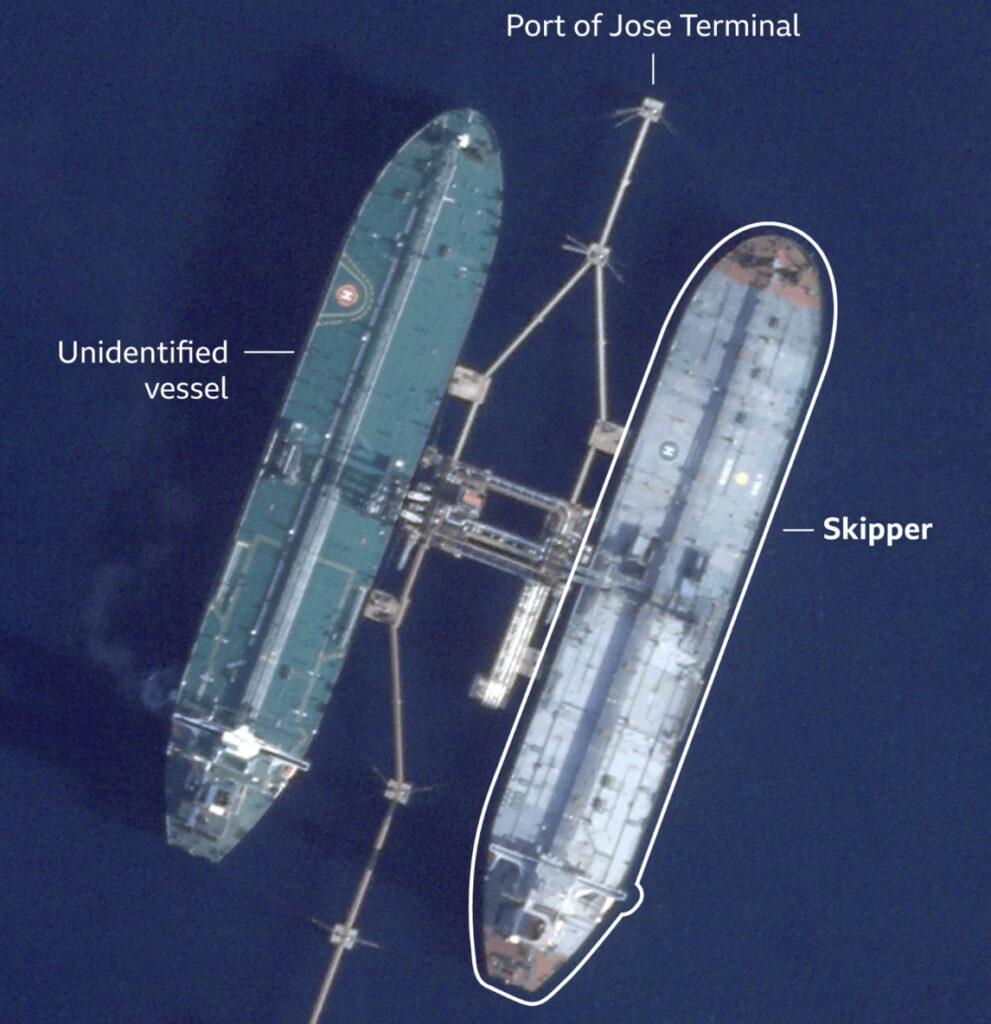
U.S. Coast Guard and special operations forces executed a high-seas seizure of the oil tanker Skipper off the coast of Venezuela on Wednesday, disabling a vessel that authorities described as a central node in an illicit “ghost fleet” transporting sanctioned crude.
The operation, launched from the aircraft carrier USS Gerald R. Ford, targeted the Very Large Crude Carrier (VLCC) after maritime intelligence confirmed it was broadcasting falsified Automatic Identification System (AIS) data to conceal its true location—a tactic increasingly common among vessels evading international sanctions.
Operation and Surveillance
While the vessel’s transponder broadcasted coordinates placing it near Guyana and Suriname, satellite imagery analysis by maritime intelligence firms, including Kpler and TankerTrackers.com, physically located the ship loading crude at Venezuela’s José terminal hundreds of miles away.
The seizure of the tanker Skipper this week has thrust a shadowy maritime war into the spotlight. As sanctions against Russia, Iran, and Venezuela tighten, a parallel “ghost fleet” of vessels has emerged, employing increasingly sophisticated electronic warfare tactics to vanish from global tracking systems.
For the satellite industry, this illicit armada represents a primary use case for next-generation intelligence products. The battle is no longer just about tracking ships; it is a high-stakes game of cat-and-mouse between orbital sensors and vessel operators manipulating the fundamental data of maritime safety.
The Threat: Anatomy of a Ghost Fleet
A “ghost fleet” (or dark fleet) consists of vessels—often aging tankers nearing the end of their operational lives—that operate outside traditional insurance and regulatory frameworks to transport sanctioned crude oil.
To evade detection, these operators employ a tiered system of obfuscation:
- “Going Dark”: The simplest method, where a crew manually disables the Automatic Identification System (AIS) transponder. However, this creates a suspicious “gap” in data that modern algorithms immediately flag.
- Identity Laundering (“Zombie” Vessels): Operators purchase scrapped vessels’ Mobile Maritime Service Identity (MMSI) numbers and program them into active tankers. This allows a ship carrying sanctioned oil to masquerade digitally as a ship that was broken up years ago.
- Flag Hopping: Rapidly changing vessel registration between “flags of convenience” (e.g., Cameroon, Palau, or Guyana) to outpace regulatory blacklists.
AIS Spoofing Mechanisms
While “going dark” is passive, AIS spoofing is active deception. It involves manipulating the ship’s broadcast data to place the vessel electronically in one location while it is physically hundreds of miles away.
- Circle Spoofing: A common anomaly where a vessel’s AIS signal broadcasts a perfect geometric circle or holding pattern. This is often a result of automated software generating fake coordinates to make the ship appear “busy” in safe waters while it conducts illicit ship-to-ship (STS) transfers elsewhere.
- GNSS Manipulation: More advanced actors use devices to feed false Global Navigation Satellite System (GNSS) coordinates into the ship’s transponder. This allows a tanker to “jump” across oceans instantly or appear to be docked at a legitimate port while actually loading crude at a sanctioned terminal.
This discrepancy confirms the vessel was engaging in “AIS spoofing,” a digital obfuscation technique where a ship manipulates its navigational signals to appear in legitimate waters while conducting illicit port calls.
Vessel and Cargo Specifications
- Vessel Type: Very Large Crude Carrier (VLCC).
- Cargo: Approximately 2 million barrels of heavy crude (Merey crude).
- Registration Status: The vessel was flying a Guyanese flag at the time of interdiction; however, the government of Guyana issued a statement confirming the registration was fraudulent.
- Sanctions Status: Designated by OFAC in 2022 for ties to the IRGC-Qods Force.
The vessel and its cargo are currently being processed under U.S. forfeiture laws.