
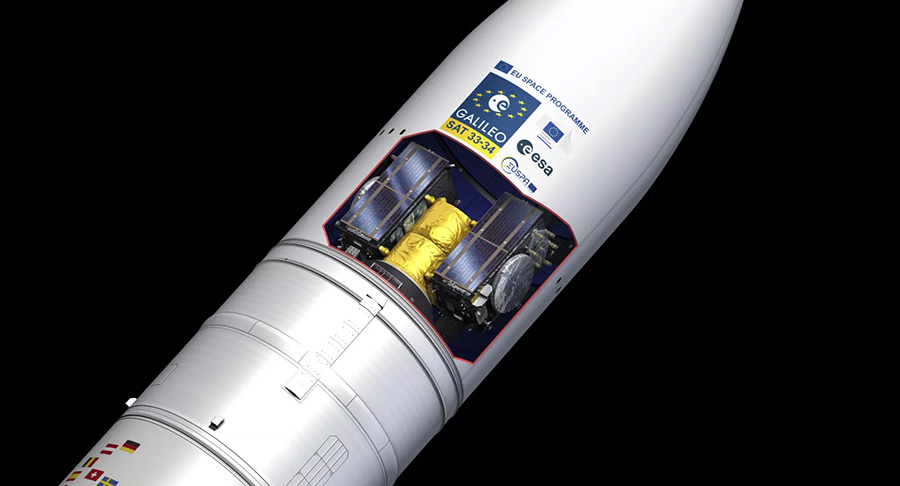
Beyond Gravity has confirmed the integration of its critical subsystems aboard the upcoming Ariane 6 flight scheduled to launch two Galileo navigation satellites on December 17. The mission, launching from French Guiana, will expand the European Global Navigation Satellite System (GNSS) constellation, which currently consists of 27 active satellites.
The Swiss-headquartered supplier provided mission-critical hardware for both the launch vehicle and the satellite payloads. The two satellites, manufactured by prime contractor OHB System AG, utilize Beyond Gravity’s onboard computers, thermal protection, and mechanism systems to maintain operational stability in Medium Earth Orbit (MEO).
Galileo Satellite Subsystem Integration
For this mission, Beyond Gravity delivered the core computing and environmental control systems required for the satellites’ 12-year operational lifespan.
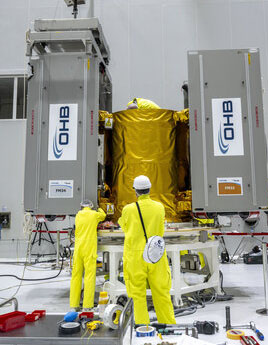
- Onboard Computing: The company supplied the satellite’s primary computer, which executes OHB’s data handling software. This system controls payload operations, monitors environmental status, and coordinates subsystem functions to maintain navigation signal precision.
- Thermal Protection: To withstand temperature fluctuations of up to 400 degrees Celsius, the satellites are encased in Beyond Gravity’s multilayer thermal insulation, composed of metal-evaporated polyimide film.
- Solar Array Mechanisms: Each spacecraft is equipped with rotating drive mechanisms that align solar arrays with the sun throughout the orbital path, ensuring consistent power generation for signal transmission.
- Mission Antennas: The company provided the antennas responsible for uploading mission data, which is subsequently processed to generate the navigation messages broadcast to users.
Ariane 6 Launch Vehicle Components
Beyond Gravity’s contributions extend to the Ariane 6 launch vehicle itself. The payload fairing, a carbon fiber composite structure with a 5.4-meter diameter, was manufactured at the company’s facility in Emmen, Switzerland. This structure protects the payload during the initial ascent through the atmosphere.
Additionally, the company supplied high-temperature thermal insulation for the launcher’s propulsion systems. This insulation protects the lower stage Vulcain engine and the upper stage Vinci engine from temperatures reaching 1,500 degrees Celsius. The upper stage also utilizes a 10-kilogram gimbal mechanism capable of transmitting 15 tons of thrust force, enabling vector control for precise orbital insertion.
Executive Perspective
“Galileo is the world’s most accurate navigation system—and we are proud to have been a key contributor to its development from the outset,” said Oliver Grassmann, Executive Vice President Satellites at Beyond Gravity. “Our highly reliable key components, including computer and thermal systems, ensure the smooth operation of the satellites in orbit. This underscores our central role in Europe’s independent satellite navigation system.”
Future LEO-PNT Architecture
While supporting the current MEO constellation, Beyond Gravity is also engaged in the European Space Agency’s (ESA) evolution toward a Low Earth Orbit Positioning, Navigation, and Timing (LEO-PNT) architecture. Known as Project Celeste, this initiative aims to supplement the existing Galileo infrastructure with satellites orbiting at approximately 500 kilometers.
These LEO assets are designed to improve signal resilience against jamming threats. Beyond Gravity is partnering with GMV and OHB System AG to provide digital signal generation and payload system clocks for the first prototype satellites, designated Pathfinder A, which are slated for launch in late 2025, followed by a larger batch in 2026.