
WASHINGTON — NASA’s Mars Atmosphere and Volatile EvolutioN (MAVEN) spacecraft has experienced a critical loss of situational awareness, triggering a safe mode event that threatens to disrupt data relay operations for the agency’s Tier 1 surface assets, including the Perseverance and Curiosity rovers.
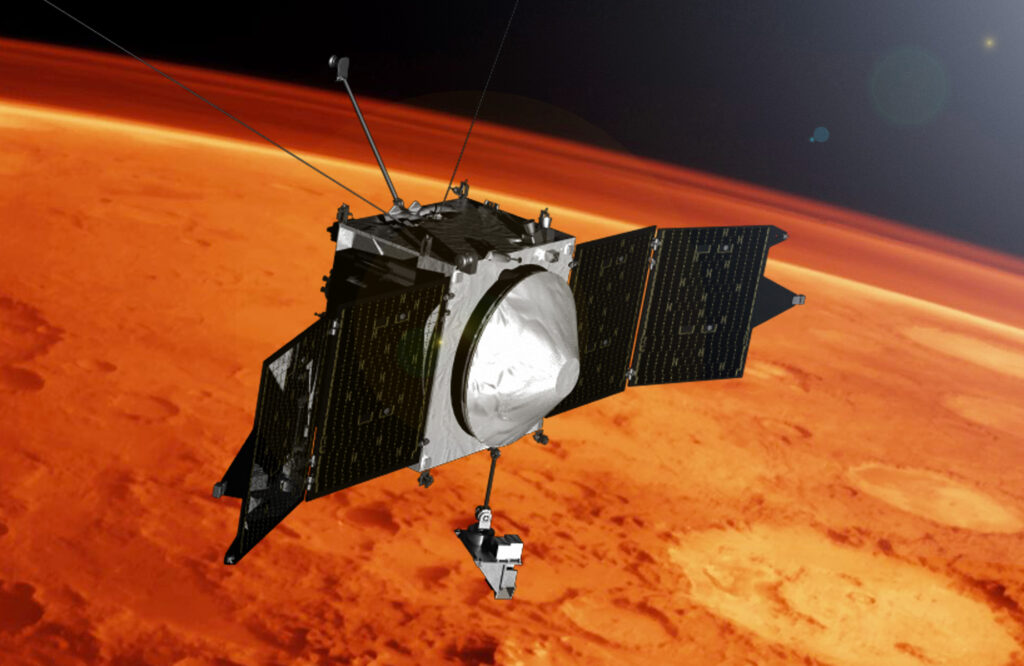
The anomaly, described as a loss of the spacecraft’s ability to determine its orientation, effectively halts MAVEN’s participation in the Mars Relay Network (MRN). While the orbiter’s primary mission is atmospheric science, it serves as a vital high-speed UHF communications bridge, receiving large packets of science data from surface rovers and beaming them back to Earth via the Deep Space Network (DSN). Without MAVEN, data return capacity from the Martian surface could be significantly throttled.
Aging Avionics and Redundancy Struggles
This incident follows a history of navigation challenges for the aging orbiter, which launched in 2013. In February 2022, MAVEN spent three months in safe mode after its Inertial Measurement Units (IMUs)—the instruments responsible for navigation—exhibited erratic behavior.
Following that event, the mission team, led by Project Manager Richard Burns at Goddard Space Flight Center, uploaded a software patch allowing the spacecraft to navigate using “all-stellar” mode (star trackers) rather than relying on the degrading gyroscopes. It remains unclear whether the current loss of situational awareness is a failure of this stellar navigation software or a new hardware anomaly.
Technical Impact: The Mars Relay Network
The Mars Relay Network relies on a constellation of orbiters to act as “bent pipe” relays for surface missions. While rovers can transmit directly to Earth using X-band antennas, the data rates are low and energy-intensive. UHF relays to orbiters like MAVEN allow for significantly higher data throughput.
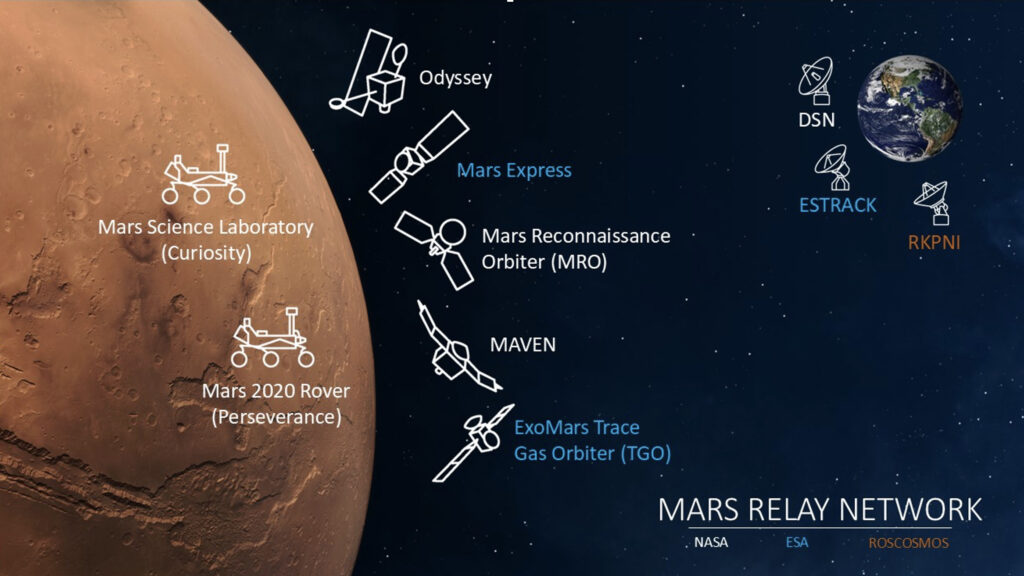
- Affected Asset: MAVEN (Mars Atmosphere and Volatile EvolutioN)
- Orbit: Elliptical, 4.5-hour period
- Network Role: UHF Data Relay for Perseverance (Jezero Crater) and Curiosity (Gale Crater)
- Principal Investigator: Shannon Curry (UC Berkeley)
Outlook
Operations teams are currently assessing the spacecraft’s telemetry to determine a recovery timeline. While the Mars Relay Network possesses redundancy through other orbiters—including the Mars Reconnaissance Orbiter (MRO) and the European Space Agency’s Trace Gas Orbiter (TGO)—MAVEN carries one of the largest relay loads. A prolonged outage could force surface teams to deprioritize high-bandwidth data returns, such as high-resolution imagery or complex spectral analysis, until the link is restored.