
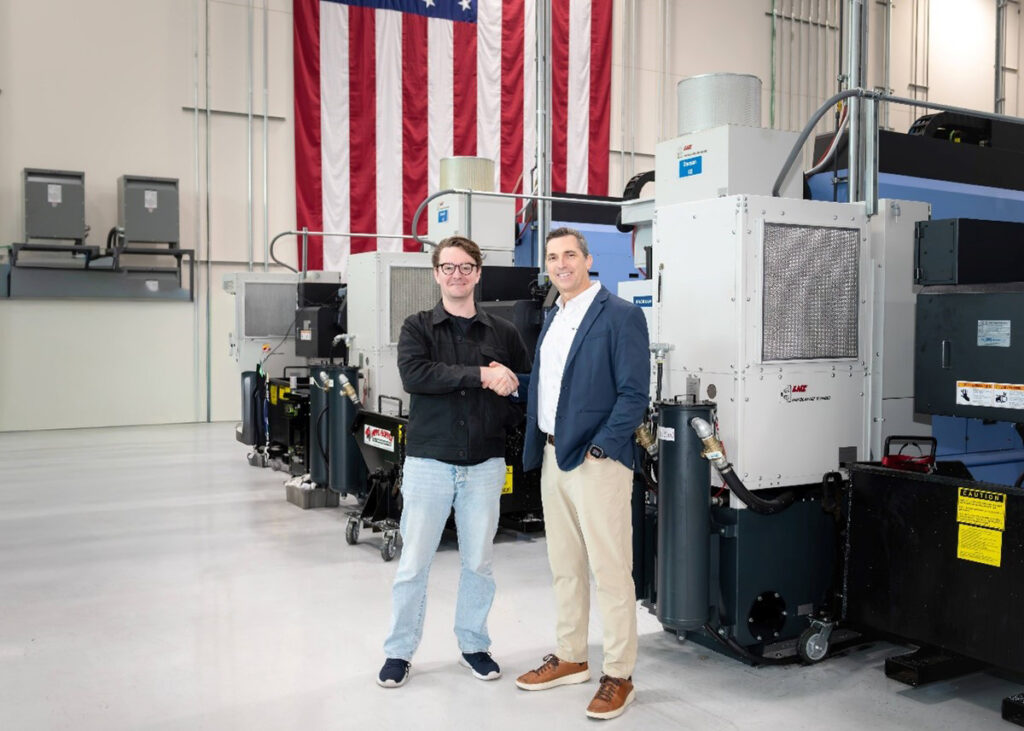
GRAND PRAIRIE, Texas — To accelerate the delivery of critical munitions and resolve supply chain bottlenecks, Lockheed Martin has entered a strategic alliance with manufacturing technology company Hadrian. Under a new Memorandum of Understanding (MoU) announced December 8, Hadrian will deploy its “Factory-as-a-Service” model directly into a Lockheed Martin production facility to automate the manufacturing of high-demand missile components.
Integration and Scope
The partnership focuses on the rapid production of parts for Lockheed Martin’s Missiles and Fire Control (MFC) division. Hadrian will establish a scalable machining and inspection cell at a Lockheed Martin site, utilizing its proprietary software stack, computer numerical control (CNC) machines, and advanced robotics.
The automated cell is specifically targeted to support several high-priority Department of Defense programs, including:
- PAC-3 MSE: Patriot Advanced Capability-3 Missile Segment Enhancement.
- THAAD: Terminal High Altitude Area Defense system.
- PrSM: Precision Strike Missile.
- GMLRS: Guided Multiple Launch Rocket System.
This integration aims to bypass traditional manufacturing latency by enabling a “software-defined” production line capable of faster setup times and higher throughput than legacy systems.
Strategic Context
The alliance comes as the U.S. defense industrial base faces pressure to surge production rates for kinetic munitions due to ongoing global conflicts and depleted stockpiles. Hadrian, a startup that raised $260 million in Series C funding in July 2025, differentiates itself by automating the entire manufacturing workflow—from quoting to final inspection—allowing for rapid scaling that traditional machine shops struggle to match.
Tom Carrubba, vice president of production operations at Lockheed Martin Missiles and Fire Control, described the collaboration as a necessary step to meet escalating demand. “We are excited to collaborate with Hadrian to deploy their automated machining and inspection technology to strengthen our manufacturing capabilities and supply chain,” Carrubba said. “This project is a key enabler for Lockheed Martin to increase production output capacity, ensuring we can meet the high demand for our customers’ munitions needs.”
Future Implications
For Hadrian, the deal validates its model of embedding capacity directly within a prime contractor’s infrastructure rather than operating solely as an external vendor. “This partnership is a model for how emerging and established players can work together to build faster, more resilient defense production,” said Hadrian CEO Chris Power. “By combining Hadrian’s advanced manufacturing capabilities with Lockheed Martin’s expertise, we’re streamlining production for current and future critical programs.”
The companies did not disclose the financial terms of the agreement or the specific timeline for the cell to reach full operational capability.