
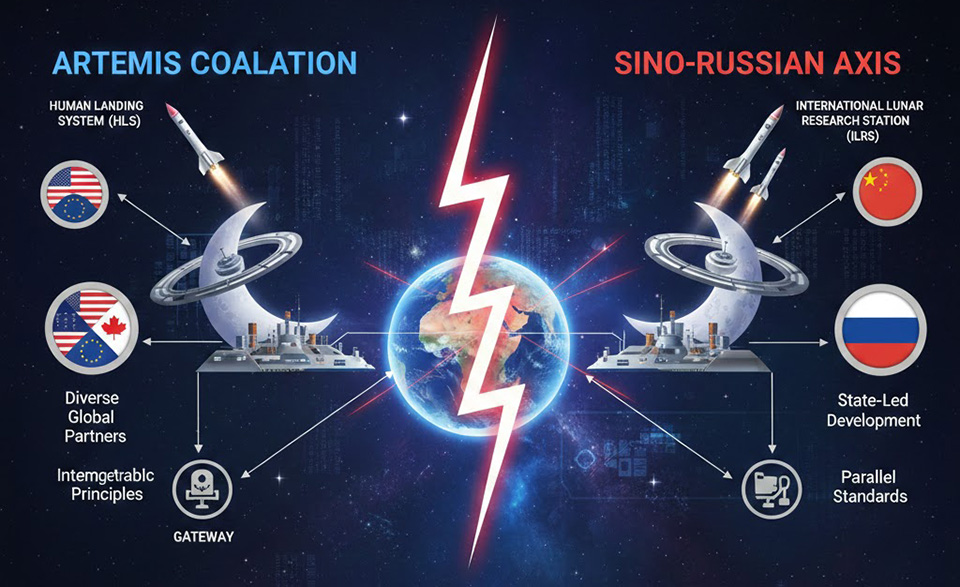
The global space race has entered a new, accelerated phase, characterized by an increasingly defined split in long-term strategic goals and infrastructure development. This division is fundamentally driven by geopolitical alignment rather than purely scientific motivation, creating two separate power blocs focused on establishing distinct long-term human and robotic lunar presences.
The Artemis Coalition: A Western-Led Ecosystem
The first major infrastructure is coalescing around the US-led Artemis Program. This initiative represents a comprehensive, multilateral effort to return humans to the Moon and establish a sustainable presence near the lunar South Pole.
Key partners in the Artemis Accord framework include major space powers such as:
- Europe (ESA)
- Canada (CSA)
- Japan (JAXA)
- Numerous other nations across the globe.

The Artemis approach is centered on creating a modular, interoperable lunar ecosystem. Critical infrastructure elements include:
- The Gateway: A multinational space station in lunar orbit, serving as a staging point for lunar surface missions and deep space exploration.
- The Human Landing System (HLS): Commercial vehicles designed to ferry astronauts from the Gateway to the lunar surface.
- Artemis Base Camp: Plans for a long-term habitation site at the lunar South Pole, focused on utilizing lunar resources (in-situ resource utilization or ISRU).
This Western-led approach is built upon a foundation of shared democratic principles, transparency, and the peaceful use of space as outlined in the Artemis Accords. The infrastructure developed by this coalition will prioritize technological standards and operational protocols that are shared and governed by the partner nations.
The Sino-Russian Axis: The International Lunar Research Station (ILRS)
Counterbalancing the Artemis framework is the growing strategic partnership between Russia (Roscosmos) and China (CNSA). This collaboration is focused on the joint development of the International Lunar Research Station (ILRS).
While details surrounding the full scope of the ILRS remain under development, the stated goal is to create a complex of experimental research facilities, either on the lunar surface and/or in lunar orbit, by the mid-2030s. This initiative signals a clear intention to create a non-Artemis-aligned space infrastructure, establishing a significant presence independent of the US-led coalition.
This power bloc is defined by a shared strategic goal to enhance their respective long-term space capabilities and project influence in the cislunar domain. The collaboration leverages Russia’s historical deep space expertise and China’s accelerating technological prowess and industrial capacity.
Geopolitics Over Science
Analysts agree that while both space programs contain profound scientific objectives, the driving force behind this bifurcation is unequivocally geopolitical.
- Strategic Autonomy: The formation of two distinct operational frameworks ensures strategic autonomy for both the Western and the Sino-Russian blocs, safeguarding national security interests and technological supply chains in a contested domain.
- Standard Setting: The initial infrastructure choices—from docking mechanisms to communication protocols and resource extraction standards—will define the future operational landscape of the Moon. By developing parallel infrastructures, each bloc is effectively setting its own standards for future international partners, solidifying spheres of influence.
- Resource Control: The lunar South Pole, hypothesized to contain accessible deposits of water ice, is a critical area of interest. The establishment of two separate, competing presences in this region reflects a competition for potential access to and utilization of these vital resources.
The net result is a space domain that is increasingly mirroring terrestrial power dynamics. While cooperation may still occur on certain limited, non-strategic missions, the long-term, high-value infrastructure of the cislunar economy and human presence is now clearly segmented. This dual development path ensures that the next wave of lunar exploration will be defined not just by scientific discovery, but by the ongoing competition between major world powers.