It’s always a good idea to explain and talk about technologies making an impact on the SmallSat Industry and satellite technology in general.
The Edge of SAR Technology
Synthetic Aperture Radar (SAR) is an active remote sensing technique that transmits its own signals and analyzes the reflected return, offering distinct operational advantages over traditional optical and infrared imaging systems.
Key Operational Advantages
The procurement of SAR satellite imagery gives the user the ability to conduct persistent surveillance under conditions that render optical systems useless:
| Feature | Description | Operational Benefit |
| All-Weather Capability | SAR signals operate in the microwave portion of the electromagnetic spectrum, which can easily penetrate clouds, fog, and rain. | Ensures uninterrupted monitoring of maritime and land assets regardless of atmospheric conditions. |
| Day/Night Imaging | SAR is an active system, meaning it generates its own illumination (microwave pulses), so it does not rely on sunlight. | Provides 24/7 coverage, crucial for critical, time-sensitive security and defense missions. |
| High Resolution & Sensitivity | SAR processing synthesizes a much larger antenna size, enabling the creation of extremely high-resolution imagery (down to sub-meter level). | Allows for the detailed detection and classification of small objects, such as vessels, vehicles, and infrastructure. |
| Coherence and Change Detection | The phase and amplitude of successive images can be compared to precisely detect minute changes on the ground (e.g., land subsidence or construction activity). | Essential for military intelligence and environmental monitoring to track movement or subtle alterations. |
Technical Principle
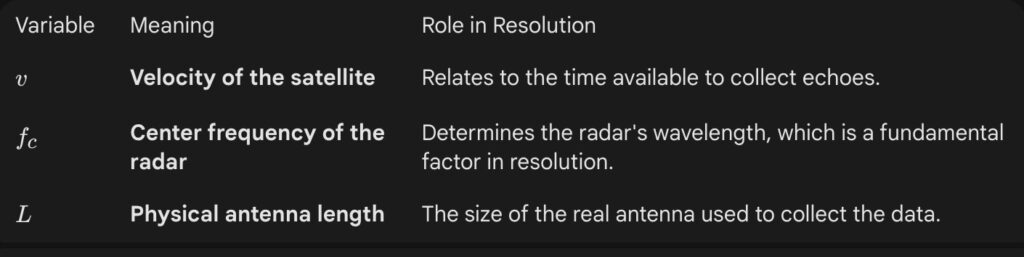
SAR works by processing multiple radar returns collected as the satellite moves, synthesizing a virtual aperture that is far larger than the physical antenna.
While the resolution formula for SAR in the azimuth direction is often simplified to R_a = \frac{L}{2} (where L is the physical antenna length), the chart provides a slightly more complex view: