
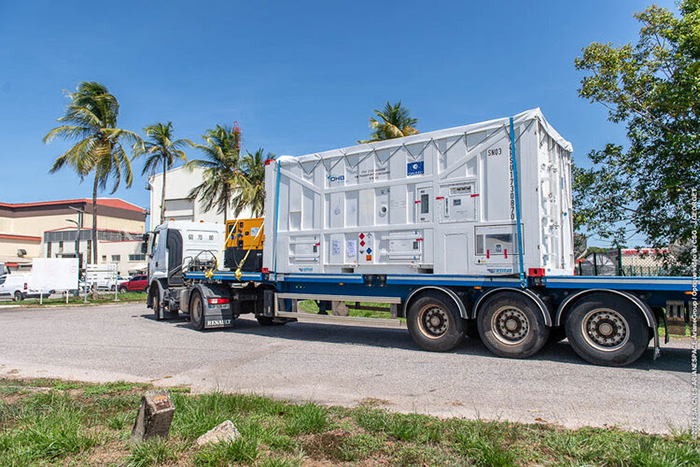
Two new Galileo satellites, SAT 33 and SAT 34, arrived in French Guiana on November 6, 2025, in preparation for the 14th operational launch of the Galileo programme. The latest additions to Europe’s independent satellite navigation constellation, they landed at Europe’s Spaceport in Kourou, French Guiana, marking the start of the final preparatory phase prior to launch and an operational orbit of 23,222 km above Earth.
A Milestone for European Space
The satellites will be launched on December 17, 2025, aboard an Ariane 6 rocket, specifically the A62 configuration (equipped with two solid rocket boosters), from Europe’s Spaceport. It marks only the fifth flight for the next-generation European launch vehicle and it is Galileo’s inaugural launch on the Ariane 6. This transition signals Europe’s commitment to self-sufficiency and the enhanced capability of the Ariane 6 to deploy heavier payloads, to develop the long-term sustainability of the Galileo constellation.
The Role of In-Orbit Spares
These additions are not destined for immediate service as primary operational satellites; they will instead serve as in-orbit spares. This strategic designation is key to improving the overall system’s performance, specifically its precision, availability, and robustness. By having ready-to-activate spares, EUSPA can quickly compensate for any potential anomaly in the operational constellation, ensuring the continuous, high-integrity service that millions of users across Europe and the globe rely on.
Final Preparations in the Clean Room
Following their journey from Europe, SAT 33 and SAT 34 are transported to the Spaceport’s clean room facilities. Over the next month, the joint team from ESA, EUSPA, Arianespace, and the manufacturer OHB will conduct a rigorous series of checks, including:
- Mechanical Inspections: Verifying the satellites withstood transport and are structurally sound.
- Electrical and Functional Testing: Confirming all electronic systems, navigation payload, and power subsystems are fully operational.
- Fueling Operations: Loading the hydrazine propellant necessary for orbital maneuvers, station-keeping, and eventual de-orbiting at the end of their operational lives.
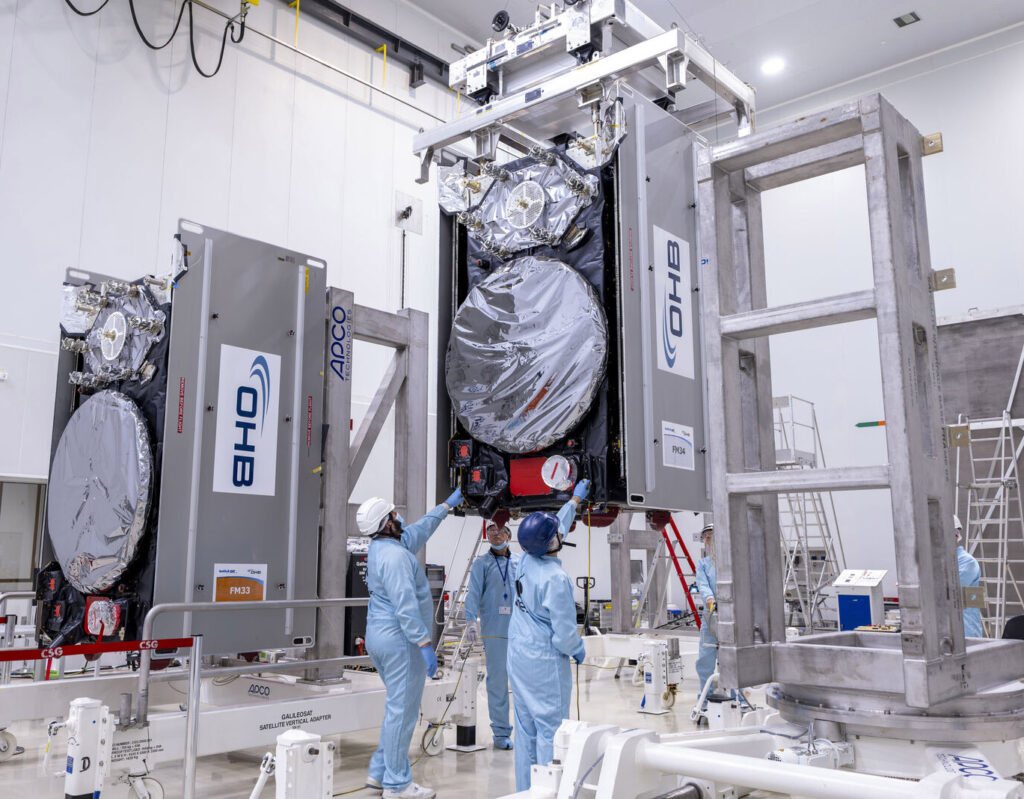
These meticulous steps are vital before the satellites are encapsulated within the Ariane 6 fairing.
The European Space Agency (ESA) manages the launch service contract with Arianespace on behalf of the European Commission. The satellites themselves were manufactured by OHB in Bremen, Germany, under a contract with ESA. Once safely in orbit, the EU Agency for the Space Programme (EUSPA), based in Prague, will take over, guiding the satellites through their In-Orbit Validation (IOV) phase, bringing them into service, and overseeing their ongoing operations.
The launch could prove the operational resilience of Galileo and a new era of European autonomous access to space.