

Rocket Lab released this announcement:
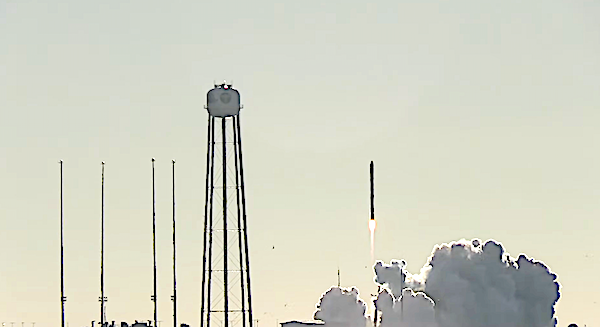
Rocket Lab Corporation (Nasdaq: RKLB), a provider of launch services and space systems, successfully launched a suborbital mission with its HASTE launch vehicle for the Defense Innovation Unit (DIU) and Missile Defense Agency (MDA) — advancing national interests in safeguarding the homeland through the testing of advanced technologies for missile defense. Photo captured by Satnews.
Rocket Lab’s commercial launch vehicle for regular and reliable hypersonic test flights — took place from Rocket Lab Launch Complex 2 on Wallops Island, Virginia, at 13:00 UTC/08:00 a.m. ET on November 18, 2025. Led by MDA, the mission deployed a government-provided primary payload developed by the John Hopkins University Applied Physics Laboratory, and multiple secondary payloads by federal and industry partners, which tested key technologies for missile defense applications.
The mission was contracted to Rocket Lab through the DIU’s Hypersonic and High-Cadence Airborne Testing Capabilities (HyCAT) program, an initiative supporting test and evaluation of new and emerging hypersonic technologies through low cost, responsive and long endurance flight testing. The mission launched within 14 months of contract signing, demonstrating streamlined operational benefits for government customers through Rocket Lab’s commercial speed, innovation, and efficiency. The mission also exemplified the cost and schedule savings that commercial liquid launch vehicles can bring to the MDA test community for developmental testing, non-traditional targets testing, and risk-reduction payload testing activities.
Rocket Lab’s Vice President Global Launch Services, Brian Rogers, says: “HASTE is an important platform for accelerating hypersonic technology readiness for the nation, and we’re proud to be delivering this mission for DIU and MDA.”
LtCol Nicholas Estep, Director of DIU’s Emerging Technology Portfolio, says: “Accessing the commercial and non-traditional ecosystem is a key enabler to accelerating progress in the hypersonics community of interest, particularly for closing mission timelines and driving towards mass and affordability. Working with MDA to demonstrate commercially-focused sub-orbital launch services is a great example of that axiom.”
The mission was Rocket Lab’s sixth launch of its HASTE rocket since the launch vehicle’s debut in 2023. A suborbital variant of Electron — the world’s most frequently launched small orbital rocket — HASTE includes much of the same innovative technology as Electron, including carbon fiber composite structures and 3D printed rocket engines, but has a modified upper Kick Stage tailored for hypersonic technology tests and a larger payload capacity. HASTE can deploy technologies at speeds of more than 7.5km per second to test air-breathing, glide, and ballistic payloads, as well as technologies to re-enter Earth’s atmosphere from space. Combined, the HASTE and Electron launch vehicles have deployed 200+ payloads for government and commercial customers to date.
Rocket Lab to launch HASTE secret government mission on Tuesday from Wallops
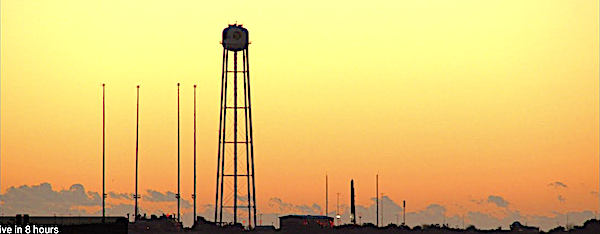
On Tuesday Rocket Lab will be conducting their Sub-orbital launch under Rocket Lab’s Hypersonic Accelerator Suborbital Test Electron (HASTE) program. This is a government top secret mission with details TBD.
The launch will take place from Rocket Lab Launch Complex 2 (Launch Area 0 C) at Wallops Flight Facility, Virginia, from 4:45 pm – 10:00 AM PST .
The forecast calls for a temperature of 40°F, clear skies, 2% cloud cover and a wind speed of 9mph.
Rocket Lab Launch Complex 2 (Launch Area 0 C) has witnessed the launch of 8 rockets, including 3 orbital launch attempts. While Wallops Flight Facility, Virginia, has been the site for 82 rocket launches.
Wallops Flight Facility is a rocket launch site on Wallops Island on the Eastern Shore of Virginia, United States, just east of the Delmarva Peninsula and north-northeast of Norfolk. The facility is operated by the Goddard Space Flight Center in Greenbelt, Maryland, and primarily serves to support science and exploration missions for NASA and other federal agencies.
WFF includes an extensively instrumented range to support launches of more than a dozen types of sounding rockets; small expendable suborbital and orbital rockets; high-altitude balloon flights carrying scientific instruments for atmospheric and astronomical research; and, using its Research Airport, flight tests of aeronautical research aircraft, including uncrewed aerial vehicles.