
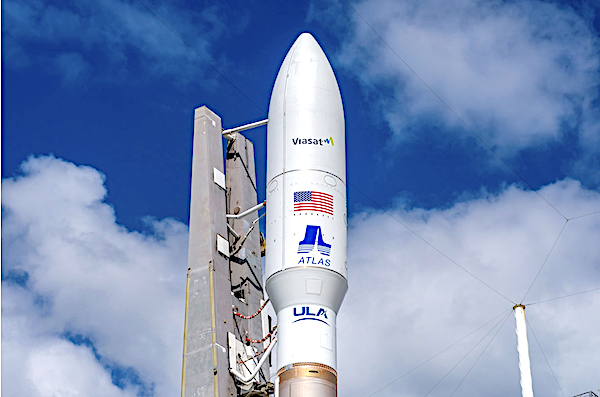
Everything continues to progress towards the ULA Atlas V launch carrying the ViaSat-3 Flight 2 (F2) mission for Viasat, a global technologies company. The mission is planned to lift off on Wednesday, November 5, from Space Launch Complex-41 at Cape Canaveral Space Force Station in Florida. The launch is planned for 10:24 p.m. EST with a 44-minute window. Today’s forecast shows a 95 percent chance of favorable weather conditions for launch.
Atlas V’s first stage has been filled with room-temperature RP-1 propellant that will feed the main engine during the initial phase of tomorrow night’s Viasat-3 Flight 2 launch. Loading of cryogenic liquid hydrogen and liquid oxygen occurs in the final hours of the launch countdown.
According to weather officials, there’s a 95% chance of favorable weather conditions at the time of the launch. Officials are monitoring weather conditions with concerns related to Cumulus Cloud Rule. The forecast calls for a temperature of 74°F, overcast clouds, 95% cloud cover and a wind speed of 5mph.
Viasat’s message on X: L-1 day until launch! With 5 solid rocket boosters & 2.7 million lbs of thrust ULA’s 196-ft tall Atlas V 551 rocket made its way to SLC-41 at Cape Canaveral for final checks before tomorrow’s #ViaSat3F2 launch. Tune in tomorrow at 10:03 p.m. EST: http://vsat.co/vs3
Launch Forecast Summary:
- Overall probability of violating weather constraints: 5%
- Primary concerns: Cumulus Cloud Rule
- 24 hour back up: overall probability of violating weather constraints: 10%
- Primary concerns: Cumulus Cloud Rule
UPDATE: ULA’s Launch Readiness is GO! for Wednesday ViaSat-3 Flight 2 one of the most powerful commercial communication satellites
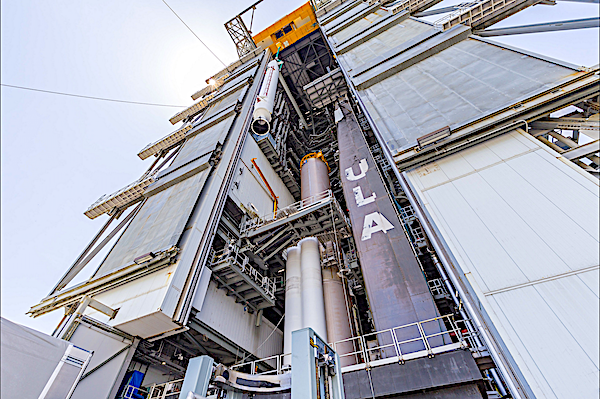
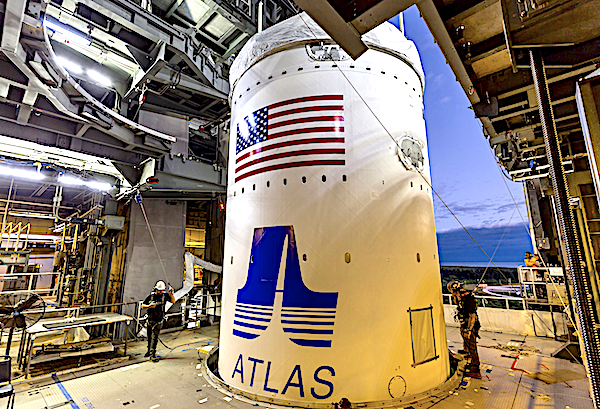
The solid rocket boosters (SRBs) are mounted onto the United Launch Alliance (ULA) Atlas V rocket that will launch the ViaSat-3 F2 ultra-high-capacity broadband satellite. Photo credit: United Launch Alliance
Everything continues to progress towards the ULA Atlas V launch carrying the ViaSat-3 Flight 2 (F2) mission for Viasat, a global technologies company. The mission is planned to lift off on Wednesday, Nov. 5, from Space Launch Complex-41 at Cape Canaveral Space Force Station in Florida. The launch is planned for 10:24 p.m. EST with a 44-minute window. Today’s forecast shows a 95 percent chance of favorable weather conditions for launch.
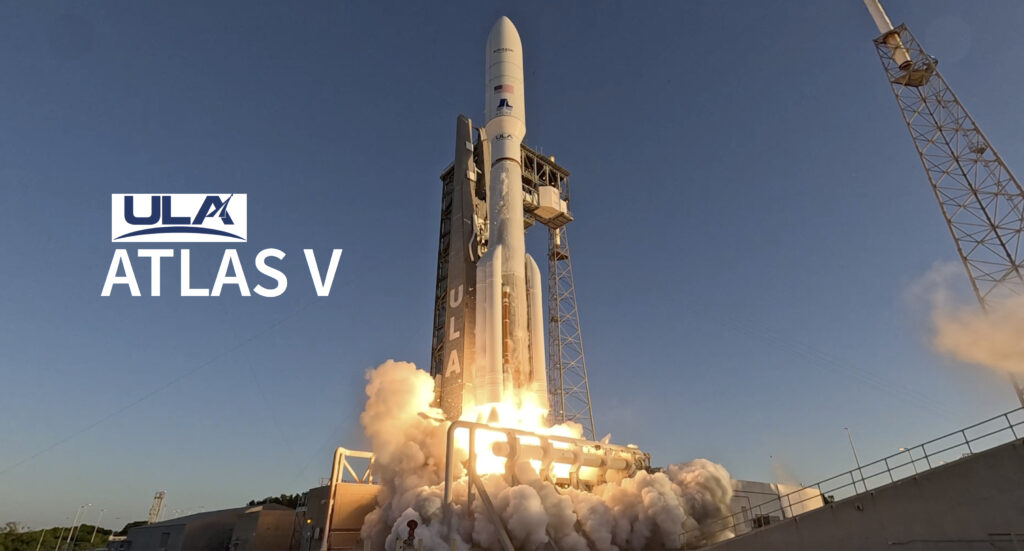
An Atlas V 551 rocket, configured with five side-mounted solid rocket boosters and a standard-length payload fairing, will utilize several launch optimization features to place the ViaSat-3 Flight 2 spacecraft into a geosynchronous transfer orbit. The craft is one of the heaviest single-satellite payloads. Liftoff will occur from Space Launch Complex-41 at Cape Canaveral Space Force Station, Florida.
Launch Readiness Review completed The Launch Readiness Review (LRR) is GO for Wednesday’s liftoff of the United Launch Alliance commercial Atlas V rocket with one of the most sophisticated and powerful commercial communications satellites — the ViaSat-3 Flight 2 ultra-high-capacity broadband spacecraft.
The LRR, led by ULA Launch Director James Whelan, was completed this morning at the Advanced Spaceflight Operations Center (ASOC).
Leadership from ULA, Viasat and Space Force assessed the readiness of the rocket, payload, mission assets and tracking support, discussed the status of pre-flight processing work, heard technical overviews of the countdown and flight, and previewed the weather forecast that projects a 95 percent chance of meeting the launch rules.
At the conclusion of the meeting, senior leaders were polled and gave a ready status for launch, then signed the Launch Readiness Certificate.
The Atlas V rocket, designated AV-100, stands 196 feet (59.7 meters) tall and will launch the payload into an elliptical geosynchronous transfer orbit (GTO). At liftoff, the rocket generates a combined thrust of 2.7 million pounds (12 megaNewtons) from its main engine and five solid rocket boosters.
ULA will offer live reports from launch control in our automatically refreshing blog beginning Wednesday at 7:30 p.m. EST (0030 UTC). The launch webcast starts at L-20 minutes.
The forecast calls for a temperature of 80°F, overcast clouds, 100% cloud cover and a wind speed of 7mph.
Launch Forecast Summary:
- Overall probability of violating weather constraints: 5%
- Primary concerns: Cumulus Cloud Rule
- 24 hour back up: overall probability of violating weather constraints: 10%
- Primary concerns: Cumulus Cloud Rule
ULA’s Atlas V plans ViaSat-3 F2 launch November 3 doubling the bandwidth of Viasat’s entire fleet
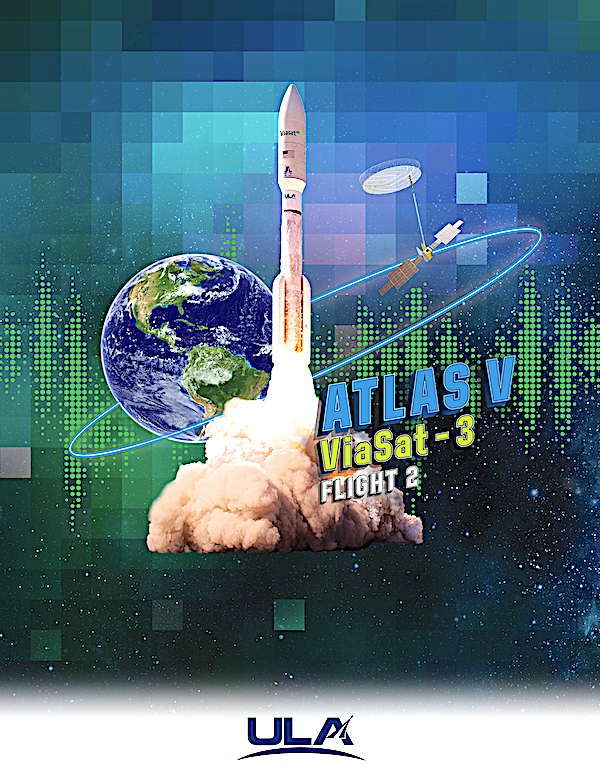
The launch of a United Launch Alliance (ULA) Atlas V 551 rocket carrying the ViaSat-3 Flight 2 (F2) mission for Viasat is planned for no earlier than Monday, November 3, 2025, pending range approval.
Once in service, VS-3 F2 is expected to more than double the bandwidth capacity of Viasat’s entire existing fleet and marks a significant milestone in our satellite roadmap.
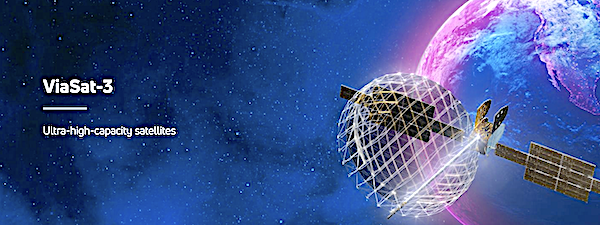
An Atlas V 551 rocket, configured with five side-mounted solid rocket boosters and a standard-length payload fairing, will utilize several launch optimization features to place the ViaSat-3 Flight 2 spacecraft into a geosynchronous transfer orbit. The craft is one of the heaviest single-satellite payloads. Liftoff will occur from Space Launch Complex-41 at Cape Canaveral Space Force Station, Florida.
The launch is scheduled for 10:36 p.m. EST at the opening of a 44-minute window, from Space Launch Complex-41 at Cape Canaveral Space Force Station, Florida.
ULA’s Atlas V ready to launch VIASAT-3 Flight 2 enhancing global connectivity

ULA’s Atlas V will soon be launching the ViaSat-3 Flight 2 ultra-high-capacity broadband spacecraft that is the second of three ultra-high-capacity satellites for Viasat, a global technology company.
Designed to significantly increase their global internet bandwidth capacity ViaSat is helping businesses, governments and communities transform their world through connectivity. Once in service, ViaSat-3 Flight 2 is expected to more than double the bandwidth capacity of Viasat’s entire existing satellite fleet and deliver enhanced global connectivity.
The ViaSat-3 is scheduled to launch in the second half of October from Cape Canaveral Space Force Station, Florida, aboard a United Launch Alliance (ULA) Atlas V rocket.
Boeing built ViaSat-3 arrives at Cape Canaveral for upcoming launch

Viasat’s ultra-high-capacity ViaSat-3 Flight 2 (VS-3 F2) satellite, built by Boeing, has completed its cross-country flight from Los Angeles International Airport (LAX) to Kennedy Space Center, Florida.
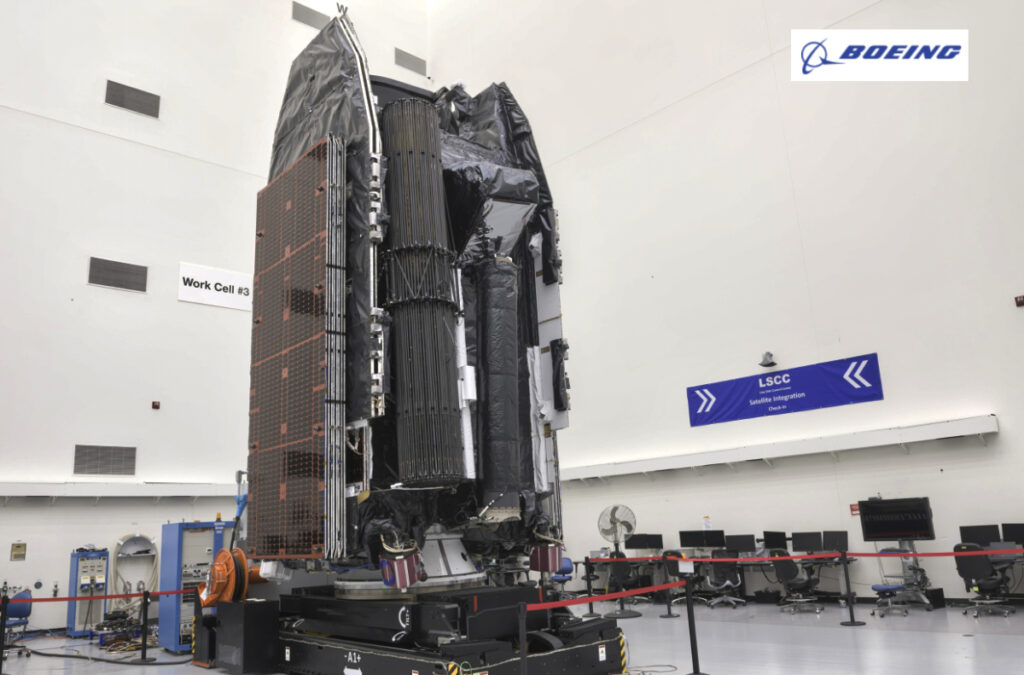
VS-3 F2 was delivered to LAX by Boeing from its El Segundo, California, facility, before being transported in one of the world’s largest cargo airplanes, an Antonov AN-124, touching down in Florida in the early hours of September 30, 2025.
The satellite was safely and securely shipped in a specialized container that carefully controls environmental factors such as temperature and air cleanliness as required to protect the highly complex technology throughout the flight.
With precision down to the millimeter, loading the container onto an AN-124 cargo bay is an exceptionally intricate procedure that takes around four to six hours.
Now that VS-3 F2 has arrived at Cape Canaveral Space Force Station, the Boeing and Viasat teams, together with launch partner United Launch Alliance (ULA), are readying the spacecraft for launch in late October 2025, aboard a powerful ULA Atlas V 551 rocket.
VS-3 F2 is the second of three ViaSat-3 Ka-band satellites and is designed to provide more than double the bandwidth capacity of Viasat’s entire existing fleet. Upon anticipated service entry in early 2026, VS-3 F2 is expected to add more than 1 Tbps capacity to our network over the Americas.
VS-3 F2 will now undergo comprehensive testing to verify all systems are go for launch following transport. After this, the satellite will be secured to the Atlas V launch vehicle adapter, enclosed within the payload fairing, which protects it during the three minutes of atmospheric flight, and then mated (attached) to the rocket. From there, it will be put through final preparations ahead of launching VS-3 F2 into a GTO, from which the satellite will propel itself over the coming few months into GEO approximately 22,000 miles (36,000 km) above the Earth’s equator.
The Atlas V rocket, which stands 196 feet (59.7 meters) tall and will weigh 1.3 million pounds (587,000 kg) when fully fueled at liftoff, will be rolled out to Space Launch Complex 41 (SLC-41) at Cape Canaveral Space Force Station the day before launch.
I’m extremely proud of the Viasat team and our partnership with Boeing in successfully completing ViaSat-3 F2’s manufacture and testing. Being just a few weeks out from launch is incredibly exciting – this achievement represents the dedication and innovative spirit of hundreds of talented professionals who’ve lent their expertise to this mission. A huge thank you to everyone who has contributed to this milestone. Now we turn our focus to getting F2 into orbit, where its tailored capabilities are expected to enable us to better serve our customers and meet increasing demand for resilient, global satellite communications,” said Dave Abrahamian, Vice President of Space Systems, Viasat. “The VS-3 constellation represents an important part of our global, multi-orbit, multi-band network, adding capacity that is secure, reliable, and highly flexible: with dynamic-beam-forming capabilities designed to rapidly shift capacity to wherever demand is greatest.”