
By Chris Forrester
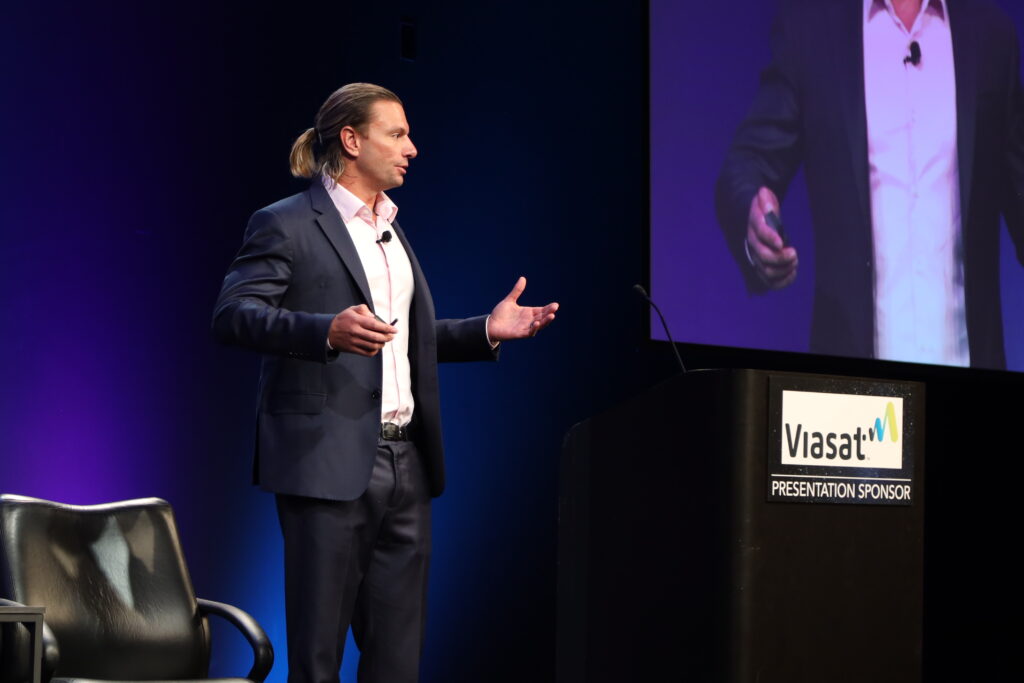
Silicon Valley Space Week’s second day, and part of its Satellite Innovation sessions, saw delegates enjoying a detailed update from Viasat’s Kevin Cohen (VP/Direct to Device, Strategic Partnerships), who delivered a Keynote. Chris Forrester reports.
Viasat, by any measure, is an important player in the satellite sector. A few weeks ago it announced a joint-venture with Abu Dhabi-based Space42 for a Direct-to-Device constellation in a new low Earth orbit project called Equatys. Space42 owns the Thuraya satellite system. The new scheme is anticipated to be capable of supporting well over 100 MHz of harmonized MSS spectrum already allocated across more than 160 markets. The new project is expected to establish a foundation for reliable global communications with commercial rollout targeted within 3 years.
Viasat is also just days away from launching its latest ViaSat-3 F2 geostationary satellite probably on November 5 subject to the usual weather conditions at the Cape. The satellite is expected to more than double Viasat’s bandwidth capacity.
Its most recent revenue results for its first-quarter declared on August 5 were $1.171 billion (up 4% year on year).
Kevin Cohen updated SVSW’s delegates with Viasat’s latest news and developments and in particular on Direct-to-Device and Equatys. He said that there were satellite proprietary hand-helds in use (Globalstar, Inmarsat, Iridium and Thuraya) but these would – in his view – migrate to a single hand-held that was already in everyone’s pockets. But smart phones were just one aspect. There were vehicles, aircraft, maritime and emergency services to be connected.
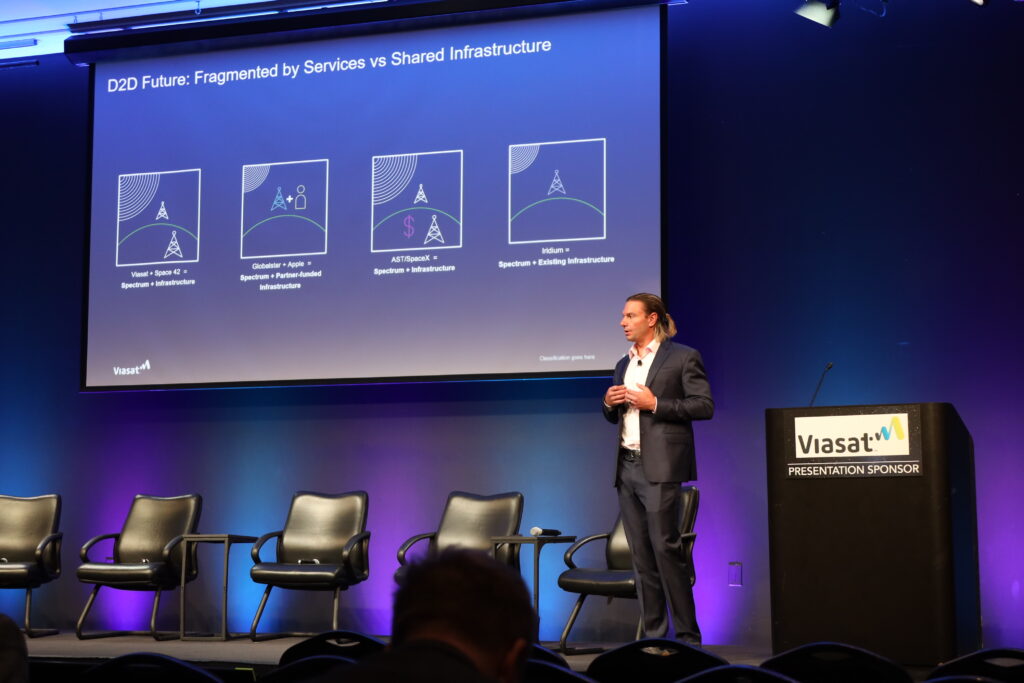
“This is all good news,” he said. “So, what’s the problem?” The core problem, he explained, is the capital intensity to acquire spectrum and deploy services He explained that Viasat’s approach was to share infrastructure to save cash, and yet end up with meaningful services to many users and at the same time achieve standards and seamless roaming and handing off of a signal.
He added that the cellular industry had over time densified coverage, and continued investing in spectrum. But he said that Viasat thinks it can harmonise spectrum and supply a price-per-gigabyte that’s potentially profitable for all concerned. However, the satellite industry needed to adopt standards to prepare for extended interoperability, and which would facilitate innovation and choice. Innovation is needed to get close to parity as far as pricing is concerned with terrestrial operators and which would lead to mass adoption.
Cohen said Viasat did not believe that one space-based operator would dominate. But there must be interoperability and portability between competing solutions.
He stressed that its j-v in Equatys need not be limited to Viasat and Space42, but was open to other players and then seamlessly integrated with terrestrial networks. It will have a global reach, he said, and at launch would supply orders of magnitude better than was available today.
Cohen said he expected services such as Zoom and Microsoft’s Teams would be possible as part of the evolution of the technology. October 14 saw the telecom arm of the United Arab Emirates’ sign an MoU with Equatys covering their expected adoption and harmonisation of the satellite service over time, and extending beyond the Emirates own border.