

The 337th meeting of ESA Council occurred at the European Space Agency’s headquarters in Paris on October 23rd and 24th, 2025.
As detailed separately, Cyprus has signed its Associate Agreement and following the ratification process will become an Associate Member of the European Space Agency.

Memorandum of Understanding with the World Food Program
The ESA Council has approved a five-year Memorandum of Understanding with the World Food Program (WFP) to establish cooperation on the use of space data and technology for food security and emergency relief. The MoU aims to accelerate the use of space data and technology to improve food security and address challenges in emergency food relief. It will allow for improved exchange of expertise, stronger synergy between ESA and WFP activities and programs while maintaining their respective mandates. ESA and WFP will work together to identify concrete use cases that could support WFP’s field operations, and to develop applications serving those needs using ESA’s expertise in Earth observation and data.

Destination Earth Phase III
The ESA Council has approved the second amendment to the Contribution Agreement between the European Union and ESA for the implementation of the Destination Earth Initiative (DestinE), which will allow DestinE to move to its third and last implementation phase. DestinE began in December 2021 with the ambition to develop a highly accurate digital twin of the Earth system by 2030. ESA is responsible for the DestinE Platform, providing access to applications, tools and services supporting DestinE data exploitation.

Phase III of DestinE is expected to begin in mid-2026 and last for 24 months. ESA’s Digital Twin Earth (DTE) program, initially funded at CM22 and seeking further subscriptions at CM25 intends to support the exploitation of DestinE data and services, fostering the development and onboarding of Earth Observation pre-operational Digital Twin Components ready for potential operationalization on the DestinE environment.

Assistance to Spain in Earth Observation
ESA has agreed to broaden its support to Spain in the implementation of the Spanish Component of the Atlantic Constellation (ESCA). The agreement for ESA’s assistance to Spain, approved in 2023, will be amended to include the launch, deployment, commissioning and early operations of the first satellite of the constellation. The Atlantic Constellation is a joint initiative between Spain and Portugal to build a constellation of 16 Earth Observation satellites. The constellation is designed to address increasing regional and global challenges related to climate change, while developing strategic capabilities in Earth observation.
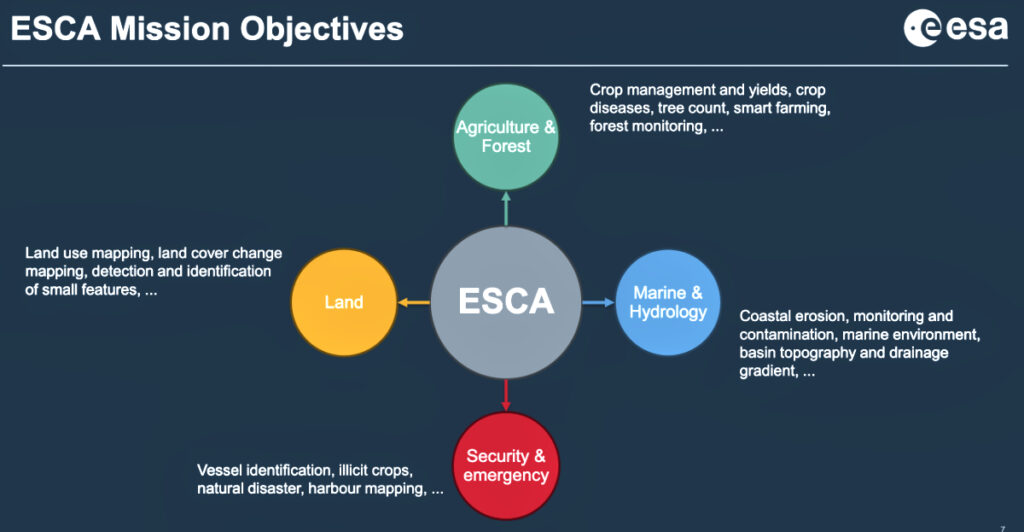
Last week, Open Cosmos was selected by the Spanish Space Agency and ESA to lead the development of Spain’s eight-satellite component.

Memorandum of Understanding with NASA
ESA Council also approved a cooperation with NASA, formalized in a draft Memorandum of Understanding between ESA and NASA on NASA’s planned contribution of the Joint EUV coronal Diagnostic Investigation (JEDI) instrument to ESA’s Vigil mission.
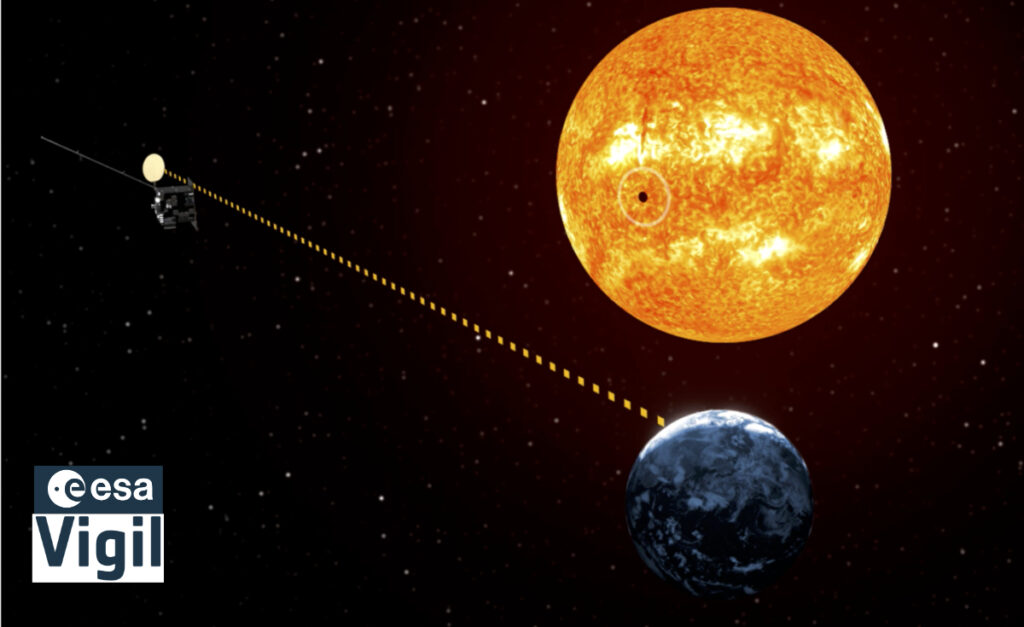
Implemented under ESA’s Space Safety Program, Vigil will be located at the Earth-Sun L5 point and is designed to provide continuous monitoring of solar activity for space weather nowcasting, forecasting, and early warning. The NASA contribution is the JEDI instrument, a high-cadence, multi-thermal EUV imager enabling flare detection, coronal hole analysis, and early identification of CMEs and solar wind streams.
Vigil is planned to carry six instruments, four for remote sensing (coronagraph, magnetograph, heliospheric imager, EUV imager) and two for in situ measurements (magnetic field, solar wind). The core payload instruments are delivered by European industry, complemented by instruments from NASA (JEDI) and NOAA (CCOR).