
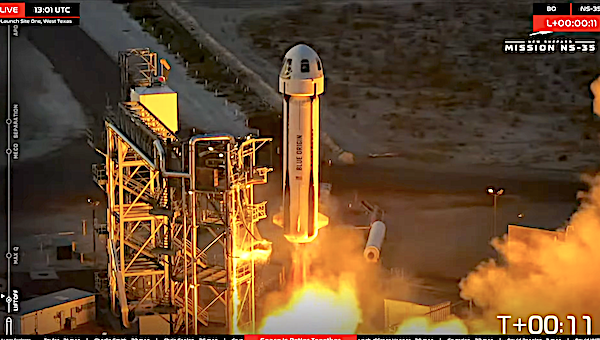
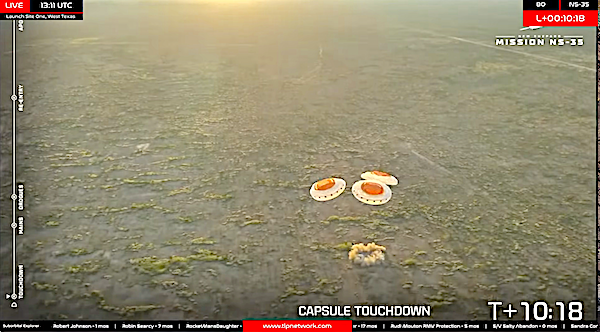
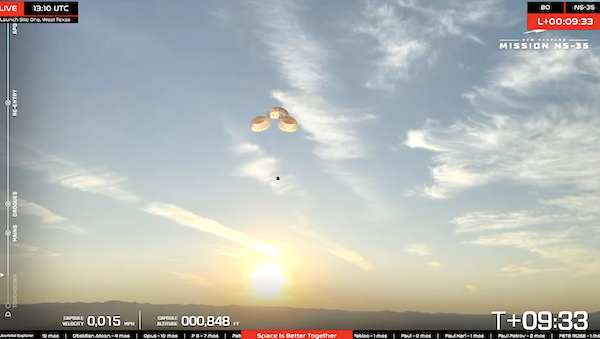
Blue Origin has completed their 35th New Shepard flight and 15th payload mission from Launch Site One in West Texas—this flight carried more than 40 payloads from students, NASA, research institutions, and commercial companies, bringing the total number of science payloads flown on New Shepard to more than 200 in number. Photos captured by Satnews.
Club for the Future, Blue Origin’s nonprofit, flew thousands of postcards as part of its Postcards to Space program. Each postcard will be returned to its creator stamped “Flown to Space.” The Club has a digital method to create and send postcards, which can be found here.
This was the 12th and final mission for the RSS H.G. Wells Crew Capsule, the dedicated vehicle for flying customer payloads and Club for the Future postcards above the Kármán Line. The vehicle will be utilized for non-flight test activities to support ongoing New Shepard development before permanent display at a location to be determined.
We’re proud to have flown hundreds of science, research, and educational payloads to space on New Shepard,” said Audrey Powers, VP, Mission and Flight Operations. “Each mission has expanded opportunities for our customers to rapidly and reliably test space technologies, conduct groundbreaking research, and engage the next generation of scientists and explorers.”

NS-35 Payload Manifest…
- NASA TechRise Student Challenge, Future Engineers: The NASA TechRise Student Challenge provides a hands-on opportunity for students in grades 6-12 at U.S. schools to gain critical skills in engineering, computing, electronics, and more that will be required for America’s technical workforce. The 24 student payloads include experiments on space farming, medical solutions, and the behavior of liquids in microgravity. NASA’s Flight Opportunities program manages TechRise, which is administered by Future Engineers.
- A.R.E.S., Ecoatoms: The A.R.E.S. payload is the first of its kind, featuring a unique structure designed for chemical coatings in microgravity. The experiment includes 432 sensors that will be coated in space simultaneously. NASA’s Flight Opportunities program provided funding for this payload.
- Biological Imaging in Support of Suborbital Science (BISS), University of Florida: Principal investigators Rob Ferl, who flew on NS-26, and Anna-Lisa Paul, are adapting ISS-based technology for suborbital use with their experiment, BISS. The upgraded FLEX fluorescence imaging system is flying for the fifth time on New Shepard and enables increasingly precise and dynamic understanding of biological responses to suborbital missions. NASA’s Flight Opportunities and Biological and Physical Sciences programs provided the funding for this payload.
- Propellant Refueling and On-Orbit Transfer Operations (PROTO) & Microgravity Ullage Detection (MUD), Carthage College: Carthage College Space Science program’s PROTO experiment is collaborating with NASA Johnson Space Center to test new alternatives to measure spacecraft propellant levels in microgravity. MUD is a non-invasive method to locate the liquid-vapor interface in spacecraft fuel tanks during microgravity. The system incorporates acoustic vibrations and external sensors to detect whether the tank wall is in contact with liquid or gas, which is critical for safe in-space refueling. This experiment is flying for the third time with New Shepard. Both payloads are supported by NASA’s Flight Opportunities program and the Wisconsin Space Grant Consortium.
- EDR Fuel Cell, Teledyne: In collaboration with NASA’s Glenn Research Center, Teledyne has spent over a decade developing a fuel cell technology that generates electricity and water from hydrogen and oxygen supplies aboard space vehicles. This experiment will test the system across all mission phases and serve as a foundational step toward scaling up power and water production to support long-term lunar and Martian habitation.
- TIS-3 & TIS-4, Teachers in Space (TIS): Teachers in Space provides training and flight opportunities for classroom spaceflight experiments designed by teachers and their students. This payload is flying experiments from New Mexico, New York, and Maine focused on radiation detection and protection, sound level detection, and environmental data collection. After the flight, teachers and students will analyze and present their findings on the Teachers in Space website, at conferences, and at science fairs. Findings from previous TIS experiments on New Shepard can be found at this direct link…