
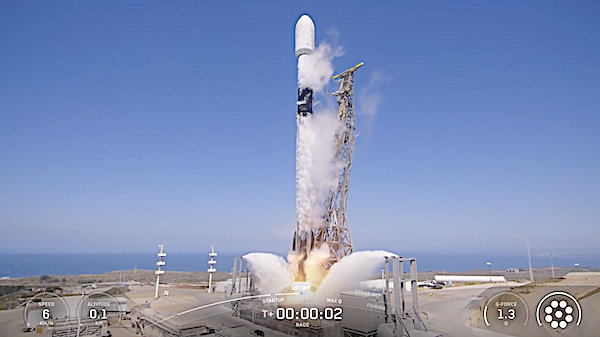
SpaceX’s Falcon 9 launched a new Earth-observation satellite along with several smaller spacecraft from California on Tuesday (Aug. 26). Photos captured by Satnews.
NAOS (National Advanced Optical System) is the space component of Luxembourg’s governmental dual-use observation satellite system LUXEOSys (Luxembourg Earth Observation System). Its purpose is to provide high resolution images to national and international governmental and military organizations such as NATO.
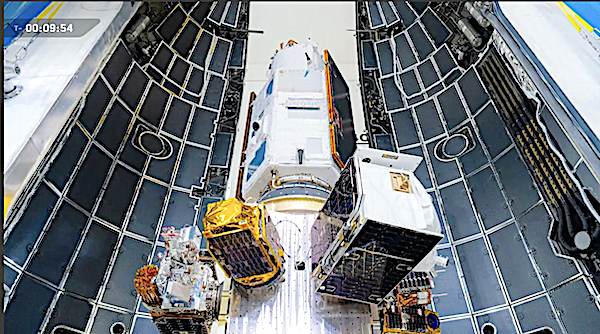
The 800 kg satellite is built by OHB Italia and is equipped with a very high-resolution optical camera with a ground resolution of 50 cm in an around 450 km high sun-synchronous orbit. It will have a operational life time of 7 years.
In addition to NAOS, which was built for Luxembourg by the company OHB Italia, the Falcon 9 is carrying small satellites for Dhruva Space (LEAP-1); the San Francisco-based company Planet (Pelican-3 and Pelican-4); and Exolaunch (Capella’s Acadia-6 and Pixxel’s FFLY-1, FFLY-2, and FFLY-3).
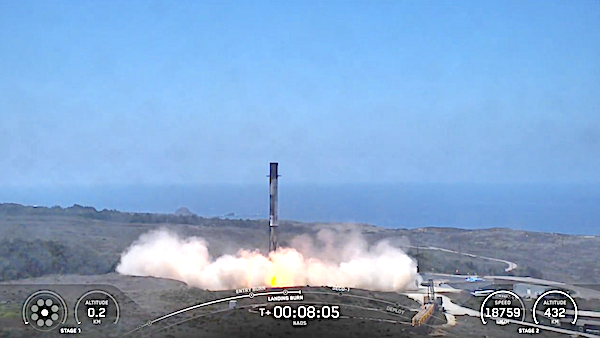
This is the 27th flight for the first stage booster supporting this mission, which previously launched Sentinel-6 Michael Freilich, DART, Transporter-7, Iridium OneWeb, SDA-0B, NROL-113, NROL-167, NROL-149, and 18 Starlink missions. Following stage separation, the first stage landed on Landing Zone 4 (LZ-4) at Vandenberg Space Force Base.