
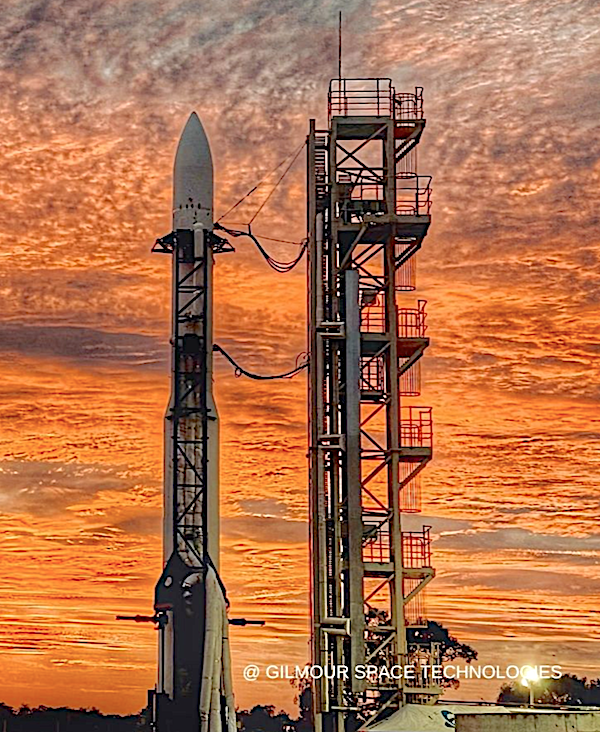
LAUNCH SCRUBBED: NEXT WINDOW NET JULY 27
We’re standing down from this week’s launch window and aiming for our next opportunity starting July 27.
Unfortunately, operational delays set us back a day and the latest upper wind forecasts have now ruled out a safe launch from Thursday through the rest of the week.
Not the outcome we hoped for, but that’s the nature of test flights. Chin up and eyes forward to NET 27 July!
FAQ: Why does the launch date keep moving?
Rocket launches are complex and delays are normal. Weather, range availability, regulatory checks, final system tests (and last-minute anomalies!) can all affect when a rocket is ready to fly.
That’s why we announce a launch window—a set of approved days when liftoff is possible—and within that, a No Earlier Than (NET) date. The NET is the earliest day we expect to be ready to launch and it can shift as we work through pre-launch activities.
It’s the global standard for space launches, giving teams the flexibility to launch only when it’s safe—especially important for a first-of-its-kind test flight, where every system is being put through its full end-to-end test for the very first time, from countdown to liftoff and beyond
In Australia, that also means close coordination with the Australian Space Agency, CASA, Airservices Australia, maritime authorities, and more.
We’ll keep sharing the latest NET date so you can stay up to date, or feel free to check back after launch day. 🙏
Australia’s Gilmour Space plans Wednesday for maiden launch of Eris Test Flight1
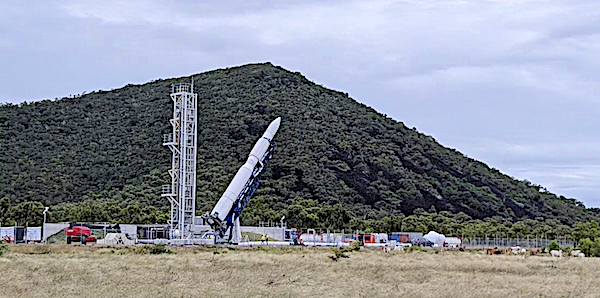

Gilmour Space Technologies is gearing up for their first Eris Test flight on Wednesday, July 16, at 2:30 PM – 12:30 AM PDT.
The launch will be from Bowen Orbital Spaceport, a private orbital launch facility owned and operated by Gilmour Space hosts of the Eris Pad which has witnessed the launch of 0 rockets, including 0 orbital launch attempts.
This will be the first Australian-made rocket, #Eris, to attempt orbit, and the nation’s first orbital launch in over 50 years.
Gilmour’s vision: ALL ORBITS. ALL PLANETS ®
The forecast calls for a temperature of 62°F, clear skies, 1% cloud cover and a wind speed of 6mph.
Australia’s Gilmour Space Technologies plans maiden flight of Eris Test Flight1 on July 16, nation’s first orbital launch in over 50 years
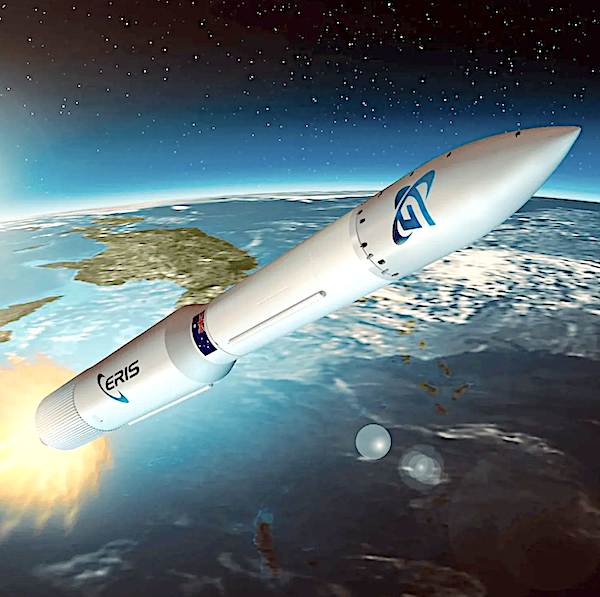
Gilmour Space plans a Tuesday, July 15, launch for the maiden flight of Eris Test Flight1 at 2:30 PM – 12:30 AM PDT. The launch will be from Bowen Orbital Spaceport, a private orbital launch facility owned and operated by Gilmour Space hosts of the Eris Pad which has witnessed the launch of 0 rockets, including 0 orbital launch attempts.
Eris TestFlight1 will be the first Australian-made rocket, #Eris, to attempt orbit, and the nation’s first orbital launch in over 50 years. Gilmour’s vision: ALL ORBITS. ALL PLANETS ®
The forecast calls for a temperature of 53°F, few clouds, 15% cloud cover and a wind speed of 7mph.
Gilmour Space Technologies is a venture-funded Australian space company headquartered in Queensland, Australia that is developing hybrid-engine rockets and associated technology to support the development of a low-cost space launch vehicle.
Australia’s Gilmour Space Technologies ready to launch maiden Eris Test flight the nation’s first orbital launch in over 50 years
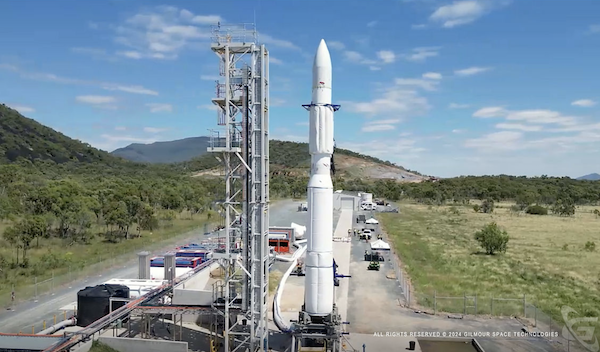
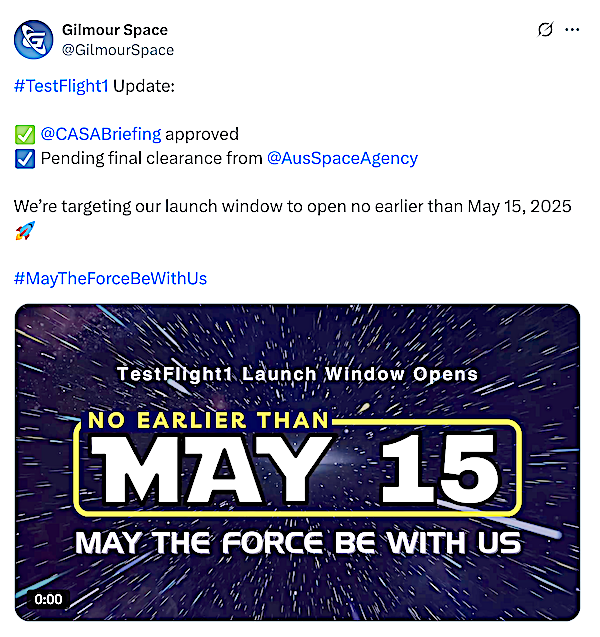
Gilmour Space Technologies is gearing up for their first Eris Test flight, no earlier than May 15. Gilmour Space’s Eris TestFlight1 will be the first Australian-made rocket, #Eris, to attempt orbit, and the nation’s first orbital launch in over 50 years. Gilmour’s vision: ALL ORBITS. ALL PLANETS ®
Weather forecast calls for a temperature of 77 °F, clear skies, 4% cloud cover and a wind speed of 5 mph.
Gilmour Space Technologies is the leading launch services company in Australia, located in Bowen Orbital Spaceport, North Queensland, providing valuable access to space to global Commercial and Defense customers. Backed by some of the country’s biggest investors, Gilmour Space is tracking to launch Eris orbital launch vehicles and ElaraSat bus/platforms to Low Earth Orbits (LEO) from 2025.
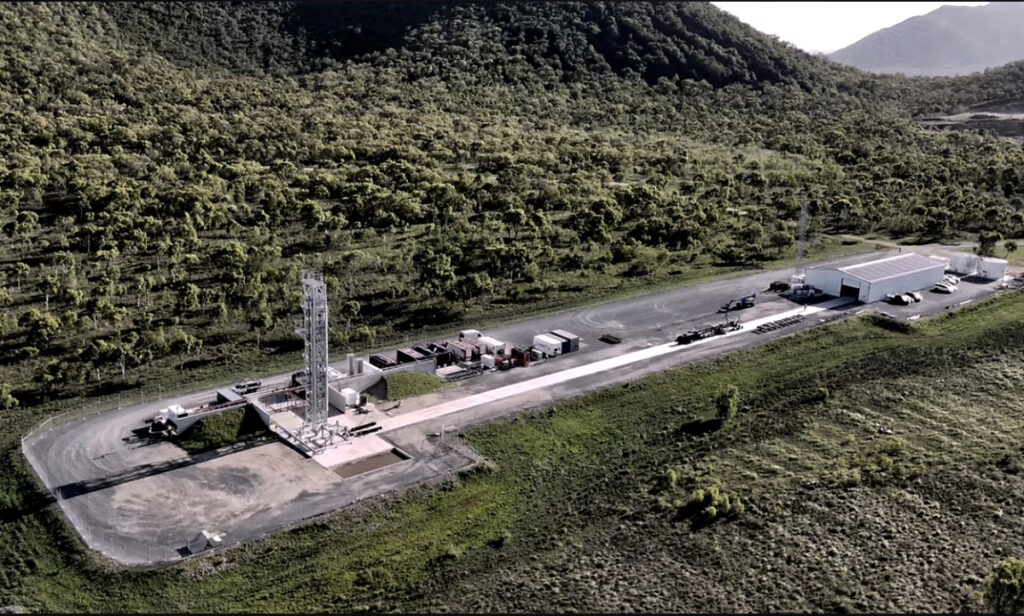
Bowen Orbital Spaceport hosts the Eris Pad which has witnessed the launch of 0 rockets, including 0 orbital launch attempts. While Bowen Orbital Spaceport, has been the site for 0 rocket launches. Private orbital launch facility owned and operated by Gilmour Space.
Gilmour has said that they plan to have fifty of their personnel based in Bowen for the inaugural launch. Eris’ maiden flight will be the first orbital launch attempt of an Australian rocket from Australian soil, according to co-founder and CEO Adam Gilmour.
Gilmour Space announces launch window for the Eris orbital rocket
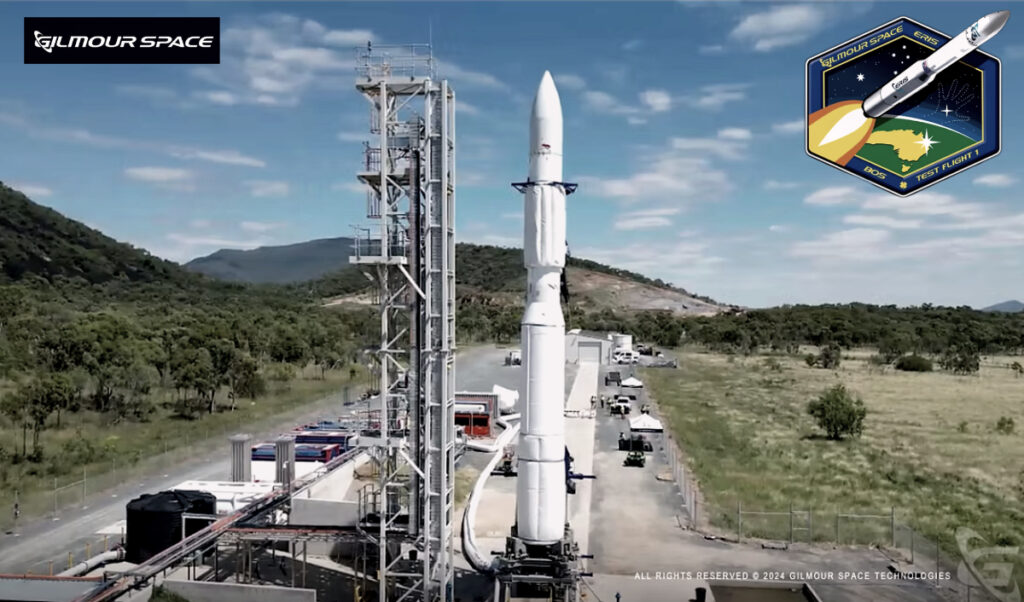

The countdown is on—Gilmour Space Technologies has announced a launch window starting ‘no earlier than’ March 15 for the maiden flight of Eris, the first Australian-designed and built rocket aiming for orbit.
The news follows final airspace approvals from the Civil Aviation Safety Authority (CASA) and Airservices Australia, clearing the last regulatory hurdle before launch. It also marks the culmination of years of innovative R&D and manufacturing by the Gold Coast-based company, which developed the Eris launch vehicle and Bowen Orbital Spaceport in North Queensland.
Gilmour Space made history in March last year when its Bowen spaceport was granted the first orbital launch facility license in Australia, and when it secured the country’s first Australian Launch Permit for Eris Test Flight 1 in November. Now, with airspace arrangements finalised and mandatory notice given to the Australian Space Agency, the company is preparing for liftoff.
“This will be the first attempt of an Australian rocket to reach orbit from Australian soil,” said Adam Gilmour, co-founder and CEO of Gilmour Space. The company is backed by private investors including Blackbird, Main Sequence, Fine Structure Ventures, Queensland Investment Corporation, and superannuation funds such as HESTA and Hostplus.
With the March 15 window fast approaching, Mr. Gilmour highlighted a few key points for those less familiar with rocket launches:
First, it’s important to understand that delays or ‘scrubs’ are a normal part of rocket launches. These can last anywhere from hours to days, or even weeks, and are often caused by weather conditions, technical issues, or other factors. “Safety is always the top priority. We’ll only launch when we’re ready, and when conditions are appropriate,” he said.
Secondly, the first launch is always the hardest. Reaching orbit is a highly complex engineering challenge, and every successful rocket company has faced setbacks in their early attempts—SpaceX, for one, did it on their fourth attempt. “It’s almost unheard of for a private rocket company to launch successfully to orbit the first time. Whether we make it off the pad, reach max Q, or get all the way to space, what’s important is that every second of flight will deliver valuable data that will improve our rocket’s reliability and performance for future launches.”
Thirdly, this is the path we must take to build the launch capability required to meet the growing demand for access to space. For Australia, launching locally-owned and controlled rockets from home soil also means more high-tech jobs, greater security, economic growth, and technological independence. “Only six countries in the world are launching regularly to space using their own technology, and Australia could soon join their ranks.”
Finally, he said: “I want to thank our incredible team for all their hard work and dedication in getting to this critical first flight. Whatever happens next, know that you’ve already made history—we now build rockets in Australia. And this is only the beginning.”