
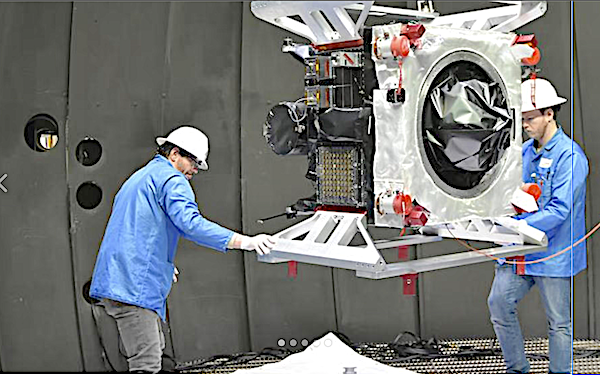
The United States Space Force (USSF) Space Systems Command (SSC) and the Air Force Research Laboratory (AFRL) have reached a critical milestone in advancing cislunar Space Situational Awareness (SSA) with the successful completion of the Oracle-M (Oracle-Mobility) Hot Fire Test at Edwards Air Force Base, California. Conducted from March 16-21, 2025, this test marks a major step toward ensuring Oracle-M’s readiness for its upcoming mission to monitor and track objects as they traverse cislunar space, the vast region between Earth and the Moon.
Oracle-M is a cutting-edge SSA pathfinder satellite designed to provide persistent situational awareness in cislunar space, demonstrating new tracking and navigation capabilities essential for future space operations. The mission will showcase tracking and trajectory estimation for monitoring cislunar objects, cloud-based ground operations with integrated government and contractor collaboration, and navigation and communications using affordable commercial ground systems. It will also support data collection and distribution to those charged with maintaining cislunar situational awareness.
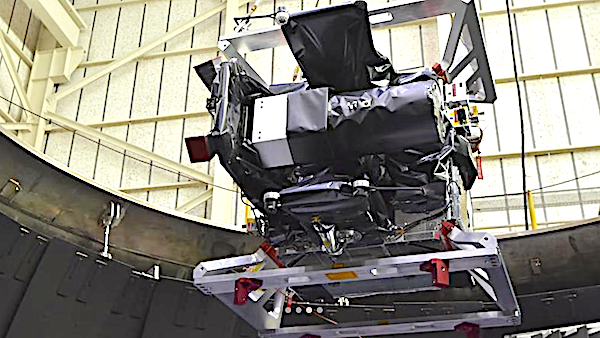
The Oracle-M Hot Fire Test at AFRL Edwards focused on evaluating its novel propulsion module, which integrates Hall Effect thrusters fueled by Xenon gas with propellant management and power processing units. While these thrusters have been tested individually, this was the first time the entire propulsion system was fired as a fully integrated module which was made possible by the unique facilities and capabilities at AFRL Edwards. This test served as a major risk reduction effort, ensuring that the propulsion system functions as expected in space. Firmly manifested as a secondary on a near term National Security Space Launch, this evaluation provides crucial data to confirm flight readiness or allow time to mitigate any unforeseen technical issues
The success of this test removes a key technical risk and validates Oracle-M’s propulsion system, bringing the satellite to initial launch capability (ILC) and ready for operational deployment. Once launched and inserted into the cislunar domain, Oracle-M will provide an unprecedented SSA capability for the U.S., enabling continuous tracking and monitoring of objects beyond geosynchronous orbit. This mission is a major advancement in U.S. efforts to capture situational awareness in the cislunar domain, providing critical data and experience that will shape future deep-space operations.
With the propulsion system now validated, Oracle-M will continue pre-launch preparations. The next major milestones include the completion of ground system operational testing in April 2025, final integration with the National Security Space Launch (NSSL) mission, launch readiness reviews, and final mission rehearsals. Oracle-M moves one step closer to launch — a mission that will define the future of space operation and U.S. national security beyond Earth’s orbit.
Space Systems Command is the U.S. Space Force field command responsible for acquiring, developing, and delivering resilient capabilities to outpace emerging threats and protect our Nation’s strategic advantage in, from, and to space. SSC manages a $15.6 billion annual space acquisition budget for the Department of Defense, working with joint forces, industry partners, government agencies, academia, and allied nations. For more information, visit ssc.spaceforce.mil and follow @USSF-SSC on LinkedIn.
The Air Force Research Laboratory is the primary scientific research and development center for the Department of the Air Force. AFRL plays an integral role in leading the discovery, development, and integration of affordable warfighting technologies for our air, space, and cyberspace force. With a workforce of more than 12,500 across nine technology areas and 40 other operations across the globe, AFRL provides a diverse portfolio of science and technology ranging from fundamental to advanced research and technology development. For more information, visit: