
A project to manufacture nanomaterials that could provide new treatments for osteoarthritis and cancer joins a trio of investigations funded by the U.S. National Science Foundation (NSF) and more on SpaceX’s 32nd Commercial Resupply Services (CRS) mission for NASA to the International Space Station (ISS). These investigations, sponsored by the ISS National Laboratory®, aim to benefit humanity and foster a robust economy in LEO.

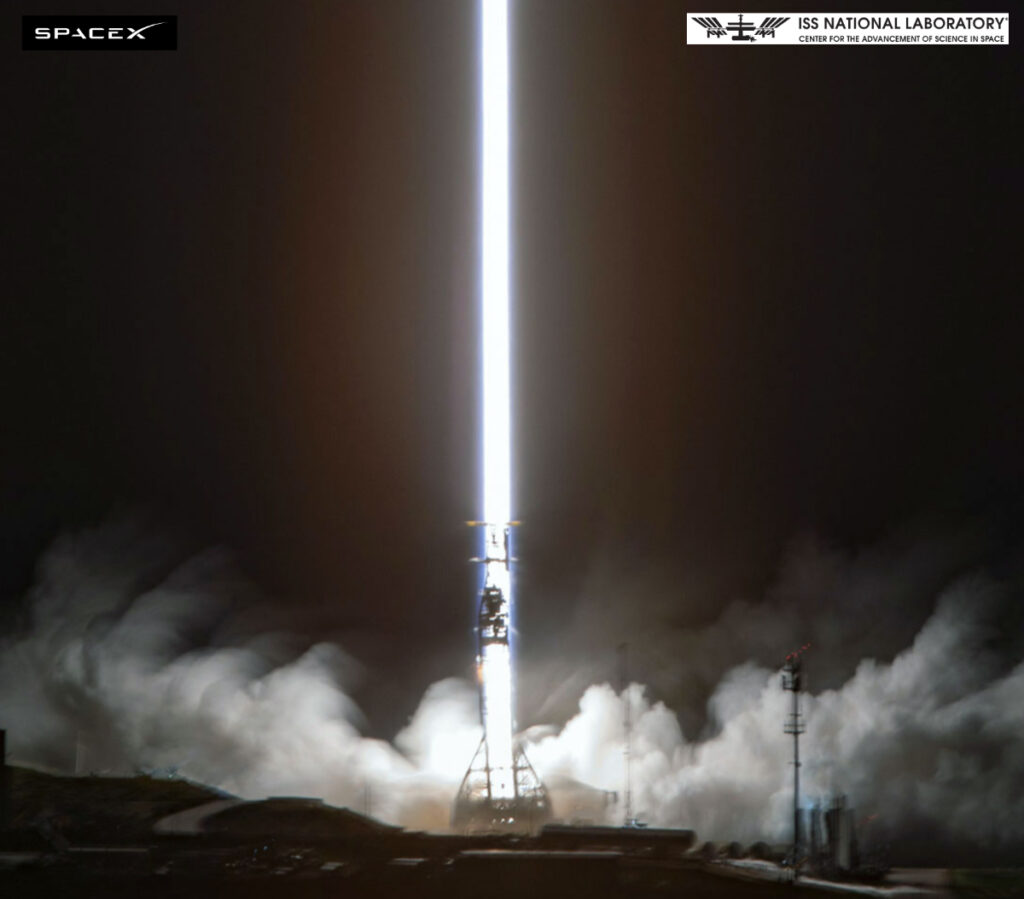
This mission is scheduled to launch no earlier than April 21, 2025, at 4:15 a.m. EDT, from Launch Complex 39A at NASA’s Kennedy Space Center in Florida. Below are highlights of ISS National Lab-sponsored investigations on this mission.
Researchers from the University of Connecticut and Eascra Biotech, with support from Axiom Space, will build on previous research to improve the production of innovative nanomaterials in space to treat osteoarthritis and cancer on Earth.
Janus base nanomaterials (JBNs) are composed of synthetic molecules that self-assemble into structures resembling human DNA. The injectable nanomaterials could help regenerate cartilage in the joints of osteoarthritis patients and could be used to carry cancer drugs into hard-to-penetrate solid tumors.
The team’s groundbreaking research is featured in the most recent issue of Upward, the official magazine of the ISS National Lab. Three investigations funded by NSF seek to advance fundamental science with valuable applications. These projects continue a strong, multi-year collaboration between NSF and the ISS National Lab: An investigation from Rensselaer Polytechnic Institute, supported by Tec-Masters, will use microgravity to study fluid flow in protein solutions.
The goal is to better understand why protein clumping occurs during the manufacturing of protein-based drugs, which affects their quality. In space, liquid forms into a floating self-contained sphere, allowing the study of complex protein motion without the walls of a container altering protein behavior. This project, which is a continuation of prior research, could help find a way to avoid or reverse protein clumping, which would address a significant challenge in the pharmaceutical industry.
A project from the University of Alabama at Birmingham, supported by Leidos, will study the formation and microstructure of ceramic-nanomaterial composites in microgravity to produce novel materials that are lightweight, electrically conductive, and stable in high-temperature environments. The materials can be made into almost any shape or size, making them valuable for many industrial applications such as energy storage, electric systems, and nanodevices.
Researchers from the University of California, Santa Barbara, will conduct an investigation, supported by Redwire Space Technologies, to better understand active liquid-liquid phase separation (LLPS)—a phenomenon that occurs when two liquids that do not mix (such as oil and water) separate. Active LLPS could be used to create soft active materials with lifelike properties that can move and change shape on their own or sense and repair themselves. These materials could be used to make more lifelike robotics.
Portland State University, in collaboration with NASA’s Jet Propulsion Laboratory in Southern California, and Teledyne Brown Engineering, Inc., will test an advanced microscope system that uses holographic technology to deliver detailed 3D views of cellular life. The Extant Life Volumetric Imaging System (ELVIS) will allow scientists to study the adaptability and resilience of life under extreme conditions, which could enhance the search for life beyond Earth.
An experiment from Sophie’s BioNutrients, supported by BioServe Space Technologies, aims to develop plant-based, protein-rich alternatives to meat and seafood using microalgae. The investigation will examine how microgravity affects protein yields in microalgae that require nutrition from organic compounds to grow. Results could provide insights into the fundamental mechanisms of microalgae cell growth, metabolism, and protein production. In addition to serving as a food source on long-duration spaceflight missions, the microalgae could also be used in life support systems and to provide oils for fuel production.
For more information on ISS National Lab-sponsored investigations on this mission, visit the launch page. To learn more about the research and technology development sponsored by the ISS National Lab, including how to propose concepts for future space-based research, visit this direct infolink…